In the final quarter of 2023, I went to NWAV51 in Queen’s, New York in October and to Patreon’s CreatorFest in Los Angeles in November. No talks from me at either, just attending interesting sessions!
Btw people should totally commission me to read their weird nerd humour audiobooks, today the tech said "you know, sometimes I end up sorta zoning out during a recording but with this one I was laughing too hard to even get close"I would enjoy doing this a couple times a year, I'm just saying
Update: I read The Unraveling by Benjamin Rosenbaum because several people in these replies (including @annleckie.com) told me to and I am pleased to report that it is indeed doing delightfully weird things with gender (even if not precisely bouba/kiki)
Blind bisexual goose named Thomas who spend six years in a love triangle with two swans and helped raise 68 babies dies at the ripe old age of 40 (novel sentences)
Just remembering that line from Puff the Magic Dragon and how for years I thought that one day I would be grown up enough to understand what ceiling wax was for (waterproofing the roof? hanging down in aesthetic wax stalactites?)Well today I'm grown up and it's sealing waxSEALING WAX
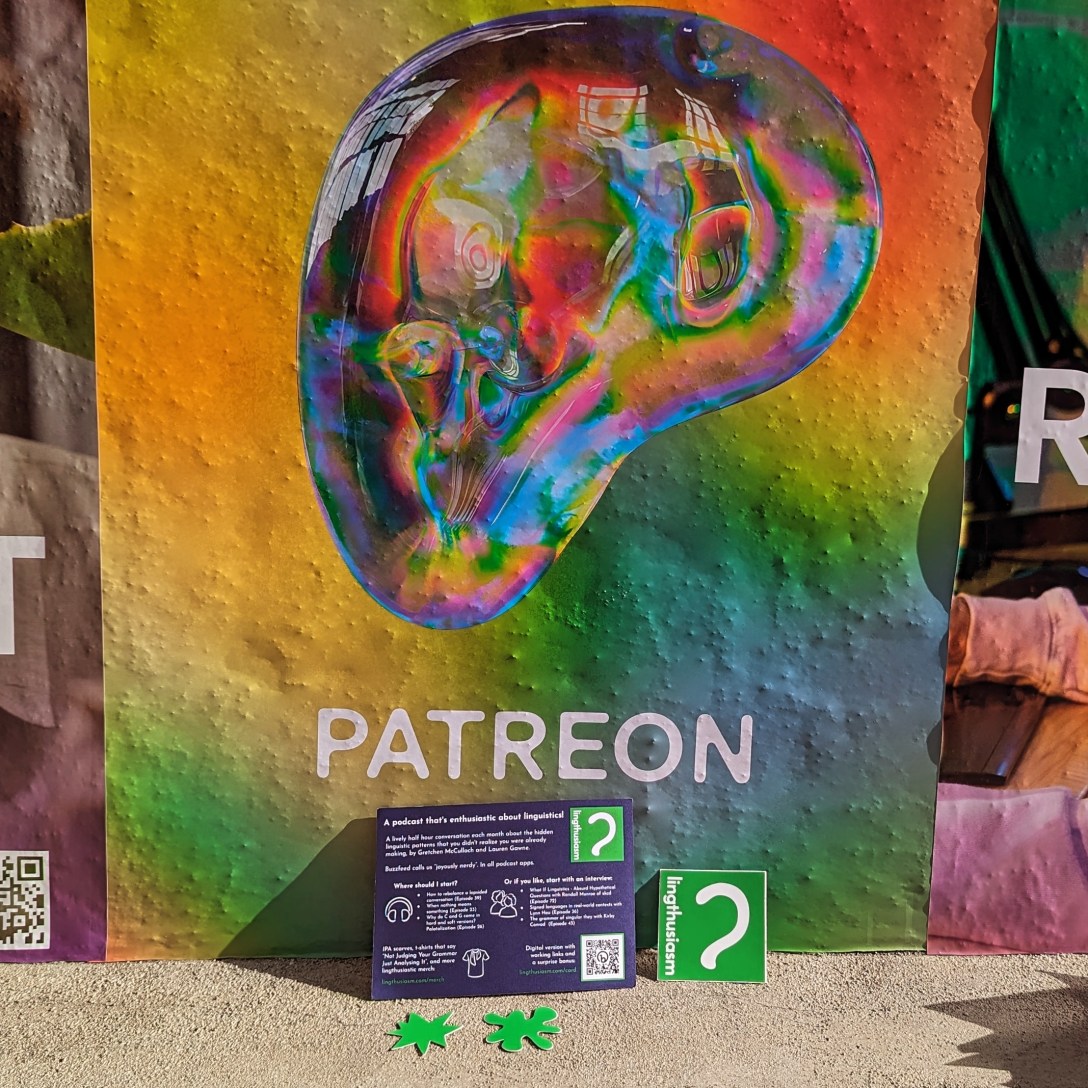
This quarter’s image (also yes, these newsletters are quarterly now since monthly evidently wasn’t working) is from Patreon CreatorFest where I brought Lingthusiasm cards and bouba/kiki stickers to give out to people I met!
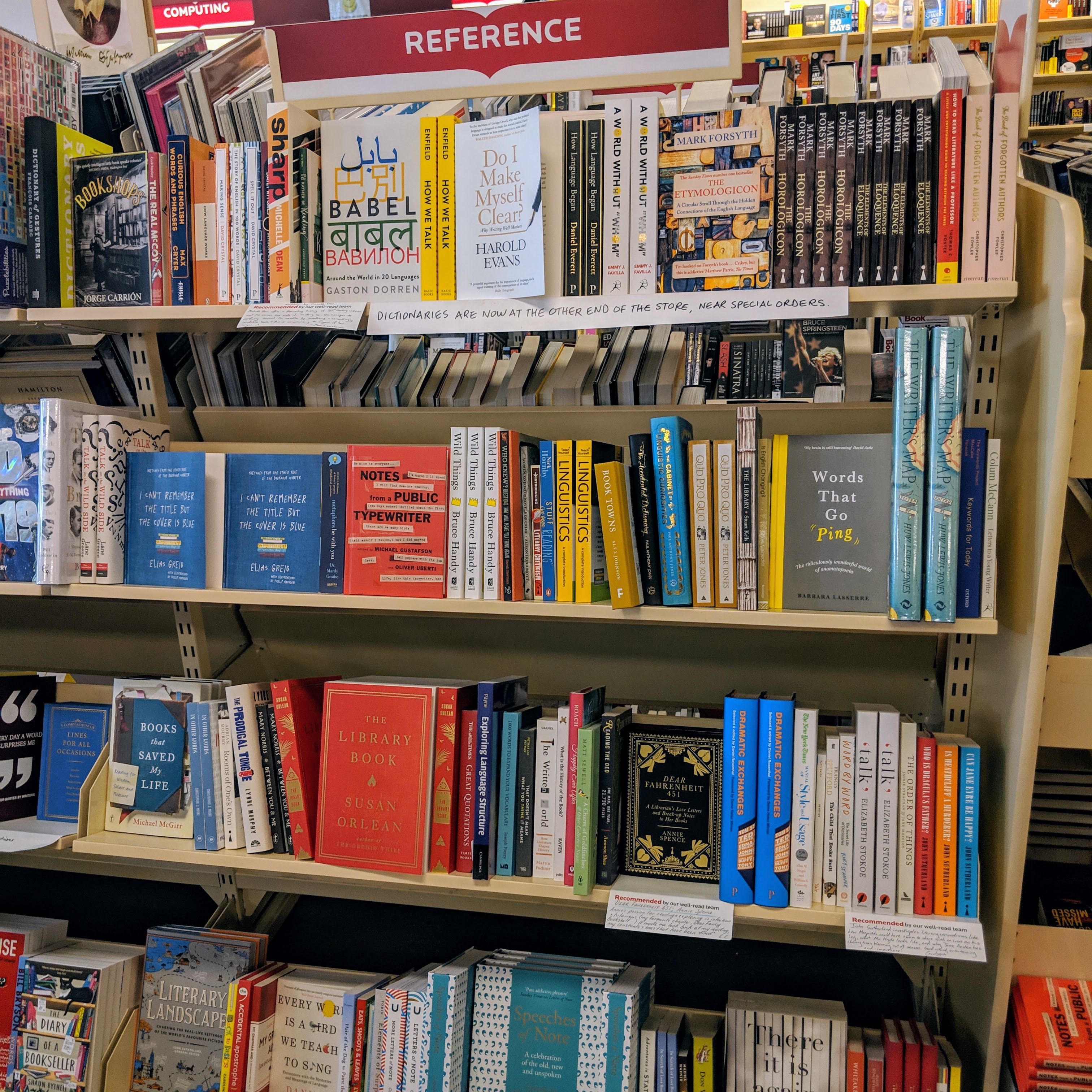
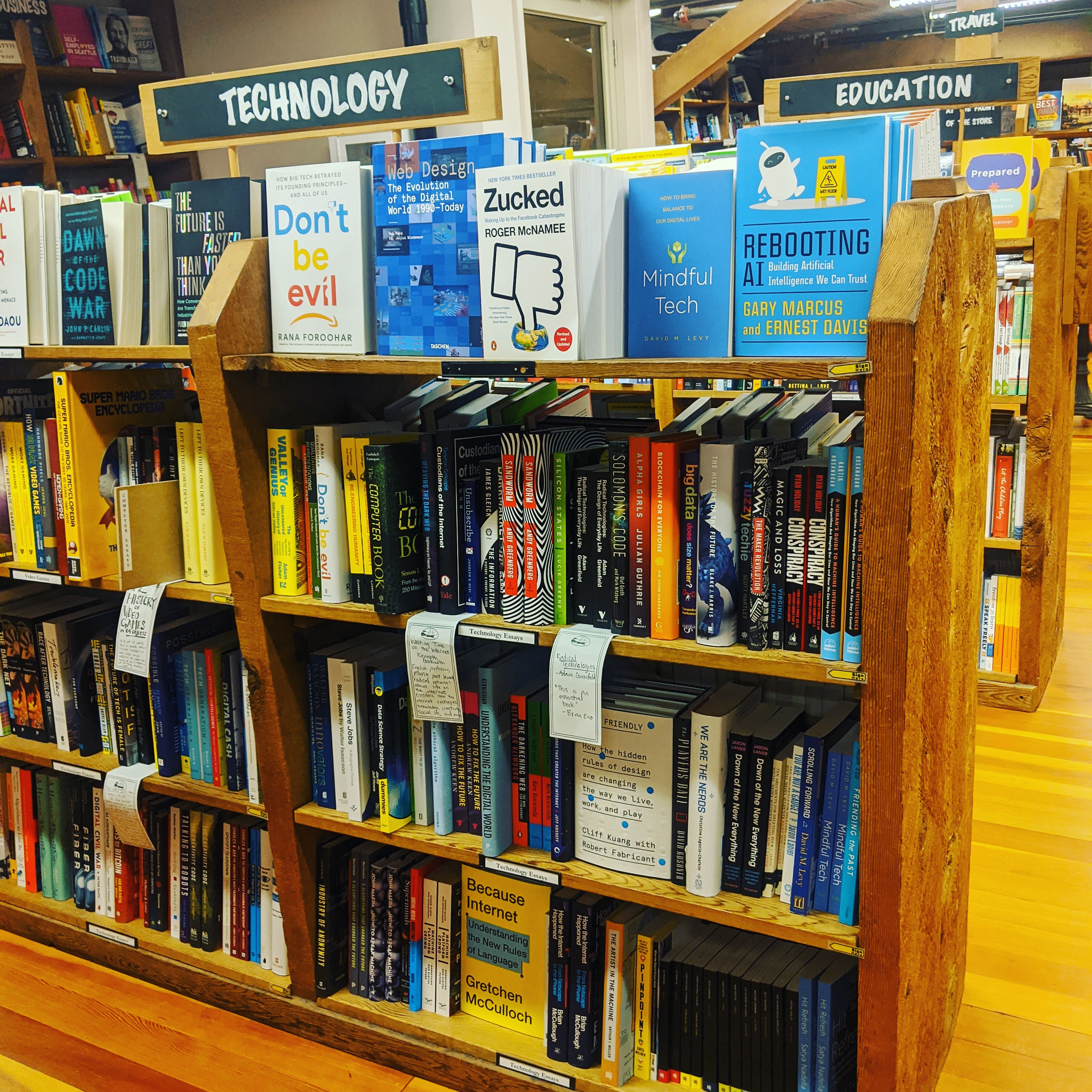
This month’s photo, since I yet again didn’t go anywhere, is a throwback photo from ReadeBook, a bookshop in Adelaide, from when I was in Australia in 2018.
I went to the American Dialect Society’s annual Word of the Year vote, which is normally in person in early January at the annual meeting of the Linguistic Society of America, but this year as both have moved online, we were able to have the WotY vote at the end of December instead. A bit weird, but still nice to see familiar faces in the chat! The winner was, surprising no one at all, “covid”, and you can see the longer (and in my mind, more interesting) list of nominees in each category here.
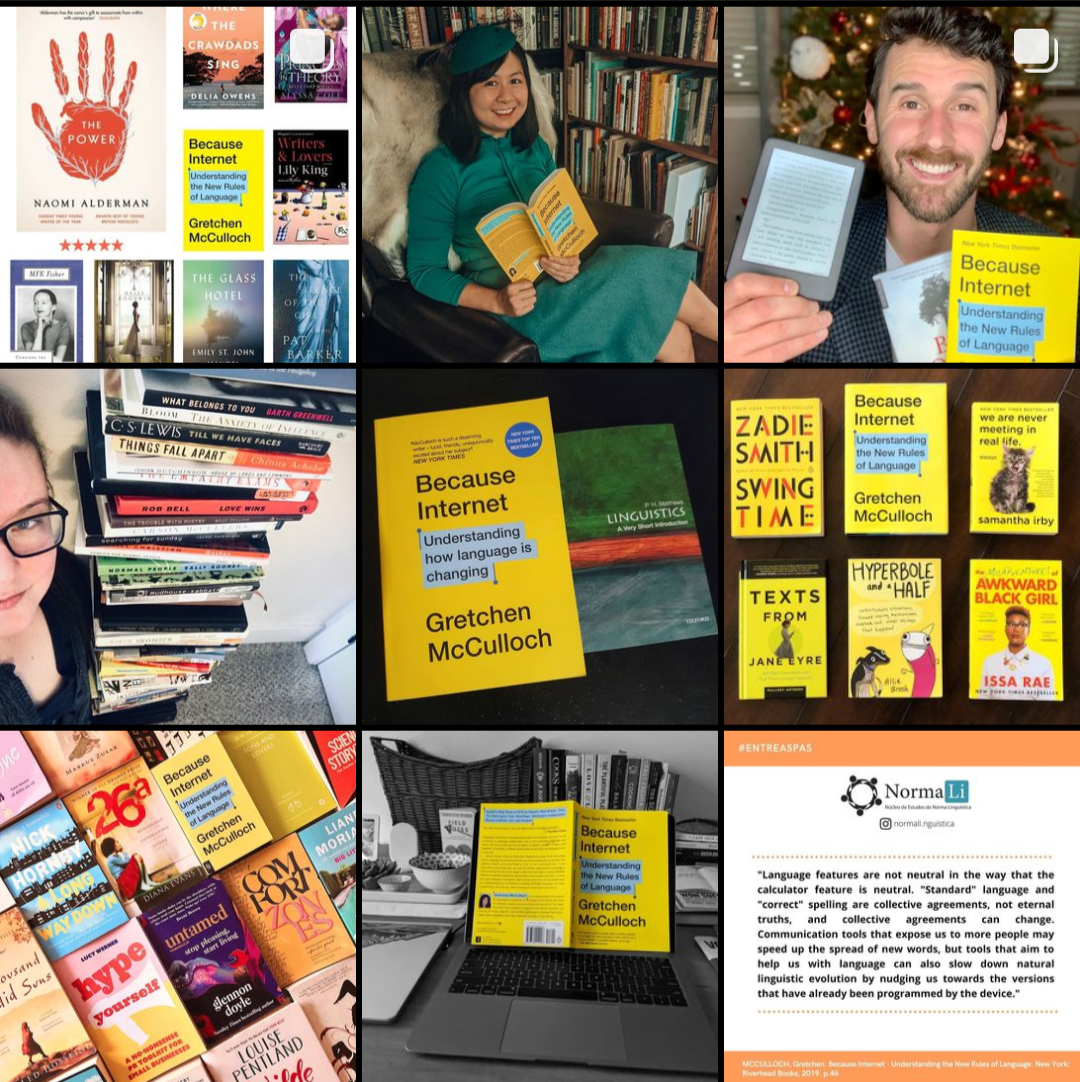
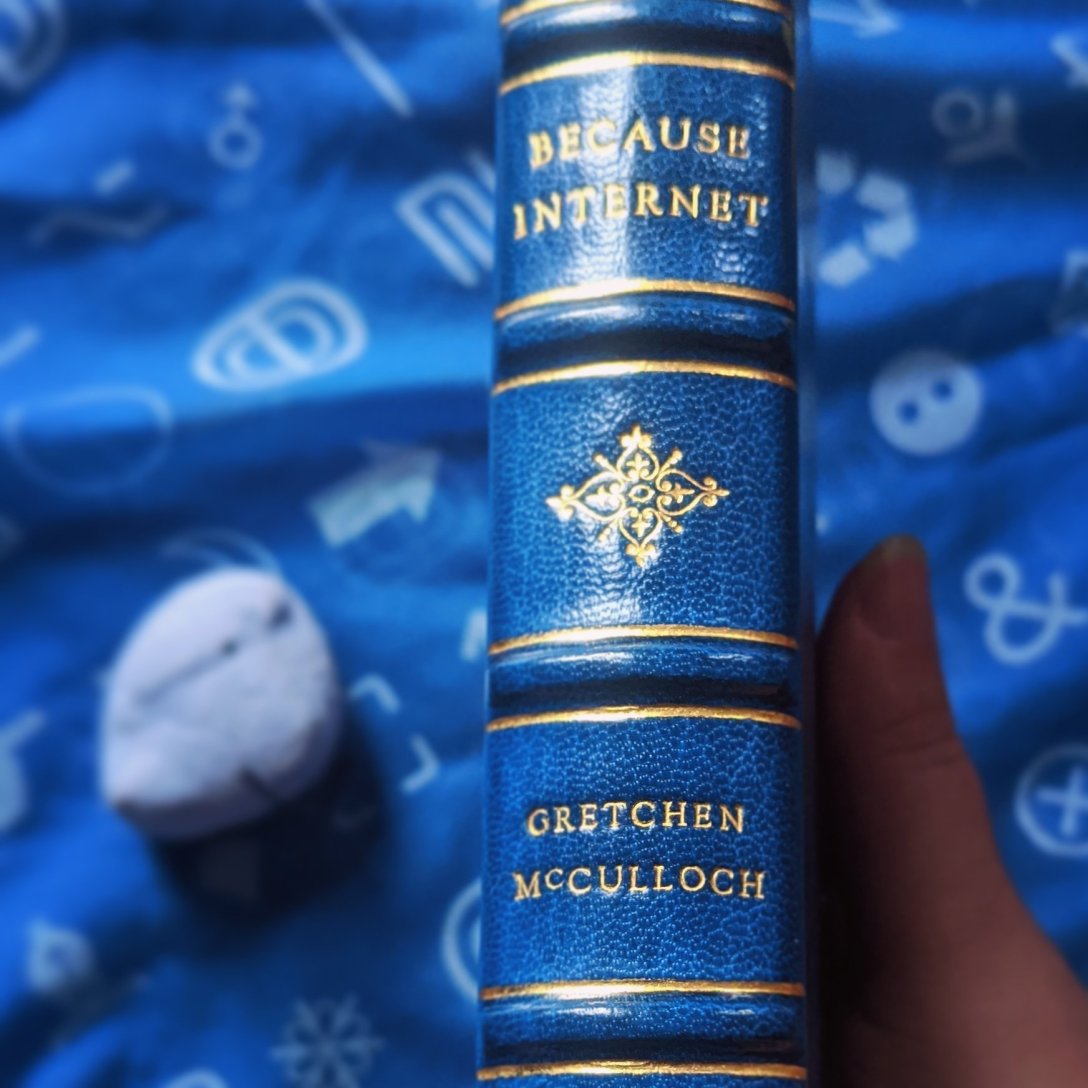
Lots of people seem to have received copies of Because Internet for Christmas this year, as it’s now in paperback, and have been tagging me in them on twitter and instagram, which is lovely! Here are some of them:
I had a very fun time doing this interview on Smart Podcast, Trashy Books this month, talking about the cheese plate as social technology, various language aspects of books I’ve read recently, and of course your ever-present Internet Linguistics Content. Here’s a quote:
Gretchen: So the interesting linguistic fact about Tooth and Claw is, I happen to know Jo Walton and she was telling me the story about the Japanese translation for Tooth and Claw. There’s a linguistic feature in Japanese where you have, like, categories for different types of entities in the world, and there’s one for humans and there’s one for monsters, and what the Japanese translator approached her for permission to do was, can I use the human category, this linguistic thing, for the dragons in this book, and for these other people, who are implicitly humans, but they’re external to the society – can I use the monster descriptor for them?
Sarah: [Gasps] Ohhh! Oh my.
Gretchen: [Laughs] And, and Jo was obviously like, oh my God, of course you can! I would have done this in English if I’d had the ability!
The Crash Course Linguistics videos (10-12 minute videos about intro linguistics!) and their accompanying Mutual Intelligibility newsletters continued coming out this month, as the prophecy (er, scheduling calendar) foretold.
Planet Word, the language museum in Washington DC that I’m on the Advisory Board for and have been watching the progress of with interest for several years, finally opened its doors! I watched the virtual ribbon cutting here (still online, if you’re curious) and I’m looking forward to eventually getting to see it in person one day.
I was on a Linguistics in the Pub panel about linguistics podcasting, along with my cohost Lauren Gawne (moderator) as well as Megan Figureoa and Carrie Gillon from The Vocal Fries and Daniel Midgley and Hedvig Skirgard from Because Language. You can rewatch it online here.
Looking ahead, linguistic changes are yet to come, Ms. McCulloch said. She explained the concept of a retronym — assigning a new name for a default now dated by technology or social change; for example, with the rise of cellphones, non-mobile phones became “landlines.”
“We are still in the phase of naming the new things we’re encountering, but eventually we’ll get to the stage where we need names for what things were like before the virus hit,” she said. We’re still assimilating to “the new normal” and its accompanying word bank, while longing for “the before times.”
But when we return to the life we knew, forever altered as it may be, we may need new qualifiers: first dates that aren’t over FaceTime; IRL hangouts, unmasked and less than six feet apart; to-stay drinks at bars.
I hit my eighth blogiversary on All Things Linguistic, and it is frankly pretty absurd that I’ve been blogging this long. Here’s the traditional year-in-review roundup post, featuring some of my favourite posts of the past year.
Two new Language Files videos came out: the Hidden Rules of Conversation (about Grice’s Maxims) and schwa, product of the ongoing collaboration between me, Tom Scott, and Molly Ruhl. (It is, uh, maybe not a coincidence that Everything Was Coming Up Schwas this month, when you have a good idea you might as well just roll with it.)
i knew that some parts of Because Internet were going to age quickly, because that’s what happens when you write a book about the internet, but i confess i wasn’t expecting this particular one
We put up many posts on Mutual Intelligibility, the new newsletter that I’m producing with Lauren Gawne with resources for people who are teaching (or self-teaching) linguistics online (thanks to our contributors Liz McCullough and Katy Whitcomb!). Here are a few of them:
In February, I did a bunch of travel. First, I went to the Bay Area for Social Science FooCamp, where I gave a lightning talk about how the internet is changing language, and for Comma-Con, Facebook’s internal conference for their writing team, where I gave a keynote about the future of language online.
The bonus episode is a robo-generated version of Lingthusiasm, where we asked last month’s guest Janelle Shane to help us use a neural net to generate a new Lingthusiasm episodes based on the transcripts of our ~70 existing episodes, and then we performed the best snippets. Accuracy: low. Hilarity: high.
My book about internet language, which I’d been working on since 2014, finally came out into the world! Because Internet hit the New York Times bestseller list and was one of TIME’s 100 books of 2019, plus tons of other media.
I wrote two op-eds for the New York Times and continued writing my Resident Linguist column at Wired, and we made two special video episodes of my podcast, Lingthusiasm.
Book: Because Internet
There were over 200 media hits for Because Internet in 2019, at final count. Here are a few highlights:
Two (!!) reviews in the New York Times, by Jennifer Szalai (NYT Daily) and Clay Shirky (NYT Book Review)
We celebrated our third year of Lingthusiasm, a podcast that’s enthusiastic about linguistics which I make with Lauren Gawne. New this year were two video episodes, about gesture and signed languages, so that you can actually see them!
Here are all 24 episodes from 2019, 12 main episodes and 12 bonus episodes:
“linguists are not kidding when they say that language enables you to understand sentences that have never been said before in the entirety of human history”
I wrote a second op-ed for the New York Times this month! It’s part of their 2010s retrospective and it’s called We Learned to Write the Way We Talk. Here’s a quote:
Language snobbery is not inevitable. It’s not that people who cling to lists of language rules don’t want love as well. It’s that they’ve been sold a false bill of goods for how to get it. In high school English classes and writing manuals, we’ve been told that being “clear” and “correct” in language will help people understand us.
But understanding doesn’t come from insisting on a list of rules, shouting the same thing only louder like a hapless monolingual tourist in a foreign country. Understanding comes from meeting other people where they are, like being willing to use gestures and a handful of semi-remembered words and yes, even to look like a fool, to bridge a language barrier with laughter and humility.
We’ve been taught the lie that homogeneity leads to understanding, when in truth, understanding comes from better appreciating variety.
Boomerspeak’s canonical features include the dot dot dot, repeated commas, and the period at the end of a text message. It can also involve random mid-sentence capitalization, typing in all caps, double-spacing after a period, signing your name at the end of a text message, and confusion between the face with tears of joy emoji and the loudly crying emoji.
But it’s not just a question of intergenerational strife. Watching boomerspeak distill and crystalize into a distinct genre this year can help us understand a bigger phenomenon: how distinctive ways of speaking bubble up into the popular consciousness and become available for commentary or imitation, a linguistic process known as enregisterment.
Here’s part of the blurb I wrote for Wired’s roundup list:
There’s always a risk, when it comes to Explaining The Youths, that said Youths will turn around and decide your explanation makes the thing no longer cool anymore (ahem, “ok boomer”). When I decided to write a book about internet language, I was worried this would be people’s response. But that’s not what I’ve been told about Because Internet. Instead, people tell me it’s helping them bridge generation gaps.
It was also very very fun to see people’s photos of giving or being given Because Internet as a gift, or finally having time to read Because Internet around the holidays! I’ve tried to like/comment/reshare as many as possible on twitter and instagram, and do feel free to keep tagging me there!
If you want to get the Weird Internet Careers series as a 30-page document, plus bonus questions to ask yourself about starting your Weird Internet Career, you can sign up for these posts as a monthly newsletter.
Full media list:
Roundups
Esquire.com – roundup “The Best Nonfiction Books of 2019 Span Everything From True Crime to Scammer Culture” – 12/3
Popsugar– roundup “18 Quirky Nonfiction Books That Will Make Perfect Holiday Gifts” – 12/3
Science Friday – roundup “The Best Science Books Of 2019” – 12/6
Vox – roundup “The best books I read in 2019” – 12/6
AtomicDust– roundup “What We’re Reading, Watching and Listening To Over Holiday Break” – 12/11
Bloomberg– roundup “Best Nonfiction Books of 2019 for Contrarians and the Curious” – 12/16
Blinkist– roundup “The Biggest Nonfiction Books of 2019” – 12/17
Better– roundup “The 10 Best Books of 2019”– 12/24
Lithhub– roundup “The Booksellers’ Year in Reading: Part 1”– 12/24
Popsugar– roundup “45 Nonfiction Books We Couldn’t Put Down in 2019”– 12/26
Read It Forward – roundup “Book Gifts for people who have everything”
Wired – roundup “12 Science Books You Should Read Right Now”
A year-in-review writing list thread, with some thoughts on how much invisible work happens behind the scenes before the splashy fruits of one’s labour are visible
Last Christmas, I gave you a chart / And the very next day, you learned IPA / This year, we’ll transcribe without fear / Our clicks will be quadrilabial
Good King Wenceslo, Good King Wenceslas, Good King Wenceslat, Good King Wenceslamus, Good King Wenceslatis, Good King Wenceslant








 Gretchen McCulloch
You must be logged in to post a comment.