The show is often as much about social habits as it is about language — one memorable episode had Gawne and McCulloch discuss “lopsided conversations,” those verbal interactions that can go off the rails if one person is either dominating or not contributing enough. It’s a fascinating listen that will change the way you see everyday communications.
I also enrolled in my third American Sign Language class, ASL 103 with Deaf instructor Hariklia (Lia) Mavroudis, again through the Lethbridge Layton Mackay Rehabilitation Centre (LLMRC) in Montreal. Back in person again after 102 on Zoom, which was a huge relief. It’s also been fun this semester to start recognizing some people from previous classes and events!
We also added linguist, technical editor, and generally excellent human Leah Velleman to the Lingthusiasm team! Her first project was sprucing up the Lingthusiasm merch page (check it out, it’s much easier to navigate now!), and you may also notice her around here helping me with these newsletters, for which I’m very grateful.
Remembering Bill Labov
The great sociolinguist Bill Labov passed away. The internet remembered him as it does, with eulogies and also silly jokes about his best-known study:
This quarter’s image is a pumpkin I carved for Halloween. Featuring two shapes, a round, blobby one and an angular, spikey one. If you had to assign the names kiki and bouba to these shapes, which one would be which?
I went to the American Dialect Society’s annual Word of the Year vote, which is normally in person in early January at the annual meeting of the Linguistic Society of America, but this year as both have moved online, we were able to have the WotY vote at the end of December instead. A bit weird, but still nice to see familiar faces in the chat! The winner was, surprising no one at all, “covid”, and you can see the longer (and in my mind, more interesting) list of nominees in each category here.
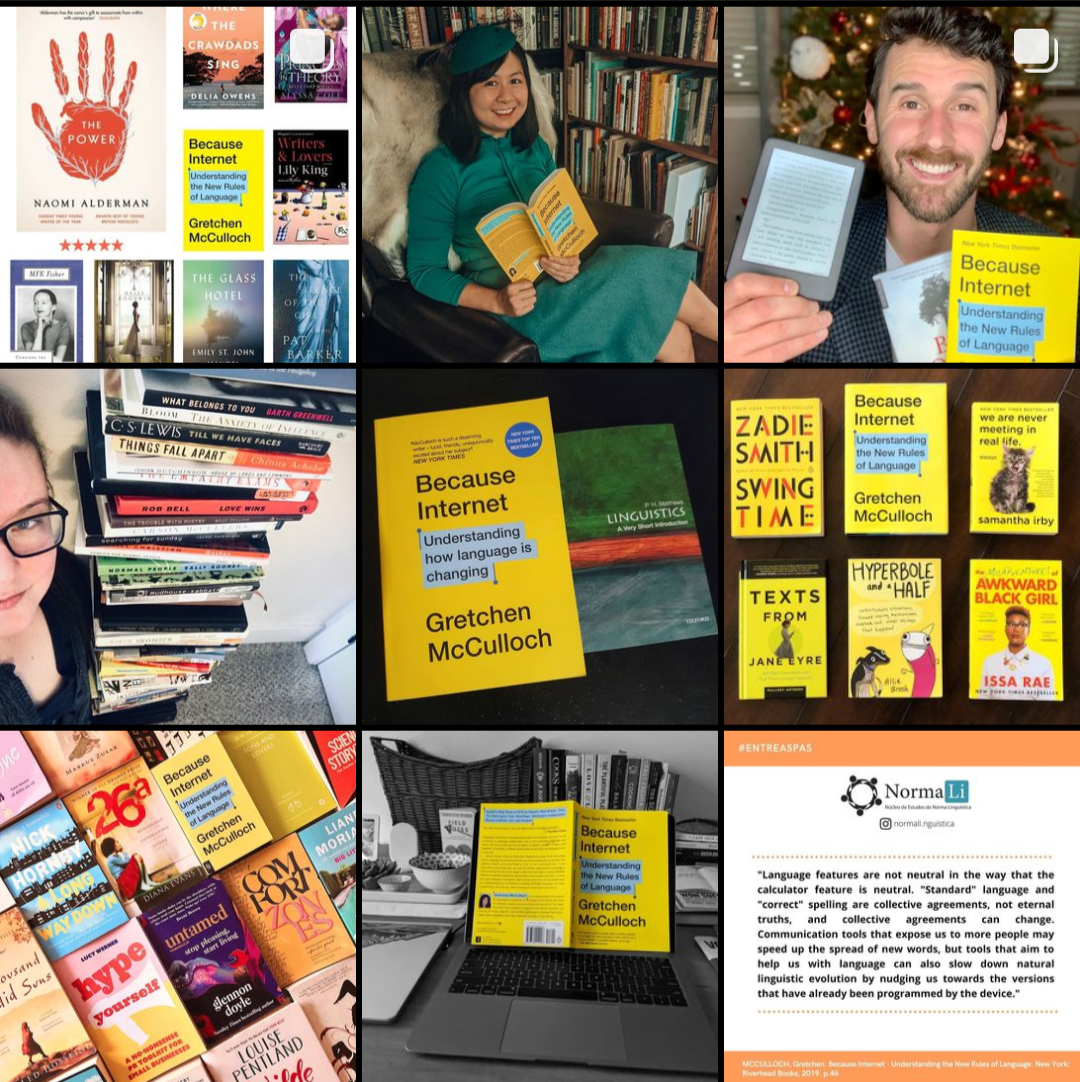
Lots of people seem to have received copies of Because Internet for Christmas this year, as it’s now in paperback, and have been tagging me in them on twitter and instagram, which is lovely! Here are some of them:
I wrote an article for Wired this month summing up the results of my experiments in having more fluid conversational groupings (popularly known as “parties”) online.
The Zoom-birthday-party-slash-quiz-show is not terrible, and it is better than nothing—not to mention far better than hosting a Fun Party for Viral Particles in your friends’ respiratory tracts. But this birthday-board-meeting simply doesn’t feel like a party. (I’d hereby like to apologize to my friends who’ve hosted said Zoom gatherings. No really, please invite me back next year, it’s the medium that’s at fault!) One possible solution is to embrace the necessary structure of large Zoom events, and organize a more formal type of fun, like book clubs and game nights and powerpoint karaoke and show-and-tell events.
But, internet help me, I was still determined to have an actual virtual party. Which raises the question: If getting a bunch of people together on a video call doesn’t feel like a party, then what does?
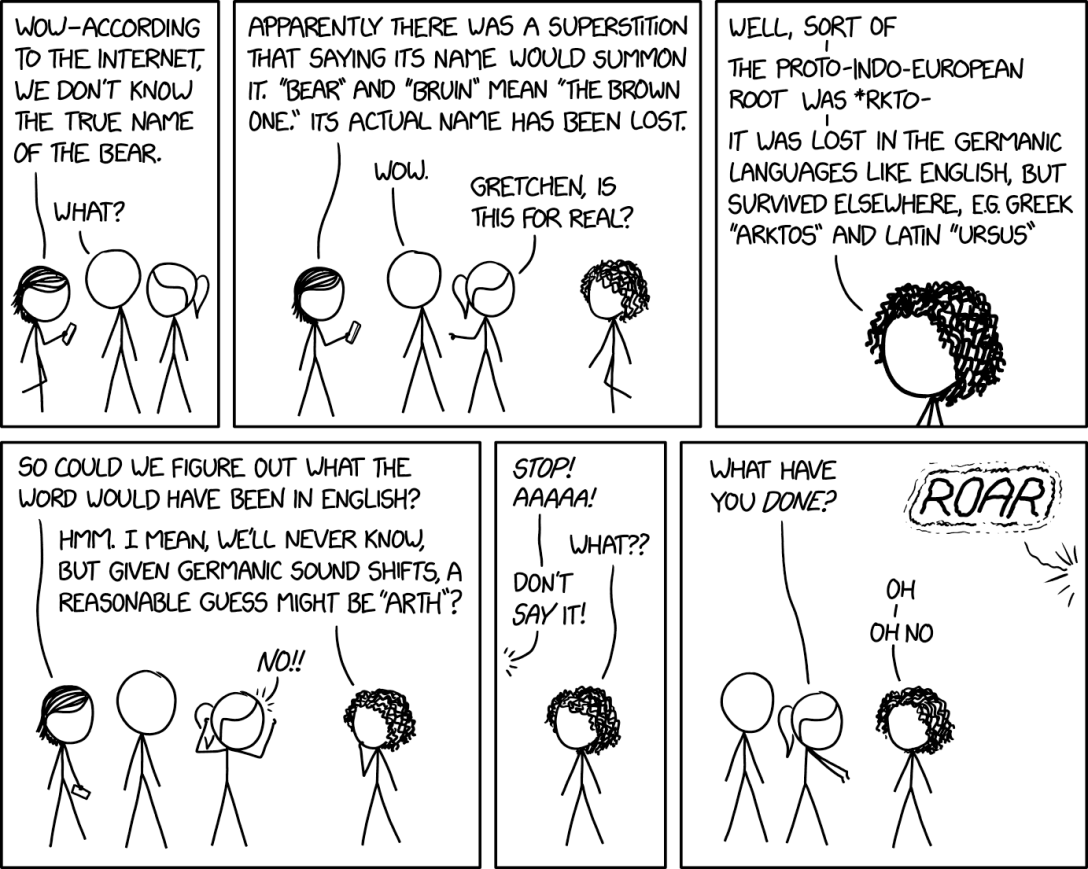
I also made a cameo in an xkcd comic. (Possibly twice, if you interpret this one as a subtweet.) I would like to thank everyone for their concern, but it is actually very comfortable here in the stomach of the Eldritch Spirit of the Brown One and I am getting some very interesting fieldwork done with this ursine speaker of Proto-Germanic so please do not be alarmed.
I did a virtual discussion event with Maria Dahvana Headley (translator of the new “bro” Beowulf edition) and Alena Smith (creator of the show Dickinson) about translation and the juxtaposition of historical texts with modern language styles. It was part of Predictive Text, a new series I’m doing with Slate’s Future Tense, and the archive video is online.
A few more Crash Course Linguistics episodes went up this month (we’re taking a few weeks off this month and next for assorted holidays this time of year).
I also read and greatly enjoyed the linguistic aspects of A Memory Called Empire, which includes poetic descriptions of fifteen syllable verbs and a very neat naming system loosely inspired by the Aztecs. More tweets to come when I eventually get my hands on a paper copy, read it now so you can follow along even better!
I was on a Linguistics in the Pub panel about linguistics podcasting, along with my cohost Lauren Gawne (moderator) as well as Megan Figureoa and Carrie Gillon from The Vocal Fries and Daniel Midgley and Hedvig Skirgard from Because Language. You can rewatch it online here.
Because Internet, my book about internet language, is now available in paperback! Links to get it in all of the formats, including how to get signed copies.
Lauren and I also finally finished the bulk of the writing on the scripts for Crash Course Linguistics this month! We’ve been working on this intensively since March, not to mention the planning side in previous months. The Crash Course and Thought Cafe teams are now moving into exciting things that we’re less involved in, like filming and animating, although we’ll still be keeping an eye on technical accuracy as it goes along. I’m excited to share that the 16 ten-minute intro linguistics videos will be going up on the Crash Course youtube channel starting in September! If you want to get emails with each of the Crash Course Linguistics videos and suggested further reading/activities as they go up, you can sign up for the Mutual Intelligibility newsletter.
I did an edition of Mutual Intelligibility about teaching internet linguistics in honour of Because Internet coming out in paperback, along with several other great resources in the internet linguistics domain.
Media list:
Rotten Tomatoes – mention “WHY AIRPLANE!’S TITLE IS ONE OF THE CLASSIC COMEDY’S BEST JOKES” – 7/2
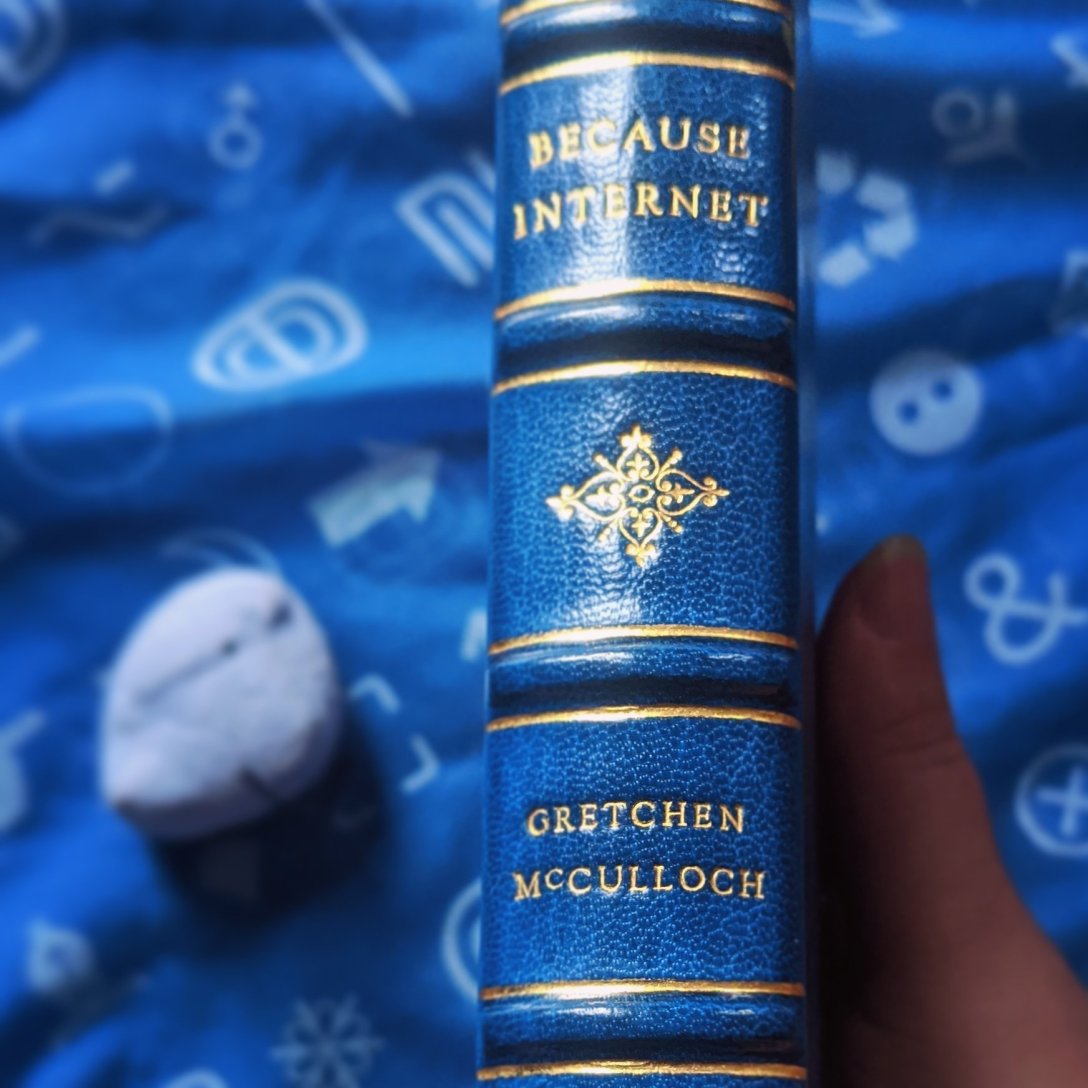
This month’s image is, of course, that snazzy paperback edition of Because Internet! The inside is pretty much the same, except that there are now two entire pages of fancy people saying nice things at the front, which you can see here, should you desire. But it’s also just been really gratifying over the past year to hear from so many regular internet people on social media finding yourselves in its pages. Thank you.
After 7 years of blogging, I thought I had pretty much figured out which sections go in this yearly summary post. But for year 8, I’ve found myself needing to add a delightful new one.
We celebrated our third year of making Lingthusiasm, a podcast that’s enthusiastic about linguistics! This year we were recommended by Buzzfeed (!!), which called Lingthusiasm “joyously nerdy”.
The most exciting Lingthusiasm episodes this year were the ones where our guests helped me and Lauren Gawne push the boundaries of what a podcast typically is: this video episode in ASL and English interviewing Lynn Hou about her research on signed languages in real-world contexts and the one where Janelle Shane used a neural net to generate fake Lingthusiasm quotes based on our existing transcripts, and then we performed the best ones out loud (see also Janelle’s blog post about making this).
Here’s all twelve regular monthly Lingthusiasm episodes:
We also started a Discord community that’s enthusiastic about linguistics, to solve the problem of “Your podcast got me (back) into linguistics, but now I don’t have people to fan out about language with! Where do I make lingthusiastic friends?”
Lauren Gawne and I also started working on several other projects in the pop linguistics ecosystem online:
LingComm Grants – grants to help the next generation of linguistics communication projects get started, which we were able to expand from one grant to four thanks to the support of our patrons. Grantees to be announced in upcoming months!
Mutual Intelligibility – a newsletter summarizing existing linguistics resources on specific topics to help instructors moving their courses online, including shorter 3 Links posts and longer Resource Guides
Linguistics Crash Course – a series of intro linguistics videos in collaboration with the educational youtube channel Crash Course and linguist Jessi Grieser, to appear later in 2020
A reflection on how starting All Things Linguistic back in 2012 was the seed that led to all of the interesting and exciting things I’m doing now, including writing articles, writing a book, and doing the podcast — and how to approach trying to do something similar.
Looking ahead, linguistic changes are yet to come, Ms. McCulloch said. She explained the concept of a retronym — assigning a new name for a default now dated by technology or social change; for example, with the rise of cellphones, non-mobile phones became “landlines.”
“We are still in the phase of naming the new things we’re encountering, but eventually we’ll get to the stage where we need names for what things were like before the virus hit,” she said. We’re still assimilating to “the new normal” and its accompanying word bank, while longing for “the before times.”
But when we return to the life we knew, forever altered as it may be, we may need new qualifiers: first dates that aren’t over FaceTime; IRL hangouts, unmasked and less than six feet apart; to-stay drinks at bars.
I hit my eighth blogiversary on All Things Linguistic, and it is frankly pretty absurd that I’ve been blogging this long. Here’s the traditional year-in-review roundup post, featuring some of my favourite posts of the past year.
Two new Language Files videos came out: the Hidden Rules of Conversation (about Grice’s Maxims) and schwa, product of the ongoing collaboration between me, Tom Scott, and Molly Ruhl. (It is, uh, maybe not a coincidence that Everything Was Coming Up Schwas this month, when you have a good idea you might as well just roll with it.)
i knew that some parts of Because Internet were going to age quickly, because that’s what happens when you write a book about the internet, but i confess i wasn’t expecting this particular one
My book about internet language, which I’d been working on since 2014, finally came out into the world! Because Internet hit the New York Times bestseller list and was one of TIME’s 100 books of 2019, plus tons of other media.
I wrote two op-eds for the New York Times and continued writing my Resident Linguist column at Wired, and we made two special video episodes of my podcast, Lingthusiasm.
Book: Because Internet
There were over 200 media hits for Because Internet in 2019, at final count. Here are a few highlights:
Two (!!) reviews in the New York Times, by Jennifer Szalai (NYT Daily) and Clay Shirky (NYT Book Review)
We celebrated our third year of Lingthusiasm, a podcast that’s enthusiastic about linguistics which I make with Lauren Gawne. New this year were two video episodes, about gesture and signed languages, so that you can actually see them!
Here are all 24 episodes from 2019, 12 main episodes and 12 bonus episodes:
“linguists are not kidding when they say that language enables you to understand sentences that have never been said before in the entirety of human history”
I wrote a second op-ed for the New York Times this month! It’s part of their 2010s retrospective and it’s called We Learned to Write the Way We Talk. Here’s a quote:
Language snobbery is not inevitable. It’s not that people who cling to lists of language rules don’t want love as well. It’s that they’ve been sold a false bill of goods for how to get it. In high school English classes and writing manuals, we’ve been told that being “clear” and “correct” in language will help people understand us.
But understanding doesn’t come from insisting on a list of rules, shouting the same thing only louder like a hapless monolingual tourist in a foreign country. Understanding comes from meeting other people where they are, like being willing to use gestures and a handful of semi-remembered words and yes, even to look like a fool, to bridge a language barrier with laughter and humility.
We’ve been taught the lie that homogeneity leads to understanding, when in truth, understanding comes from better appreciating variety.
Boomerspeak’s canonical features include the dot dot dot, repeated commas, and the period at the end of a text message. It can also involve random mid-sentence capitalization, typing in all caps, double-spacing after a period, signing your name at the end of a text message, and confusion between the face with tears of joy emoji and the loudly crying emoji.
But it’s not just a question of intergenerational strife. Watching boomerspeak distill and crystalize into a distinct genre this year can help us understand a bigger phenomenon: how distinctive ways of speaking bubble up into the popular consciousness and become available for commentary or imitation, a linguistic process known as enregisterment.
Here’s part of the blurb I wrote for Wired’s roundup list:
There’s always a risk, when it comes to Explaining The Youths, that said Youths will turn around and decide your explanation makes the thing no longer cool anymore (ahem, “ok boomer”). When I decided to write a book about internet language, I was worried this would be people’s response. But that’s not what I’ve been told about Because Internet. Instead, people tell me it’s helping them bridge generation gaps.
It was also very very fun to see people’s photos of giving or being given Because Internet as a gift, or finally having time to read Because Internet around the holidays! I’ve tried to like/comment/reshare as many as possible on twitter and instagram, and do feel free to keep tagging me there!
If you want to get the Weird Internet Careers series as a 30-page document, plus bonus questions to ask yourself about starting your Weird Internet Career, you can sign up for these posts as a monthly newsletter.
Full media list:
Roundups
Esquire.com – roundup “The Best Nonfiction Books of 2019 Span Everything From True Crime to Scammer Culture” – 12/3
Popsugar– roundup “18 Quirky Nonfiction Books That Will Make Perfect Holiday Gifts” – 12/3
Science Friday – roundup “The Best Science Books Of 2019” – 12/6
Vox – roundup “The best books I read in 2019” – 12/6
AtomicDust– roundup “What We’re Reading, Watching and Listening To Over Holiday Break” – 12/11
Bloomberg– roundup “Best Nonfiction Books of 2019 for Contrarians and the Curious” – 12/16
Blinkist– roundup “The Biggest Nonfiction Books of 2019” – 12/17
Better– roundup “The 10 Best Books of 2019”– 12/24
Lithhub– roundup “The Booksellers’ Year in Reading: Part 1”– 12/24
Popsugar– roundup “45 Nonfiction Books We Couldn’t Put Down in 2019”– 12/26
Read It Forward – roundup “Book Gifts for people who have everything”
Wired – roundup “12 Science Books You Should Read Right Now”
A year-in-review writing list thread, with some thoughts on how much invisible work happens behind the scenes before the splashy fruits of one’s labour are visible
Last Christmas, I gave you a chart / And the very next day, you learned IPA / This year, we’ll transcribe without fear / Our clicks will be quadrilabial
Good King Wenceslo, Good King Wenceslas, Good King Wenceslat, Good King Wenceslamus, Good King Wenceslatis, Good King Wenceslant
I wrote an op-ed for the New York Times (my first time writing there instead of being quoted!), from the perspective of 200 years in the future when people have nostalgia for the good old days of quaint emoji. Here’s one part that I liked (longer excerpt here).
The early 21st century was also a golden era for linguistic innovation related to using indirect constructed dialogue to convey actions and mental states. In speech, this era saw the rise of “be like” and in writing, the “me:” and *does something* conventions. (And I’m like, how did people even communicate their internal monologues without these?? also me: *shakes head* yeah I have no idea.)
We now take these linguistic resources for granted, but at the time they represented a significant advancement in modeling complex emotions and other internal conditions on behalf of oneself and other people. Imagine being limited to the previous generation of dialogue tags, which attempted to slice everything into sharp distinctions between “said,” “felt” and “thought.”
My keynote talk about internet linguistics at the CoEDL Summer School in Canberra, Australia last year went online. I also switched this monthly newsletter from Mailchimp to Substack (existing subscribers were already migrated, and you can still view it online at gretchenmcculloch.com/news, but if you’d like to get an email when I write a new post like this, you can sign up here).
I spent a week at a friend’s cottage by a lake for a much-needed respite, where I wasn’t on the internet much but did enjoy JY Yang’s Tensorate series :)








 Gretchen McCulloch
You must be logged in to post a comment.