April 2021: #LingComm21, Lingthusiasm liveshow and #lingfest

We finally ran LingComm and LingFest, the events we’d been planning for the past few months!

LingComm21, the first International Conference on Linguistics Communication, had just under 200 registrants, around 100 of which were formally part of the programming in some way. It was fantastic to get to see old friends and meet new people and find out more about so many great lingcomm projects. Thank you to everyone involved in the conference, especially the organizing committee and those who participated through panels, posters, volunteering, and organizing meetups. My opening remarks and closing remarks are here as blog posts, and see the #LingComm21 hashtag for highlights of what people noticed about the conference.

We did a liveshow for my podcast, Lingthusiasm! Here’s a fun thread that I did about backchannels while we were getting ready for the show. If you’ve now realized that you want to belatedly watch the liveshow, here’s the archive link (for patrons, as encouraging people to become patrons is what helps us keep the show running).

The Lingthusiasm liveshow was part of LingFest, a fringe-festival-like program of online linguistics events aimed at a general audience, which contained a total of 12 events attended by a total of over 700 participants. Thank you to everyone who both created and attended events!

I also moderated a panel for the European Chapter of the Association for Computational Linguistics (EACL) on NLP Applications for Crisis Management and Emergency Situations.

The main episode of Lingthusiasm this month was about R and R-like sounds (rhoticity), featuring A Thing About Eeyore that keeps blowing listeners’ minds, and the bonus was about talking to babies and small children.

Selected tweets:

Selected blog posts:

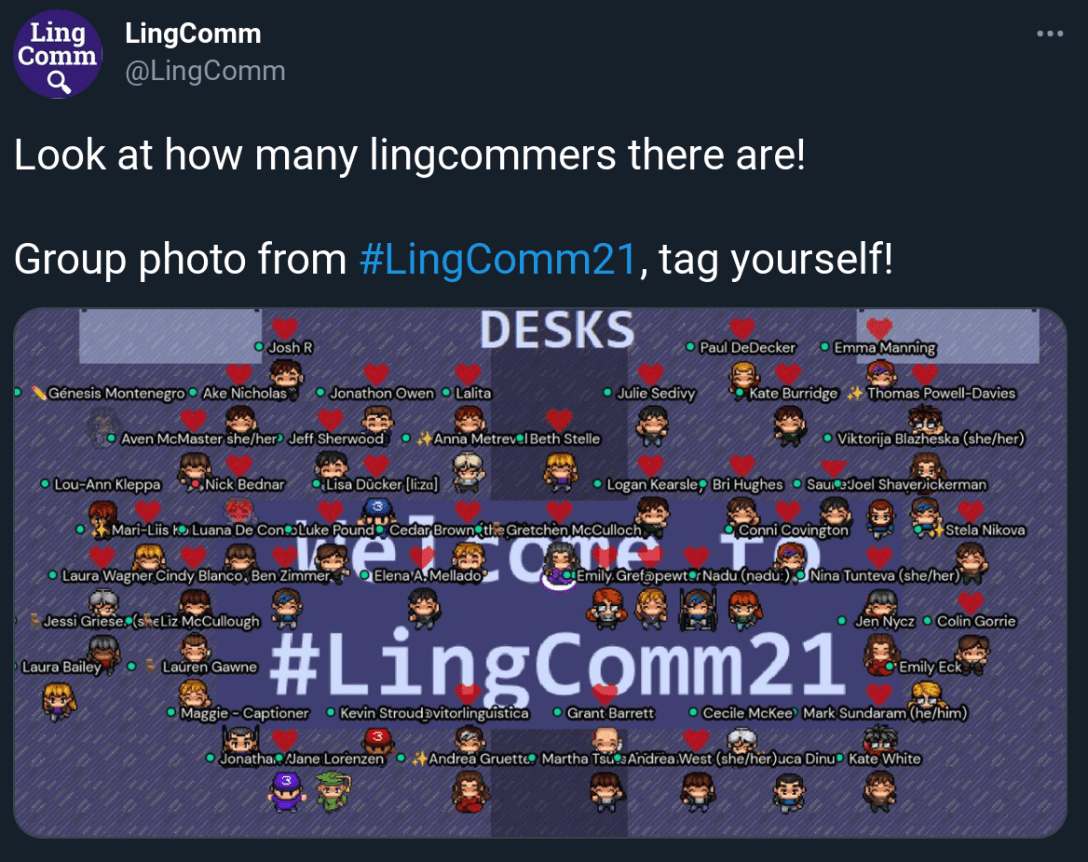
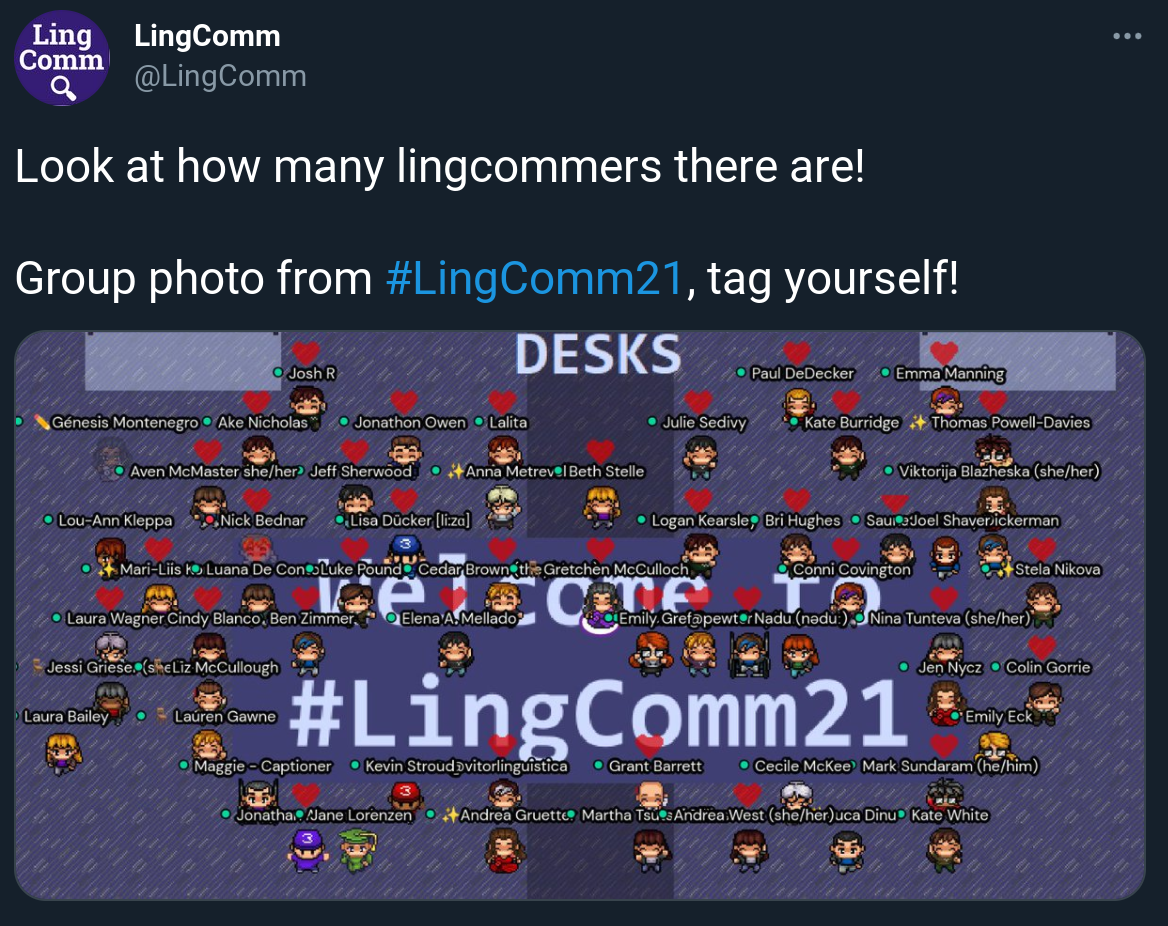
This month’s image is a group photo of attendees from the LingComm21 conference! So much fun to get to be in a group photo again for a change!

Tweet from @LingComm reading: Look at how many lingcommers there are! Group photo from #LingComm21, tag yourself! With screencap of about 50 videogame-style avatars from Gather around the word #LingComm21

March 2021: LingComm21 preparations and two video talks

This month was largely occupied in continued preparations for a pair of events in April:

The main episode of Lingthusiasm was about how linguists figure out the grammar of a language (transcript) and the bonus was about reduplication and a classic linguistics paper affectionately known as the salad-salad paper.

I did two video talks: at Planet Word, the new language museum in Washington DC, about internet language and Because Internet, and for Slate’s Future Tense about the meaning of emoji with Jennifer Daniel.

I collaborated on another video with Tom Scott, this one about the rhythms of poetry in different languages or Why Shakespeare Could Never Have Been French:

Selected tweets:

Selected blog posts:

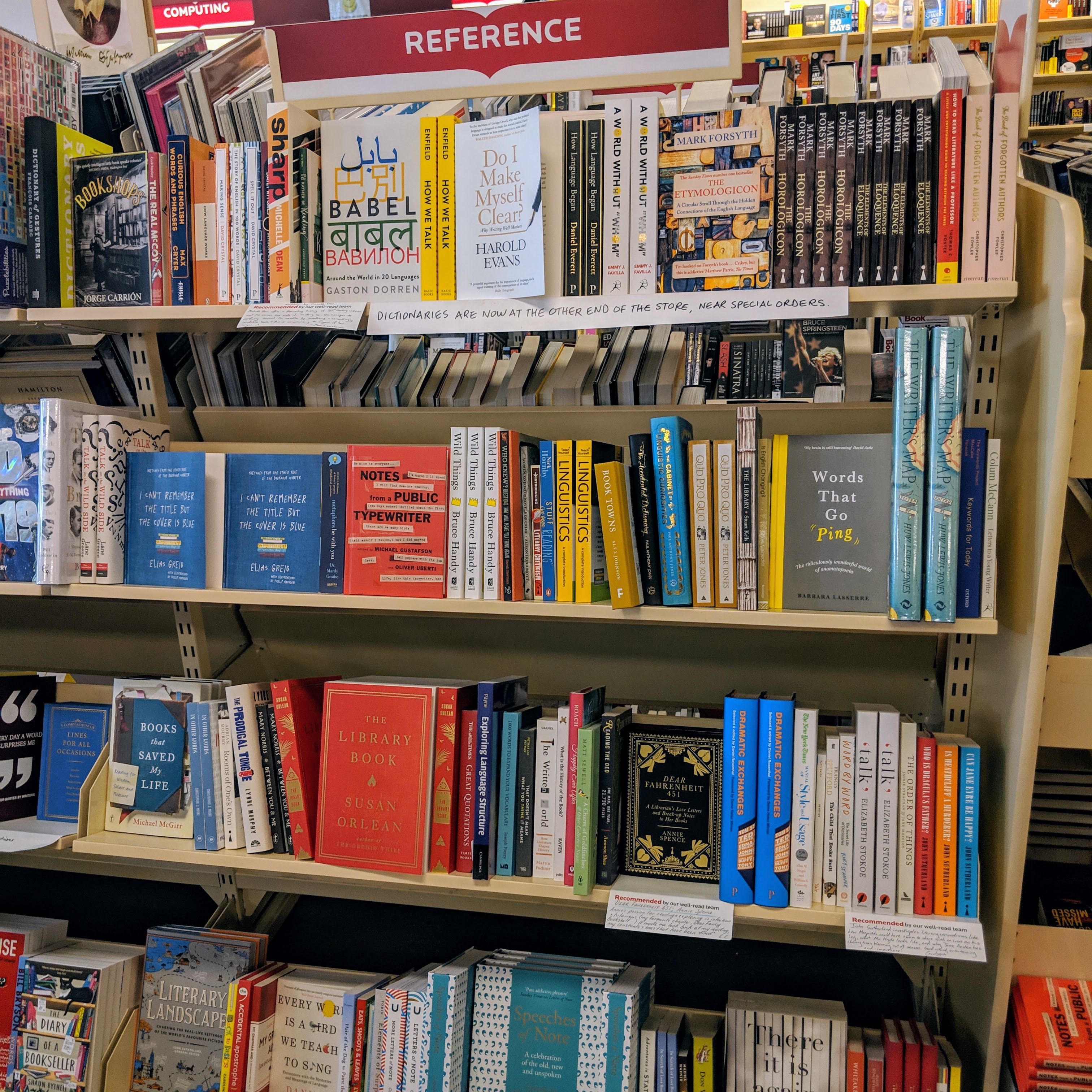
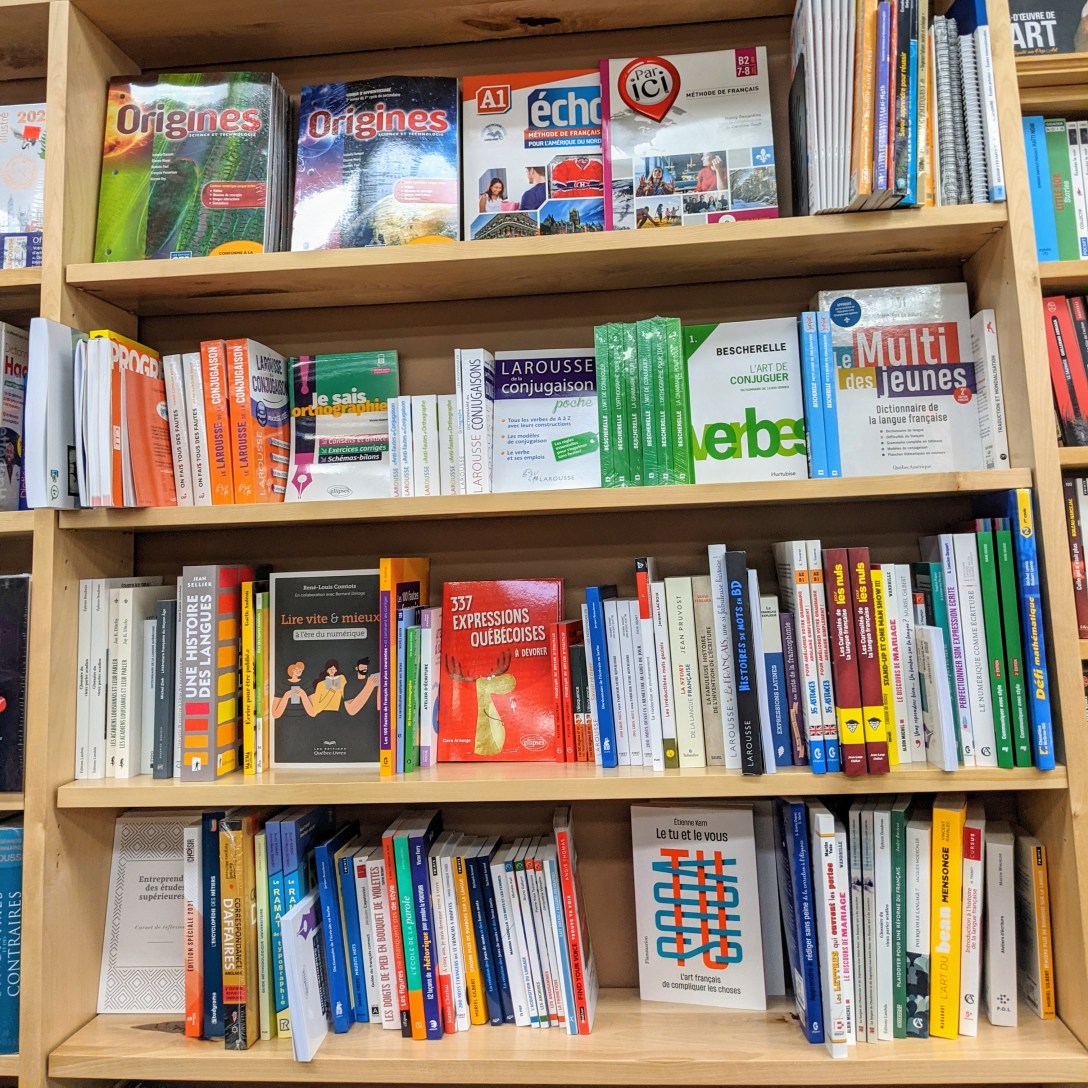
This month’s photo, since I yet again didn’t go anywhere, is a throwback photo from ReadeBook, a bookshop in Adelaide, from when I was in Australia in 2018.

Reference section featuring linguistics books at ReadeBook in Adelaide, South Australia

February 2021: Announcing #LingComm21 and #lingfest

This month, I announced LingComm21, the first International Conference on Linguistics Communication, and LingFest, a fringe-festival-style coordination of independently organized public linguistics events, together with an excellent organizing committee consisting of Lauren Gawne, Jessi Grieser, Laura Bailey, and Liz McCullough (different spelling, no relation!), both to take place in April 2021.

I wrote a thread about how we came to the idea of running a linguistics communication conference, plus a more official-looking announcement on LinguistList.

We reached our 100th episode of Lingthusiasm! This month’s main episode of Lingthusiasm was about imperatives (transcript) and the bonus was a Q&A episode featuring naming dogs, modifying English, keeping up with linguistics research outside academia, and more. (Also, the cutest IPA update.)

I attended the virtual AAAS conference, including making a virtual “hotel bar” in Gather to hang out with fellow attendees in.

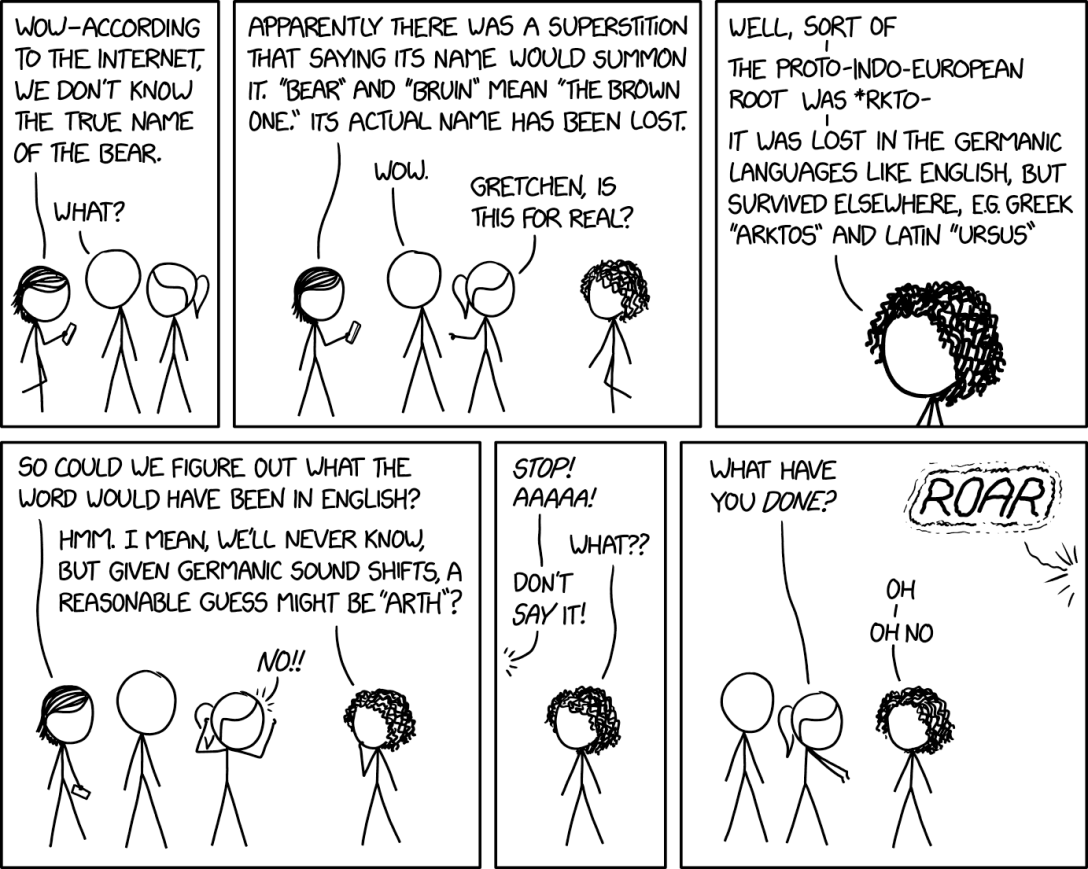
I also may or may not have been in another xkcd comic, this time about the Tower of Babel. (I am choosing to consider it a representation of curly-haired linguists everywhere.)

Media:

Selected tweets:

Selected blog posts:

This month’s featured image is from xkcd. I have to say, I’m severely tempted to screencap that exultant curly-haired linguist as a new profile picture.

January 2021: Linguistics, Language and the Public Award, end of Crash Course Linguistics, and a cappella song about Because Internet

I started off the year as usual at the Linguistic Society of America annual meeting, at which I was honoured to be the recipient of the Linguistics, Language, and the Public Award. I put up my acceptance speech as a blog post (and also a reminder that I wrote a series on how to have a career sorta like mine). Although this year was virtual and Word of the Year had been in December, it was still great to see everyone in the unofficial Gather space that I made for the conference (thanks to everyone who helped brainstorm ideas for what to call a fantasy linguistics coffeeshop). Also thanks to Christian Brickhouse and Lauren Collister for running the annual Wikipedia editathon with me, which we also did in Gather and it worked well there.

The final Crash Course Linguistics videos and accompanying resource posts on Mutual Intelligibility came out!

There’s also now a directory of all of the Mutual Intelligibility posts, a whole year’s worth of compiled resources, which we put up to conclude the project. Many thanks to everyone who read and contributed to the project, especially our editor Liz McCullough.

The main Lingthusiasm episode this month was about how writing is a technology (a companion to the final Crash Course episode), and the bonus was our 100th episode total, a “director’s cut” of excellent deleted scenes from previous episodes that we’d had to cut for time. It’s also the one-year anniversary of launching the Lingthusiasm patron Discord, which has since become a place that’s lively and active but not too much to keep up with, in my opinion an ideal state for an online community.

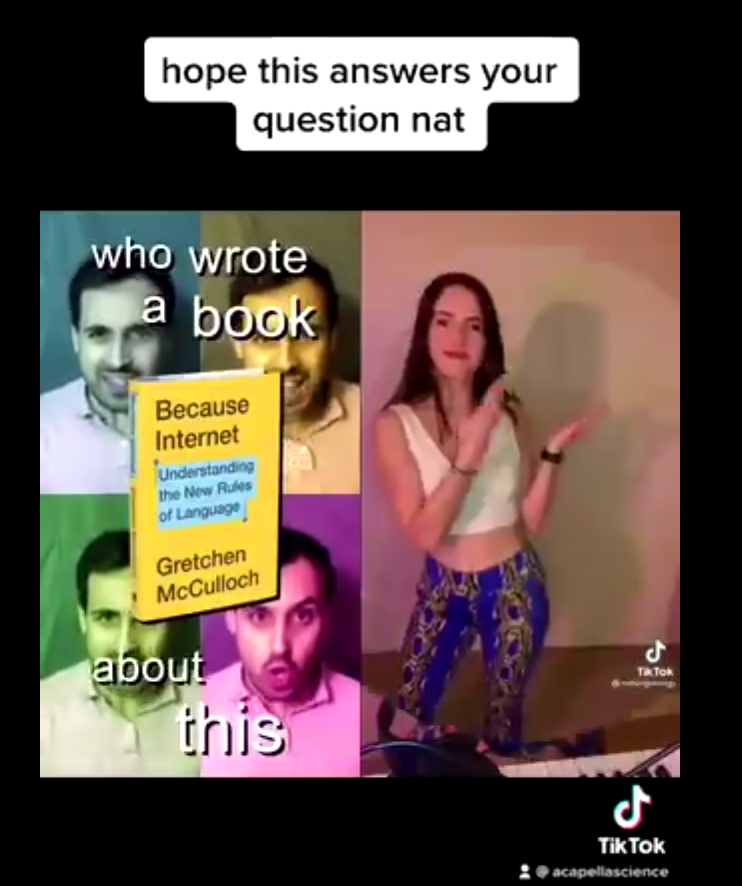
Someone made a musical tiktok video asking why adults over 40 use ellipsis so much, a lot of people tagged me in it so I tweeted about it, and then the delightful A Capella Science made an extremely catchy response video, also in music, with the answer:

Media:

Selected tweets:

Selected blog posts:

This month’s image is a screencap from the A Cappella Science video about Because Internet, which I still utterly cannot get over. Amazing.

2020 Year in Review

Crossposted from my blog, All Things Linguistic.

2020 wasn’t the year anyone was expecting, and I did much less travel than in previous years. But, while I was social distancing at home like everyone else, I did at least keep doing enjoyable linguistics things: Crash Course Linguistics videos went from early planning stages to nearly complete, Because Internet came out in paperback, and my podcast Lingthusiasm launched two other projects to contribute to the pop linguistics ecosystem: LingComm Grants and Mutual Intelligibility.

Because Internet

Because Internet, my book about internet language which hit the NYT bestseller list last year, came out in paperback this year! Links to get it in all of the formats, including how to get signed copies.

Here are some photos of the new paperback edition, same bright yellow cover, now with 10x more nice quotes from people. I also wrote an old-school reflexive blog post about what it’s like to hit the final milestone in a book journey that began in 2014.

Crash Course Linguistics

I worked on these 16 fun intro linguistics videos, 10-12 minutes long each, along with a large team, including linguists Lauren Gawne and Jessi Grieser, host Taylor Behnke, the animation team at Thought Cafe, and of course the production team at Crash Course itself. Writing the scripts ended up being our first lockdown project in the spring, and then reviewing the filmed and animated episodes for accuracy a second lockdown project in the fall. The final few videos will be appearing in early 2021 — you can watch them all at this playlist.

Other Writing

Wired Resident Linguist column:

Language Files videos, with Tom Scott and Molly Ruhl:

Lingthusiasm

My fourth year of producing a podcast that’s enthusiastic about linguistics with Lauren Gawne! Regular episodes:

  1. Making machines learn language – Interview with Janelle Shane
  2. This time it gets tense – the grammar of time
  3. What makes a language easy? It’s a hard question
  4. The grammar of singular they – Interview with Kirby Conrod
  5. Schwa, the most versatile English vowel
  6. Tracing languages back before recorded history
  7. Hey, no problem, bye! The social dance of phatics
  8. The happy fun big adjective episode
  9. Who you are in high school, linguistically speaking – Interview with Shivonne Gates
  10. How translators approach a text
  11. Climbing the sonority mountain from A to P
  12. Small talk, big deal

And 12 bonus episodes, with thanks to our patrons for keeping the show sustainable:

  1. What might English be like in a couple hundred years?
  2. Generating a Lingthusiasm episode using a neural net
  3. Teaching linguistics to yourself and other people
  4. When letters have colours and time is a braid – The linguistics of synesthesia
  5. A myriad of numbers – Counting systems across languages
  6. Doing linguistics with kids
  7. Tones, drums, and whistles – linguistics and music
  8. LingComm on a budget (plus the Lingthusiasm origin story)
  9. The quick brown pangram jumps over the lazy dog
  10. The most esteemed honorifics episode
  11. Crash Course Linguistics behind the scenes with Jessi Grieser
  12. Q&A with lexicographer Emily Brewster of Merriam-Webster

We started a Lingthusiasm Discord server, a place for people who are enthusiastic about linguistics to find each other and talk! And we released new schwa-themed merch with the (admittedly aspirational these days) slogan Never Stressed.

Lingthusiasm also sponsored two other projects this year: LingComm Grants and Mutual Intelligibility.

LingComm Grants – We gave out four $500 grants to up-and-coming linguistics communications projects. Thank you again to everyone who applied, and do check out the projects of the winners of the 2020 LingComm Grants.

Mutual Intelligibility – A newsletter to connect linguistics instructors with existing linguistics resources suitable for teaching online in a bite-sized, easy-to-digest fashion, with considerable help from the editing and organizational skills of Liz McCullough.

Conferences

I did do a tiny bit of travel this year, my usual January trip to the Linguistics Society of America annual meeting (this year in New Orleans) and February trips to Comma Con (I gave a keynote about the future of language online), Social Science FooCamp, PanLex at Long Now, the Internet Archive offices (all San Fransisco Bay Area) and the American Association for the Advancement of Science (AAAS) annual meeting (Seattle).

Virtual conferences and talks:

Media and internet crossovers

Selected media

Selected twitter threads

Books I enjoyed:

Helpful threads:

General fun:

Selected blog posts

I celebrated my eighth blogiversary on All Things Linguistic! Here are some of my favourite posts from this year:

Linguistics jobs and other advice:

Languages:

Linguist fun:

Missed out on previous years? Here are the summary posts from 201320142015201620172018, and 2019. If you’d like to get a much shorter monthly highlights newsletter via email, with all sorts of interesting internet linguistics news, you can sign up for that at gretchenmcc.substack.com.

November 2020: Proximity chat in Wired, bears in xkcd, vaccines in Jolene

I wrote an article for Wired this month summing up the results of my experiments in having more fluid conversational groupings (popularly known as “parties”) online.

The Zoom-birthday-party-slash-quiz-show is not terrible, and it is better than nothing—not to mention far better than hosting a Fun Party for Viral Particles in your friends’ respiratory tracts. But this birthday-board-meeting simply doesn’t feel like a party. (I’d hereby like to apologize to my friends who’ve hosted said Zoom gatherings. No really, please invite me back next year, it’s the medium that’s at fault!) One possible solution is to embrace the necessary structure of large Zoom events, and organize a more formal type of fun, like book clubs and game nights and powerpoint karaoke and show-and-tell events.

But, internet help me, I was still determined to have an actual virtual party. Which raises the question: If getting a bunch of people together on a video call doesn’t feel like a party, then what does?

A Mission to Make Virtual Parties *Actually* Fun

I also made a cameo in an xkcd comic. (Possibly twice, if you interpret this one as a subtweet.) I would like to thank everyone for their concern, but it is actually very comfortable here in the stomach of the Eldritch Spirit of the Brown One and I am getting some very interesting fieldwork done with this ursine speaker of Proto-Germanic so please do not be alarmed.

I late-night-wrote a parody version of “Jolene” but about vaccines (“Vaccine, Vaccine, Vaccine, Vaciiiiine / I’m begging you please go in my arm”) which someone made an excellent video recording of and then it got picked up by quite a lot of media outlets, including the BBC, New York Times (print), Associated Press, Boston Globe, and Fortune. (Youtube version, for posterity.) Still no word on whether Dolly Parton herself has seen it yet, which would be thoroughly incredible.

I did a virtual discussion event with Maria Dahvana Headley (translator of the new “bro” Beowulf edition) and Alena Smith (creator of the show Dickinson) about translation and the juxtaposition of historical texts with modern language styles. It was part of Predictive Text, a new series I’m doing with Slate’s Future Tense, and the archive video is online.

I also did a talk at the Australian Educational Podcasting Conference: From mythbusting to metaphors – Learning from cross-disciplinary research to communicate complex topics better. (Not recorded, but my slides are at the link.)

A few more Crash Course Linguistics episodes went up this month (we’re taking a few weeks off this month and next for assorted holidays this time of year).

The main episode of Lingthusiasm was about how sonority shapes our sense of what a possible word is in various languages and the bonus episode was a behind-the-scenes episode about the making of Crash Course Linguistics with Jessi Grieser. It was also our anniversary month — we’ve now been making Lingthusiasm for four years! Thank you to everyone who’s helped spread the word about the show, both for our anniversary and in general. We know that parasocial relationships are especially important in isolation and it’s been an honour to be that for so many people this year.

I got sent a review copy of The Language Lover’s Puzzle Book, which is exactly the sort of book that I wish had been available to me as a 15 year old budding linguist and which I hope you get for language or puzzle fans in your life, of any age. Thread with some pictures and impressions.

I also read and greatly enjoyed the linguistic aspects of A Memory Called Empire, which includes poetic descriptions of fifteen syllable verbs and a very neat naming system loosely inspired by the Aztecs. More tweets to come when I eventually get my hands on a paper copy, read it now so you can follow along even better!

Media:

Selected tweets:

Selected blog posts:

This month’s image is, obviously, xkcd!Gretchen. Seriously, look at that hair, I’m so impressed!

October 2020: More Crash Course, SBTB, #SciWri20

I had a very fun time doing this interview on Smart Podcast, Trashy Books this month, talking about the cheese plate as social technology, various language aspects of books I’ve read recently, and of course your ever-present Internet Linguistics Content. Here’s a quote:

Gretchen: So the interesting linguistic fact about Tooth and Claw is, I happen to know Jo Walton and she was telling me the story about the Japanese translation for Tooth and Claw. There’s a linguistic feature in Japanese where you have, like, categories for different types of entities in the world, and there’s one for humans and there’s one for monsters, and what the Japanese translator approached her for permission to do was, can I use the human category, this linguistic thing, for the dragons in this book, and for these other people, who are implicitly humans, but they’re external to the society – can I use the monster descriptor for them?

Sarah: [Gasps] Ohhh! Oh my.

Gretchen: [Laughs] And, and Jo was obviously like, oh my God, of course you can! I would have done this in English if I’d had the ability!

428. The Cheese Plate is a Technology: Because Internet with Gretchen McCulloch

The Crash Course Linguistics videos (10-12 minute videos about intro linguistics!) and their accompanying Mutual Intelligibility newsletters continued coming out this month, as the prophecy (er, scheduling calendar) foretold.

This month’s main episode of Lingthusiasm was about how translators approach a text, featuring that new translation of Beowulf that I’m super keen on, the Tale of Genji, and more. The bonus episode was about honorifics, that most esteemed and venerable of topics.

I’m pleased to report that the latest set of draft emoji from Unicode include three emoji that I co-wrote the proposals for, along with Lauren Gawne and Jennifer Daniel.

I virtually attended the online National Association of Science Writers (NASW) conference, where I got to try out the Remo table-based proximity chat platform and also ran a “night owls hang out at the hotel bar” meetup in Gather. I also really liked this quote on how writing for the public is difficult and sublime.

Planet Word, the language museum in Washington DC that I’m on the Advisory Board for and have been watching the progress of with interest for several years, finally opened its doors! I watched the virtual ribbon cutting here (still online, if you’re curious) and I’m looking forward to eventually getting to see it in person one day.

A further video in my ongoing collaboration with Tom Scott, about the corpus statistics behind the pronunciation of “gif”.

Media:

Selected tweets:

Selected blog posts:

I didn’t really go anywhere this month, so here’s a small easter egg from inside a Crash Course Linguistics video.

February 2020: Comma-Con keynote, SocSci FooCamp, #AAASmtg, and visiting PanLex and the Internet Archive

In February, I did a bunch of travel. First, I went to the Bay Area for Social Science FooCamp, where I gave a lightning talk about how the internet is changing language, and for Comma-Con, Facebook’s internal conference for their writing team, where I gave a keynote about the future of language online.

While in SF, I also paid visits to the Wired mothership office, to PanLex at Long Now (where I got to see one of the original Rosetta Project disks), and to the Internet Archive’s headquarters (where I took a short video of this art installation of the first full crawl of the web, 1997).

I then went to Seattle for the American Association for the Advancement of Science (AAAS) annual meeting. Highlights: a short talk about emoji, gesture, and internet linguistics, a thread from a SciComm workshop, the Language Science for Everyone booth, and meeting a bunch of people who have a similar sort of weird internet/scicomm job as I do but in different fields.

Looks like there won’t be much travel in anyone’s cards for the upcoming months, so I’m glad I got to see so many friends and meet new interesting people while it was still a thing.

The main episode of Lingthusiasm was about time and tense in languages. I also did a lingcomm thread about how we approached the topic.

The bonus episode is a robo-generated version of Lingthusiasm, where we asked last month’s guest Janelle Shane to help us use a neural net to generate a new Lingthusiasm episodes based on the transcripts of our ~70 existing episodes, and then we performed the best snippets. Accuracy: low. Hilarity: high.

The Lingthusiasm Patron Discord server is also still going strong, and people have requested a linguistics basics book club channel, to read through an open access linguistics textbook supportively together. I did a thread about how this solves a big lingcomm problem I’ve been working on for years.

A new collab video with Tom Scott and Molly Ruhl went up, this time about the sentences humans can understand but computers can’t.

This month’s media list:

  • Tor.com– roundup “Jo Walton’s Reading List: January 2020”– 2/5
  • Medium – CommunicationHealth Bookclub –2/13
  • The Atlantic —feature “Corporate Buzzwords Are How Workers Pretend to Be Adults”– 2/19
  • Thrive Global—mention—2/21
  • Beachcomber– roundup “recommended reading”– 2/6

Selected tweets:

Selected blog posts:

This month’s image is the Rosetta Disk from when I visited PanLex, with a bonus sunset in the background.

rosetta disk panlex sunset

January 2020: a robo-generated episode of Lingthusiasm, Lingthusiasm Discord server, LingComm Grant, and xkcd hovertext

I got namechecked in the hovertext of an xkcd comic this month, which may have resulted in more congratulatory messages from friends than when my book was reviewed in the New York Times, so, you know, it’s good to see that everyone has their priorities on track.

My Wired article about code being based on English got translated into Japanese for Wired Japan. I can’t actually read it, but I suppose that’s the point. Here’s the English version again if you missed it.

Several exciting Lingthusiasm-related announcements! 

Our main episode on Lingthusiasm was an interview with Janelle Shane, who the Very Online might recognize as that person who gets neural nets to come up with weird names for ice cream flavours, colour terms, and other delightfully strange experiments. We talked about how machines understand language (and don’t) and her excellent new book You Look Like A Thing And I Love You.

We also challenged Janelle to train a neural net on Lingthusiasm episode transcripts, which Lauren and I performed to great hilarity in a special bonus episode (technically February’s bonus, but released at the same time because we didn’t want to make you wait). Here’s a short excerpt:

Gretchen: “We’re gonna start with the question of, ‘How do we spell “soup”?’ How do we spell soup?”
Lauren: “Yes. I had to say ‘soup’ in the first 10 minutes or so of this episode because I was like, ‘Oh, my gosh! I just can’t spell “soup.”’”
Gretchen: “Oh, my gosh! I just can’t spell ‘soup.’”
Lauren: “Oh, my gosh! I just cannot spell ‘soup.’”
Gretchen: “Oh, my gosh! I just cannot spell ‘soup.’”
Lauren: “Oh, my gosh! I do not know how to spell ‘soup.’”
Gretchen: “I know how to spell ‘soup.’”
Lauren: “Oh, my gosh! I have never been able to sell ‘soup.’”
Gretchen: “I’m sorry, Lauren, but I can’t spell ‘soup.’”
Lauren: “Oh, my gosh! I’m so sorry.”
Gretchen: “Thank you, Lauren.”
Lauren: “We are very sorry. This is a problem.”
Gretchen: “Sorry, Lauren.”
Lauren: “Can I borrow you some soup?”
Gretchen: “Yeah.”
Lauren: “And soup.”
Gretchen: “And, you know, I think it’s a good question.”
Lauren: The thing thinks we’re very into soup.
Gretchen: We’re in a soup loop.
Janelle: I love it.

As you may have noticed, GPT-2 did okay at figuring out the tone of a Lingthusiasm episode and the back-and-forth turntaking between me and Lauren, but as for the content…let’s just say that we don’t vouch for any of the linguistics in this particular episode. But we do vouch for the hilarity.

Technically, January’s bonus episode was about predicting the future of English, so you effectively get two bonuses this month! Make sure to also read Janelle’s blog post about making the robo-generated Lingthusiasm episode.

We also made a Discord server (easy to use chatroom) for Lingthusiasm patrons, thus solving the problem of “Your podcast got me into linguistics, but now I don’t have people to fan out about language with! Where do I make lingthusiastic friends?” Here’s how to join.

Finally, we announced the LingComm Grant, a $500 (USD) grant that we’re giving out to help another linguistics communication project, thanks to the support of the Lingthusiasm patrons! See the announcement thread or check out our new LingComm.org website for details.

I started the year by attending the Linguistic Society of America annual meeting, this year in New Orleans. As usual, I ran a lingwiki Wikipedia editathon and judged the Five Minute Linguist competition.

This month’s media list, which is finally calming down again to something resembling normalcy:

National Print/Top Online:

Newsletters:

  • Math With Bad Drawings – roundup “Books I loved in 2019”– 1/6
  • Dan Pink’s Pinkcast newsletter – roundup “my 4 favorite books of 2019”– 1/7

Local Print/Online:

Selected tweets:

Selected blog posts:

This month’s photo is the obligatory screenshot of the hovertext in the xkcd comic containing my name.

ok okay xkcd

2019 Year in Review

Cross-posted from my blog, All Things Linguistic

2019 was a very big year for me.

My book about internet language, which I’d been working on since 2014, finally came out into the world! Because Internet hit the New York Times bestseller list and was one of TIME’s 100 books of 2019, plus tons of other media.

I wrote two op-eds for the New York Times and continued writing my Resident Linguist column at Wired, and we made two special video episodes of my podcast, Lingthusiasm.

Book: Because Internet

There were over 200 media hits for Because Internet in 2019, at final count. Here are a few highlights:

Short-form Writing

Wired Resident Linguist column:

I also co-wrote an academic article with Lauren Gawne, Emoji as Digital Gestures in the journal Language@Internet [Open Access].

Events, Talks, and Videos

In January, I did a lingwiki Wikipedia editathon and judged the 5 Minute Linguist competition, both at the LSA annual meeting.

In March, I gave a comic talk at the festival of Bad Ad-hoc Hypotheses (BAHfest) about why we should make English spelling more weird and confusing, which you can watch online. Recommended if you like Unicode jokes.

In May, I recorded the Because Internet audiobook! Here’s a thread with my linguistic thoughts about the process and an audio sample of me reading the audiobook. 

In July, I went to the LSA Summer Institute in UC Davis, to do a lingwiki Wikipedia editathon focussing on articles about underrepresented languages, a talk about effective communication of linguistics to a general audience, and MC’d the 3 Minute Thesis event. Plus, I had book launch party in Montreal with Argo Bookshop!

In September, I did a book event in Toronto in conversation with Ryan North (of Dinosaur Comics fame), featuring a packed house with many old friends at The Ossington with Flying Booksn. I also went to XOXO fest in Portland, and did two talks about the book in Seattle, with Textio and the Seattle Review of Books and Elliott Bay Books.

In October, I was on a panel about busting language myths through podcasting at Sound Education in Boston. I was also on panels about Using Language for Worldbuilding (moderator) and “What did we say before we said Cool?” at Scintillation, a small speculative fiction convention in Montreal.

I now have a speaking reel! So if you’ve ever wondered what it’s like when I’m giving a talk about internet linguistics, you can now watch a five minute highlights video here!

I collaborated on several Language Files videos with youtuber Tom Scott:

Lingthusiasm Podcast

We celebrated our third year of Lingthusiasm, a podcast that’s enthusiastic about linguistics which I make with Lauren Gawne. New this year were two video episodes, about gesture and signed languages, so that you can actually see them!

Here are all 24 episodes from 2019, 12 main episodes and 12 bonus episodes:

  1. How languages influence each other – Interview with Hannah Gibson on Swahili, Rangi, and Bantu languages
  2. The verb is the coat rack that the rest of the sentence hangs on
  3. Why do we gesture when we talk? (also a video episode!)
  4. Pop culture in Cook Islands Māori – Interview with Ake Nicholas
  5. You heard about it but I was there – Evidentials
  6. Why spelling is hard – but also hard to change
  7. Emoji are Gesture Because Internet
  8. Putting sounds into syllables is like putting toppings on a burger
  9. Villages, gifs, and children – Interview with Lynn Hou on signed languages in real-world contexts (also a video episode!)
  10. Smell words, both real and invented
  11. Many ways to talk about many things – Plurals, duals, and more
  12. How to rebalance a lopsided conversation

Bonus episodes on Patreon:

  1. Naming people (and especially babies)
  2. How the internet is making English better (liveshow from Melbourne)
  3. Adapting your language to other people
  4. How do radio announcers know how to pronounce all the names? With guest Tiger Webb
  5. Talking with dogs, horses, ravens, dolphins, bees, and other animals
  6. North, left, or towards the sea? With guest Alice Gaby
  7. Words from your family – Familects!
  8. Welcome aboard the metaphor train!
  9. Behind the scenes on Because Internet (Q&A)
  10. Jobs, locations, family, and invention – Surnames
  11. Reading fiction like a linguist
  12. The sounds of sheep, earthquakes, and ice cream – Onomatopoeia

We also made new Lingthusiasm merch, including  items with the best esoteric Unicode symbols on themadding socks, mugs, and notebooks in all our prints (IPA, tree diagrams, and esoteric symbols), onesies saying Little Longitudinal Language Acquisition Project, greeting cards that say “thanks” or “congrats” on them in IPA; the pun-tastic “glottal bottle” and liquids for your liquids bottle/mug; and shirts/mugs/bags that say Linguistic “Correctness” is just a lie from Big Grammar to Sell More Grammars. (See photos of all the Lingthusiasm merch here.)

Selected twitter threads

Book-writing meta threads

Other threads 

Some books I enjoyed! 

Selected blog posts

I celebrated my seventh year blogging at All Things Linguistic! Here are some of my favourite posts from this year:

A series on Weird Internet Careers

Memes and linguist humour 

Other Linguistics 

Things about languages 

Linguistics jobs interviews

Lists and how to

Missed out on previous years? Here are the summary posts from 20132014201520162017, and 2018. If you’d like to get a much shorter monthly highlights newsletter via email, with all sorts of interesting internet linguistics news, you can sign up for that at gretchenmcc.substack.com.