Gretchen McCulloch, the Canadian linguist and author of “Because Internet,”dedicated an entire chapter of her book to “typographical tone of voice,” which explores not only periods and ellipses as signifiers of tone, but also TYPING IN ALL CAPS, which is seen as yelling; using *asterisks* and ~tildes~ for emphasis; the all lowercase “minimalist typography,” which can indicate a kind of deadpan, sarcastic monotone; and, of course, tYp1nG l1k3 th!z. (This is called “l33t [elite] speak,” and while it was once a sincere and popular way of spicing up texts, it is now employed almost exclusively in irony.)
The main episode of Lingthusiasm was an interview with Jade Abbott and Bonaventure Dossou from Masakhane, a grassroots initiative to make natural language processing tools in African languages, for Africans, by Africans. The bonus episode was about the linguistics of Pokemon names, looking at highly important Pokemonastics research like what makes a name sound cuddly or powerful. Also, Lingthusiasm now has a LinkedIn page, in case that’s a thing that’s been missing from your life. You’re welcome?
linguists are really not kidding when they say that your command of language enables you to understand sentences never before said by the human species: bacteria/Michelangelo edition
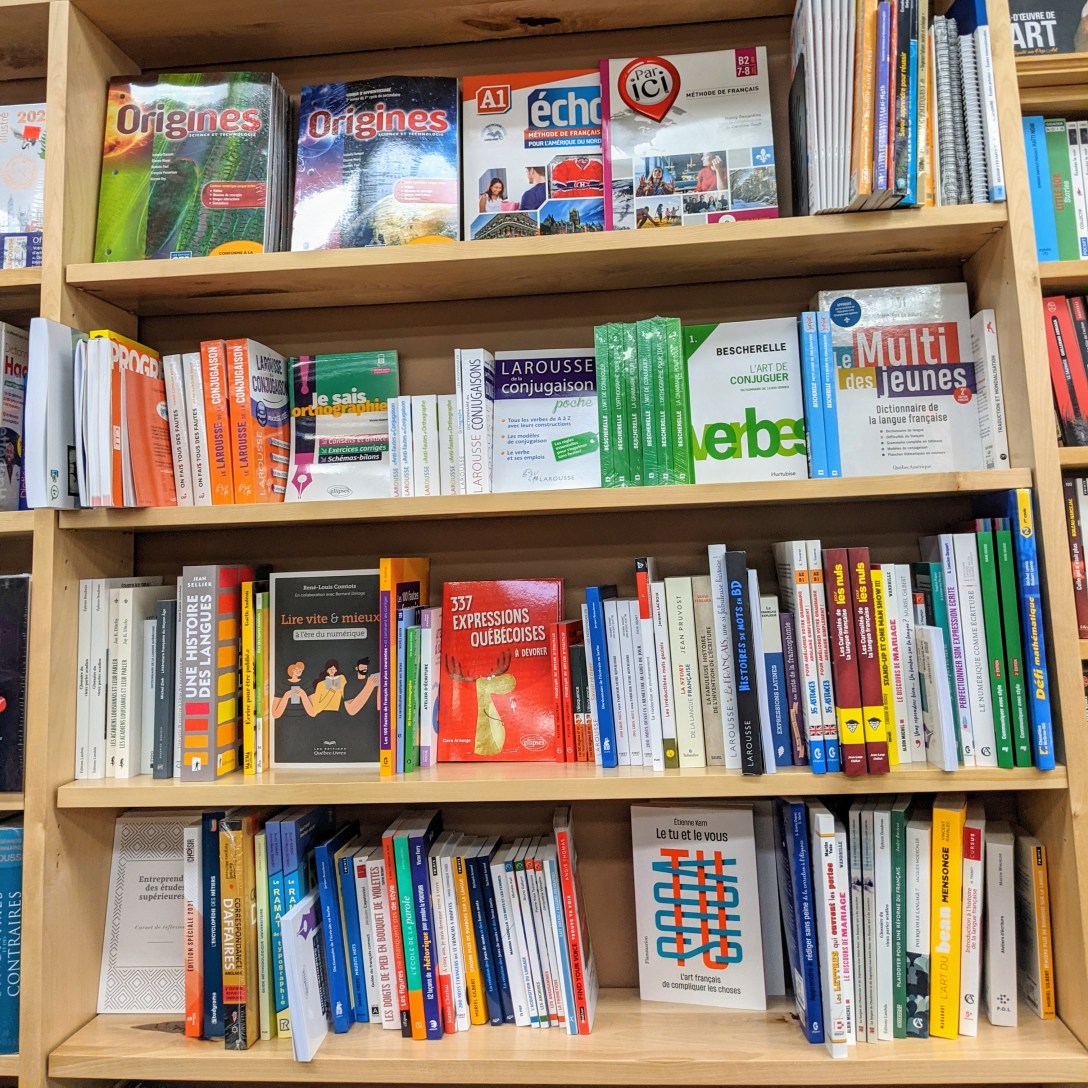
This month’s image is, finally, inside a new bookshop again! This is from Librairie l’Alphabet in Rimouski, admittedly definitely a linguistics section that overlaps considerably with “reference” but containing a few French-language books I hadn’t seen before.
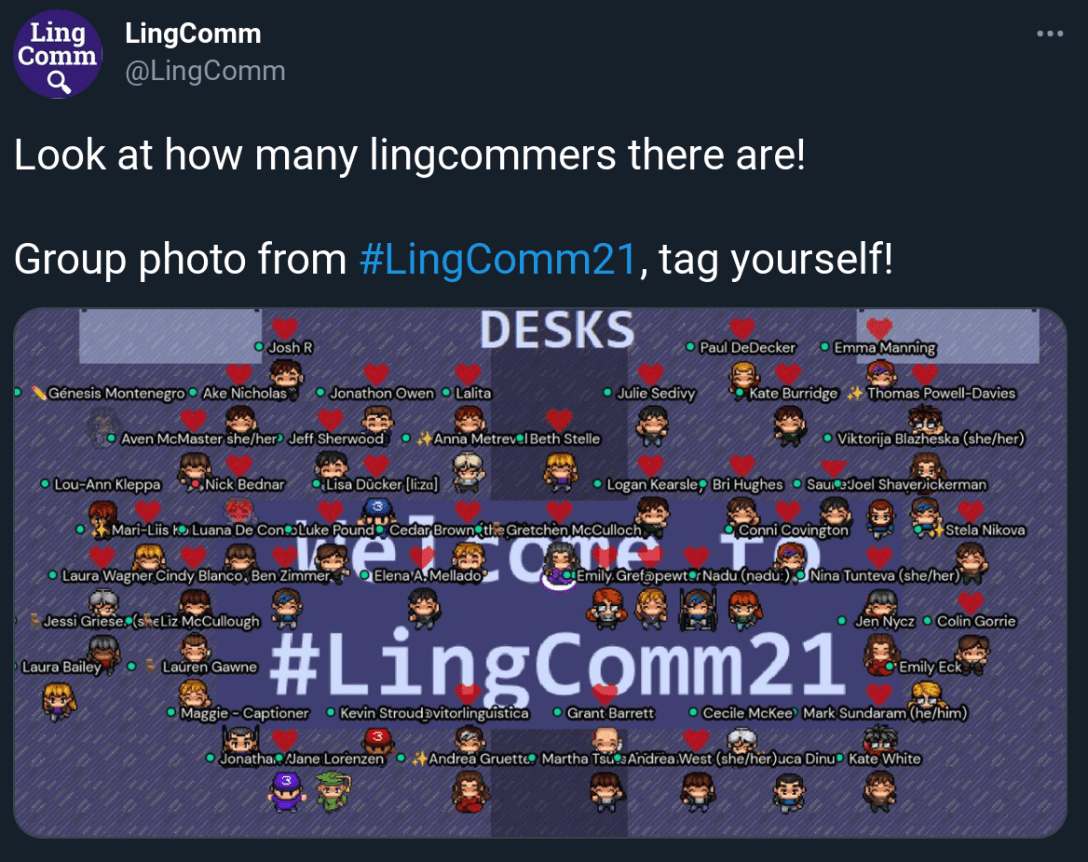
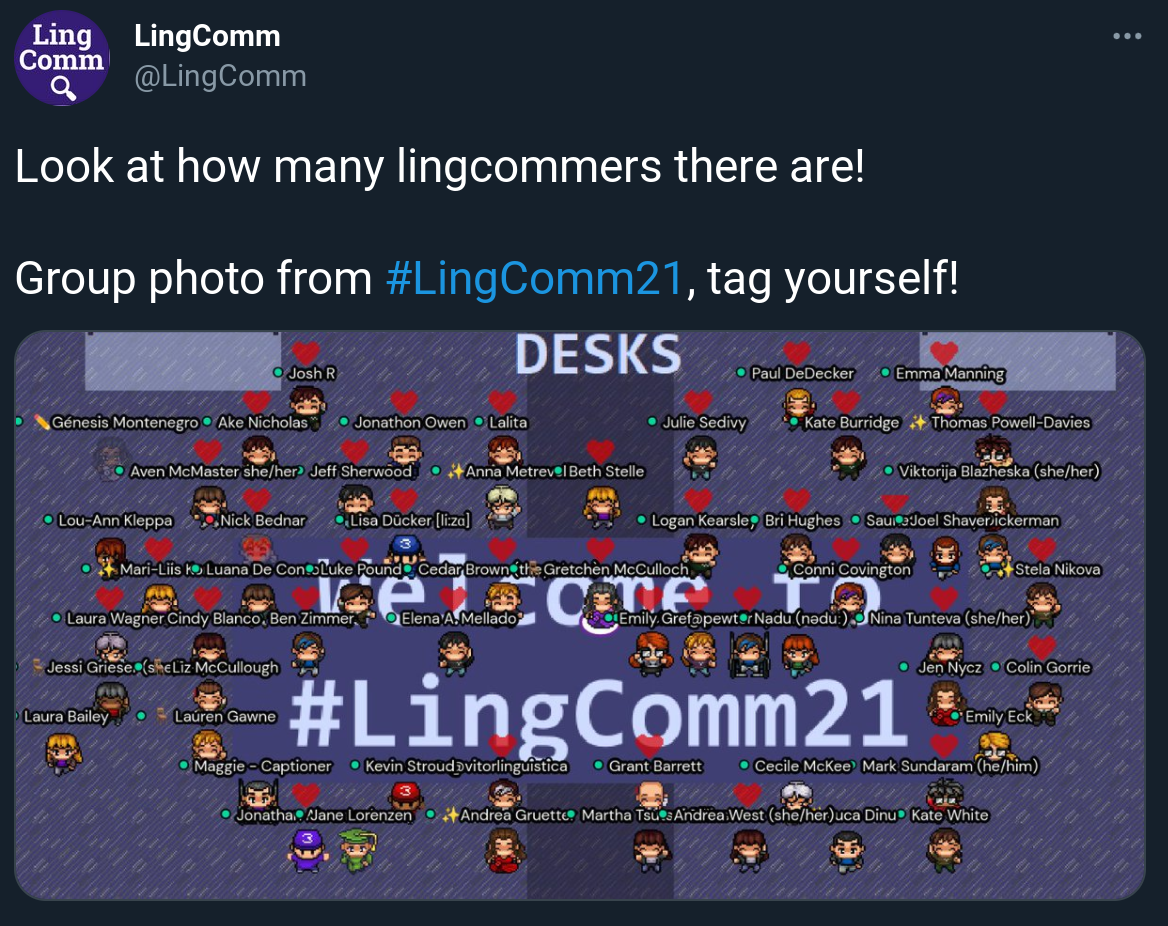
In the aftermath of #LingComm21, we did a couple tours of the custom Gather space that we made for the conference. The tours are finished now, but if you want to see people’s screencaps of the parts of the space and the conference that they found memorable, you can check the photos tab of the #LingComm21 hashtag.
In appfreciation opf pfinally being pfurnished with the Pfizer vaccine I will be pfroducing all opf my voiceless bilabial stopfs and pfricatives as apffricates pfor the next pfortnight.
No pfurther comments.
— Gretchen McCulloch @gretchenmcc.bsky.social (@GretchenAMcC) May 12, 2021
(See the thread for further suggestions on how you can adapt your speaking style if you received a vaccine from a different manufacturer!)
In appfreciation opf pfinally being pfurnished with the Pfizer vaccine I will be pfroducing all opf my voiceless bilabial stopfs and pfricatives as apffricates pfor the next pfortnight.
We finally started going out of lockdown here this month, so while I haven’t yet managed any new bookshop or travel photos, I did at least get to have a drink outside after the sun went down.
We did a liveshow for my podcast, Lingthusiasm! Here’s a fun thread that I did about backchannels while we were getting ready for the show. If you’ve now realized that you want to belatedly watch the liveshow, here’s the archive link (for patrons, as encouraging people to become patrons is what helps us keep the show running).
Here's a few backchannels to start us off…
oh really? wow tsk-tsk yikes gotcha yup, yup mh-mhm that's great oh my god I know right
— Gretchen McCulloch @gretchenmcc.bsky.social (@GretchenAMcC) April 24, 2021
I also moderated a panel for the European Chapter of the Association for Computational Linguistics (EACL) on NLP Applications for Crisis Management and Emergency Situations.
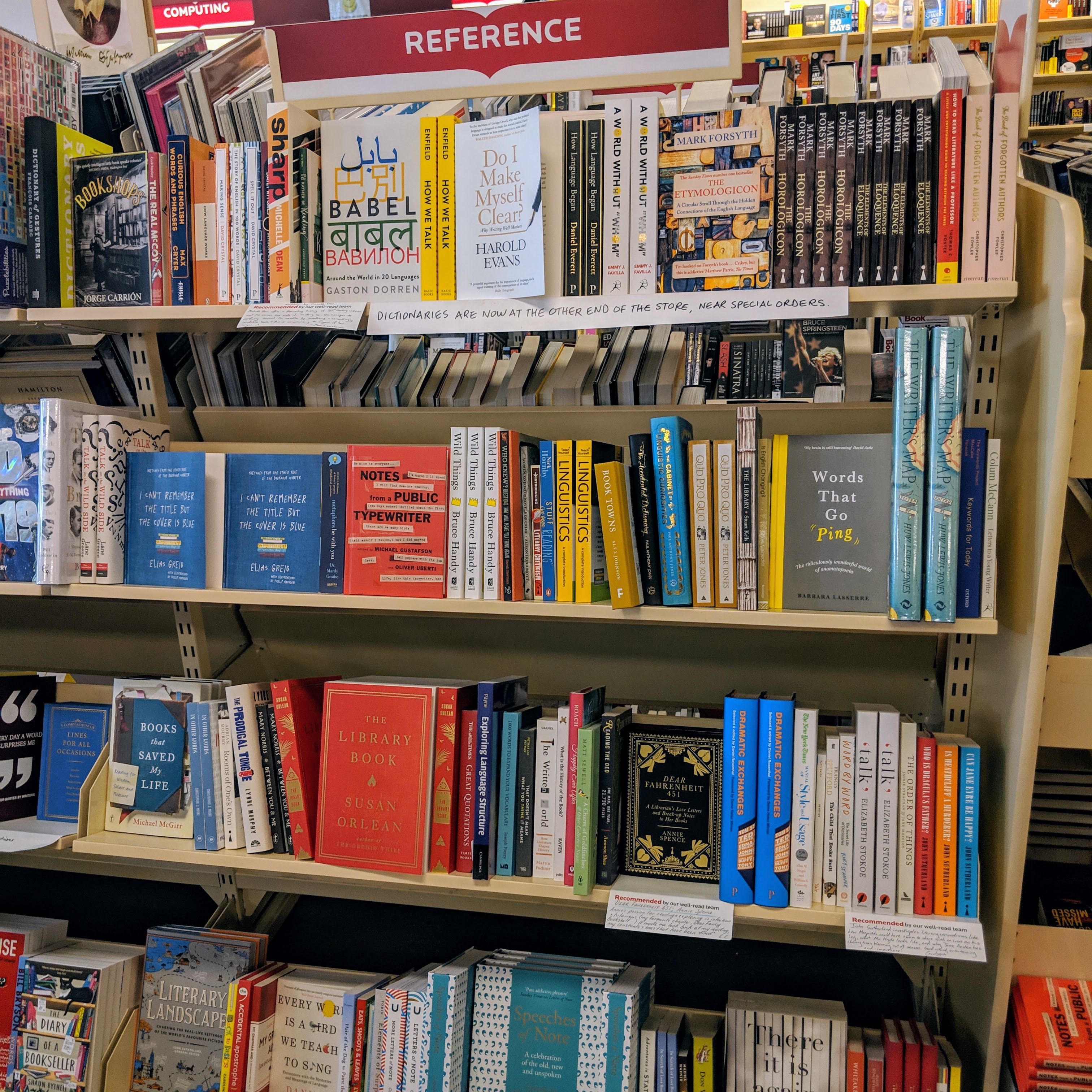
This month’s photo, since I yet again didn’t go anywhere, is a throwback photo from ReadeBook, a bookshop in Adelaide, from when I was in Australia in 2018.
This month, I announced LingComm21, the first International Conference on Linguistics Communication, and LingFest, a fringe-festival-style coordination of independently organized public linguistics events, together with an excellent organizing committee consisting of Lauren Gawne, Jessi Grieser, Laura Bailey, and Liz McCullough (different spelling, no relation!), both to take place in April 2021.
I also may or may not have been in another xkcd comic, this time about the Tower of Babel. (I am choosing to consider it a representation of curly-haired linguists everywhere.)
This month’s featured image is from xkcd. I have to say, I’m severely tempted to screencap that exultant curly-haired linguist as a new profile picture.
I went to the American Dialect Society’s annual Word of the Year vote, which is normally in person in early January at the annual meeting of the Linguistic Society of America, but this year as both have moved online, we were able to have the WotY vote at the end of December instead. A bit weird, but still nice to see familiar faces in the chat! The winner was, surprising no one at all, “covid”, and you can see the longer (and in my mind, more interesting) list of nominees in each category here.
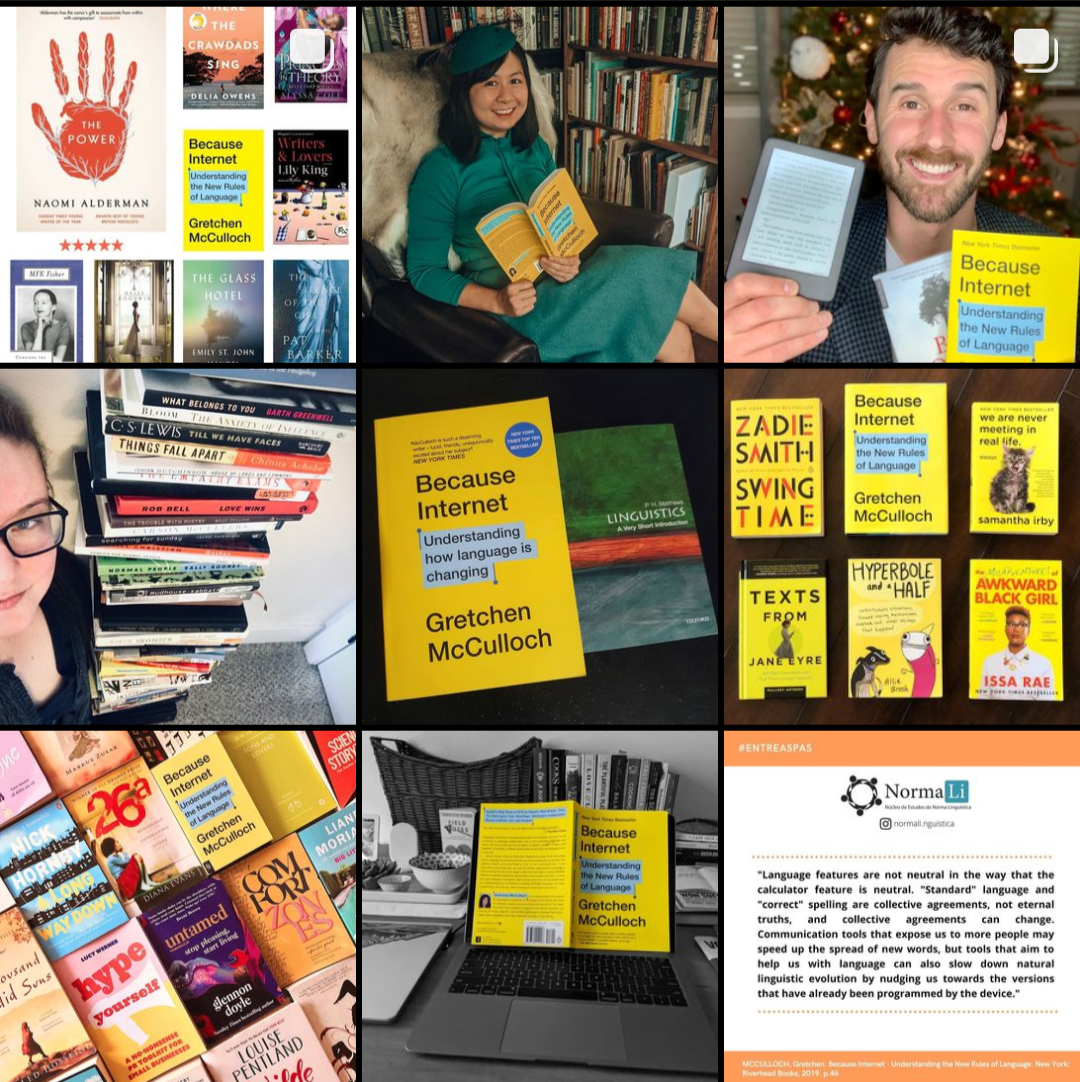
Lots of people seem to have received copies of Because Internet for Christmas this year, as it’s now in paperback, and have been tagging me in them on twitter and instagram, which is lovely! Here are some of them:
I wrote an article for Wired this month summing up the results of my experiments in having more fluid conversational groupings (popularly known as “parties”) online.
The Zoom-birthday-party-slash-quiz-show is not terrible, and it is better than nothing—not to mention far better than hosting a Fun Party for Viral Particles in your friends’ respiratory tracts. But this birthday-board-meeting simply doesn’t feel like a party. (I’d hereby like to apologize to my friends who’ve hosted said Zoom gatherings. No really, please invite me back next year, it’s the medium that’s at fault!) One possible solution is to embrace the necessary structure of large Zoom events, and organize a more formal type of fun, like book clubs and game nights and powerpoint karaoke and show-and-tell events.
But, internet help me, I was still determined to have an actual virtual party. Which raises the question: If getting a bunch of people together on a video call doesn’t feel like a party, then what does?
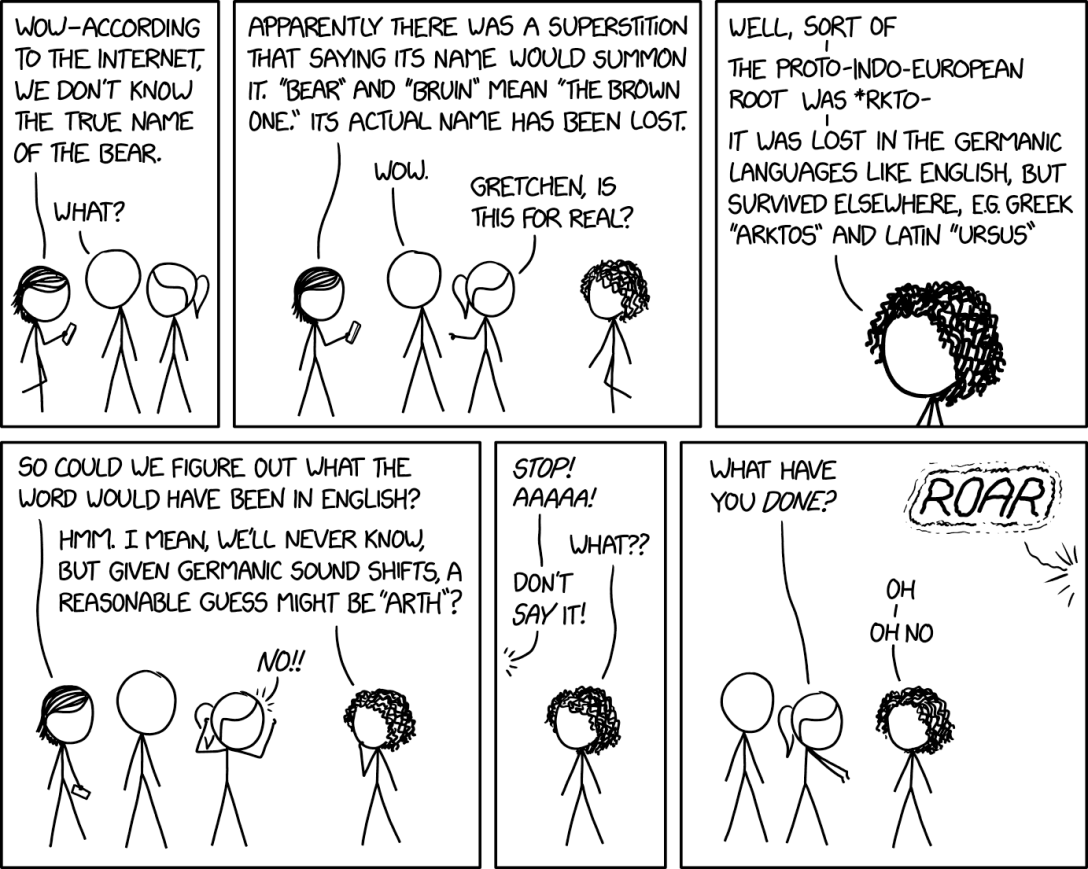
I also made a cameo in an xkcd comic. (Possibly twice, if you interpret this one as a subtweet.) I would like to thank everyone for their concern, but it is actually very comfortable here in the stomach of the Eldritch Spirit of the Brown One and I am getting some very interesting fieldwork done with this ursine speaker of Proto-Germanic so please do not be alarmed.
I did a virtual discussion event with Maria Dahvana Headley (translator of the new “bro” Beowulf edition) and Alena Smith (creator of the show Dickinson) about translation and the juxtaposition of historical texts with modern language styles. It was part of Predictive Text, a new series I’m doing with Slate’s Future Tense, and the archive video is online.
A few more Crash Course Linguistics episodes went up this month (we’re taking a few weeks off this month and next for assorted holidays this time of year).
I also read and greatly enjoyed the linguistic aspects of A Memory Called Empire, which includes poetic descriptions of fifteen syllable verbs and a very neat naming system loosely inspired by the Aztecs. More tweets to come when I eventually get my hands on a paper copy, read it now so you can follow along even better!
I had a very fun time doing this interview on Smart Podcast, Trashy Books this month, talking about the cheese plate as social technology, various language aspects of books I’ve read recently, and of course your ever-present Internet Linguistics Content. Here’s a quote:
Gretchen: So the interesting linguistic fact about Tooth and Claw is, I happen to know Jo Walton and she was telling me the story about the Japanese translation for Tooth and Claw. There’s a linguistic feature in Japanese where you have, like, categories for different types of entities in the world, and there’s one for humans and there’s one for monsters, and what the Japanese translator approached her for permission to do was, can I use the human category, this linguistic thing, for the dragons in this book, and for these other people, who are implicitly humans, but they’re external to the society – can I use the monster descriptor for them?
Sarah: [Gasps] Ohhh! Oh my.
Gretchen: [Laughs] And, and Jo was obviously like, oh my God, of course you can! I would have done this in English if I’d had the ability!
The Crash Course Linguistics videos (10-12 minute videos about intro linguistics!) and their accompanying Mutual Intelligibility newsletters continued coming out this month, as the prophecy (er, scheduling calendar) foretold.
Planet Word, the language museum in Washington DC that I’m on the Advisory Board for and have been watching the progress of with interest for several years, finally opened its doors! I watched the virtual ribbon cutting here (still online, if you’re curious) and I’m looking forward to eventually getting to see it in person one day.











 Gretchen McCulloch
You must be logged in to post a comment.