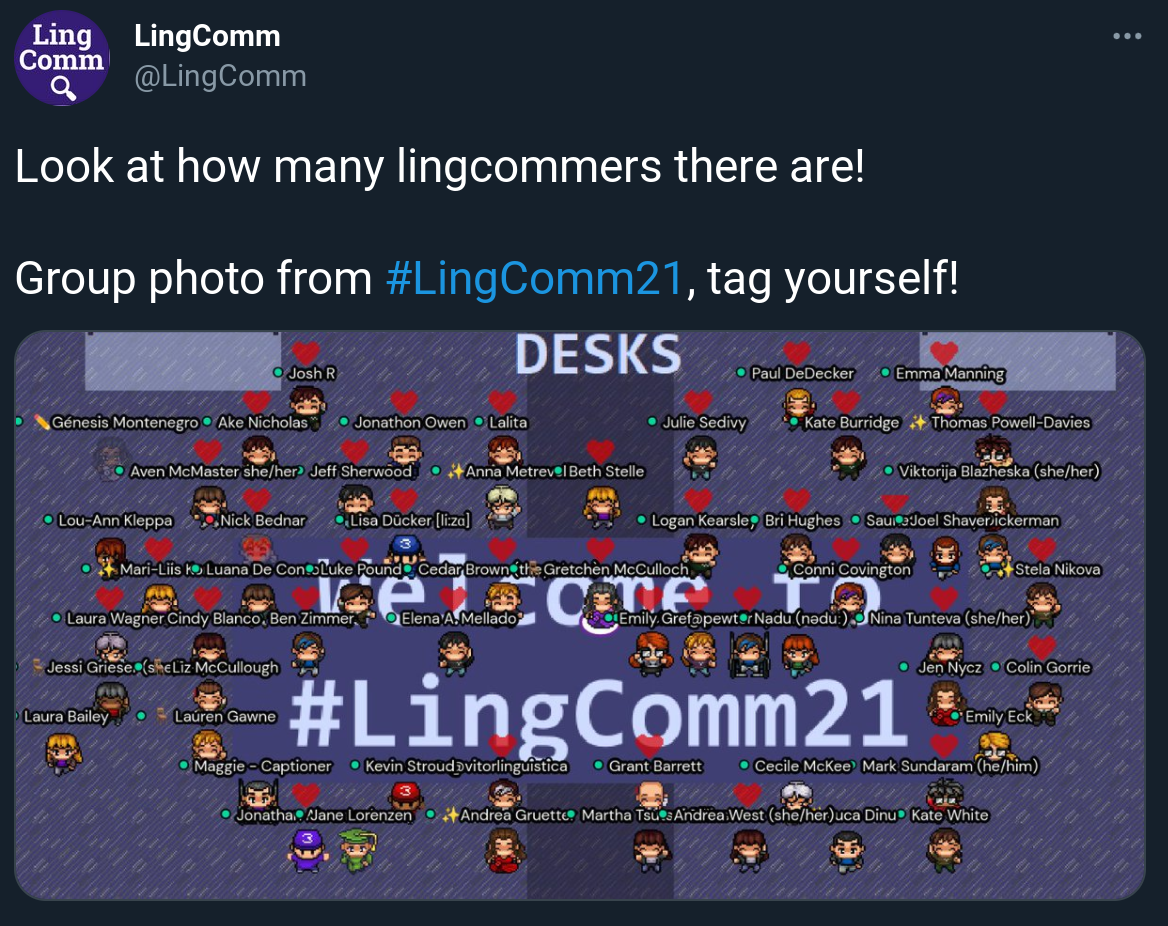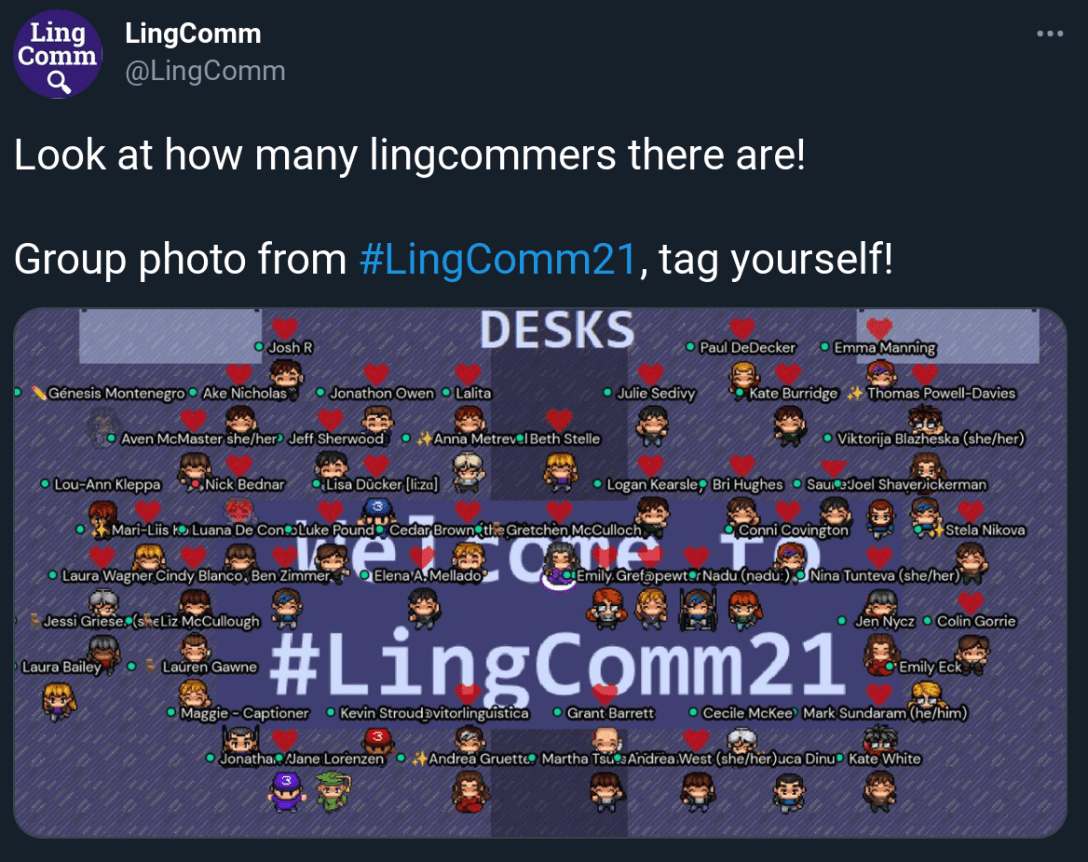
This month, I announced LingComm21, the first International Conference on Linguistics Communication, and LingFest, a fringe-festival-style coordination of independently organized public linguistics events, together with an excellent organizing committee consisting of Lauren Gawne, Jessi Grieser, Laura Bailey, and Liz McCullough (different spelling, no relation!), both to take place in April 2021.
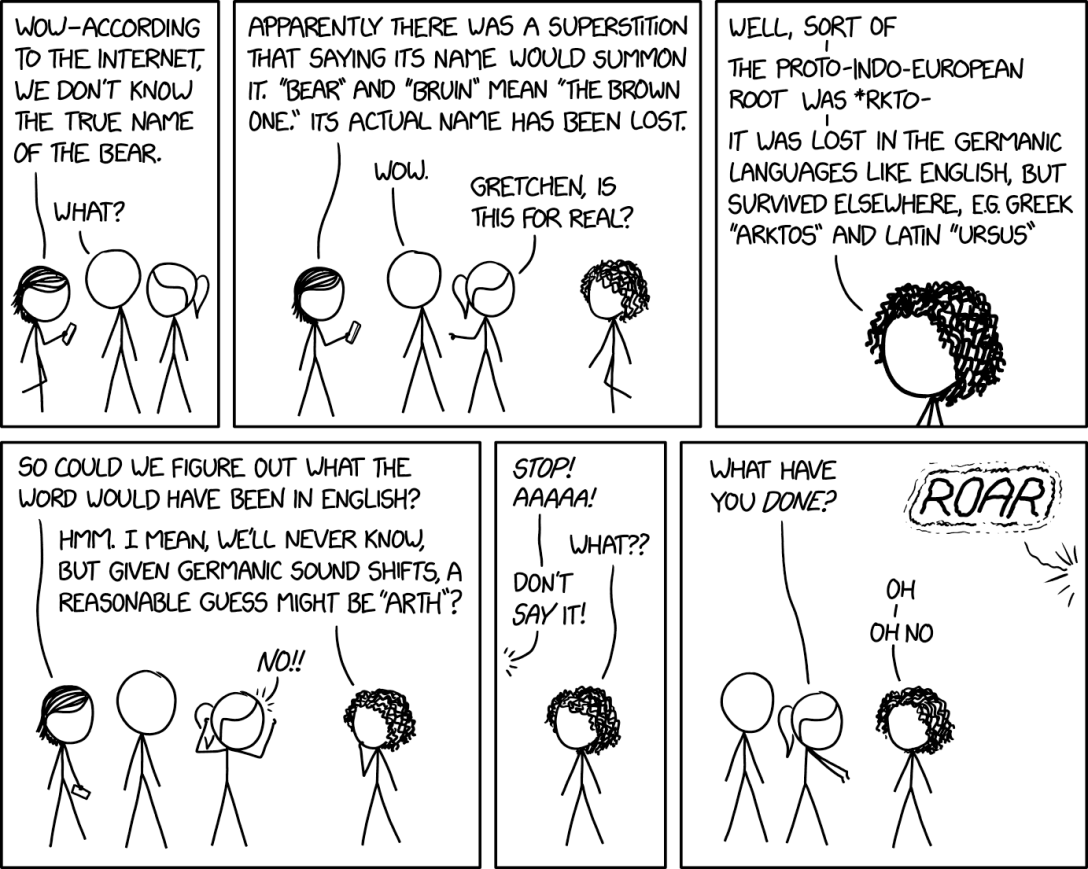
I also may or may not have been in another xkcd comic, this time about the Tower of Babel. (I am choosing to consider it a representation of curly-haired linguists everywhere.)
This month’s featured image is from xkcd. I have to say, I’m severely tempted to screencap that exultant curly-haired linguist as a new profile picture.
2020 wasn’t the year anyone was expecting, and I did much less travel than in previous years. But, while I was social distancing at home like everyone else, I did at least keep doing enjoyable linguistics things: Crash Course Linguistics videos went from early planning stages to nearly complete, Because Internet came out in paperback, and my podcast Lingthusiasm launched two other projects to contribute to the pop linguistics ecosystem: LingComm Grants and Mutual Intelligibility.
Because Internet
Because Internet, my book about internet language which hit the NYT bestseller list last year, came out in paperback this year! Links to get it in all of the formats, including how to get signed copies.
I worked on these 16 fun intro linguistics videos, 10-12 minutes long each, along with a large team, including linguists Lauren Gawne and Jessi Grieser, host Taylor Behnke, the animation team at Thought Cafe, and of course the production team at Crash Course itself. Writing the scripts ended up being our first lockdown project in the spring, and then reviewing the filmed and animated episodes for accuracy a second lockdown project in the fall. The final few videos will be appearing in early 2021 — you can watch them all at this playlist.
We started a Lingthusiasm Discord server, a place for people who are enthusiastic about linguistics to find each other and talk! And we released new schwa-themed merch with the (admittedly aspirational these days) slogan Never Stressed.
Lingthusiasm also sponsored two other projects this year: LingComm Grants and Mutual Intelligibility.
LingComm Grants – We gave out four $500 grants to up-and-coming linguistics communications projects. Thank you again to everyone who applied, and do check out the projects of the winners of the 2020 LingComm Grants.
Mutual Intelligibility – A newsletter to connect linguistics instructors with existing linguistics resources suitable for teaching online in a bite-sized, easy-to-digest fashion, with considerable help from the editing and organizational skills of Liz McCullough.
I went to the American Dialect Society’s annual Word of the Year vote, which is normally in person in early January at the annual meeting of the Linguistic Society of America, but this year as both have moved online, we were able to have the WotY vote at the end of December instead. A bit weird, but still nice to see familiar faces in the chat! The winner was, surprising no one at all, “covid”, and you can see the longer (and in my mind, more interesting) list of nominees in each category here.
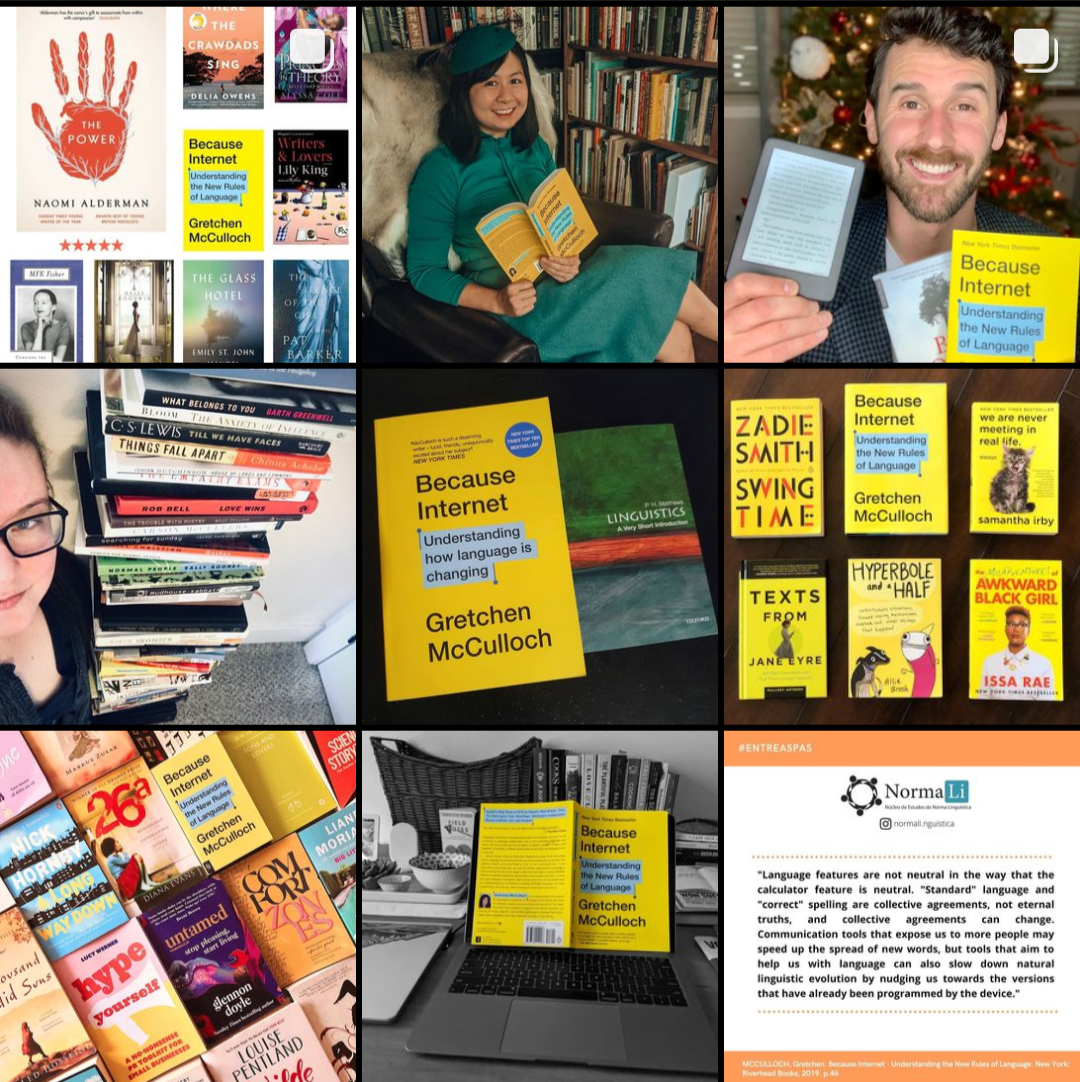
Lots of people seem to have received copies of Because Internet for Christmas this year, as it’s now in paperback, and have been tagging me in them on twitter and instagram, which is lovely! Here are some of them:
I wrote an article for Wired this month summing up the results of my experiments in having more fluid conversational groupings (popularly known as “parties”) online.
The Zoom-birthday-party-slash-quiz-show is not terrible, and it is better than nothing—not to mention far better than hosting a Fun Party for Viral Particles in your friends’ respiratory tracts. But this birthday-board-meeting simply doesn’t feel like a party. (I’d hereby like to apologize to my friends who’ve hosted said Zoom gatherings. No really, please invite me back next year, it’s the medium that’s at fault!) One possible solution is to embrace the necessary structure of large Zoom events, and organize a more formal type of fun, like book clubs and game nights and powerpoint karaoke and show-and-tell events.
But, internet help me, I was still determined to have an actual virtual party. Which raises the question: If getting a bunch of people together on a video call doesn’t feel like a party, then what does?
I also made a cameo in an xkcd comic. (Possibly twice, if you interpret this one as a subtweet.) I would like to thank everyone for their concern, but it is actually very comfortable here in the stomach of the Eldritch Spirit of the Brown One and I am getting some very interesting fieldwork done with this ursine speaker of Proto-Germanic so please do not be alarmed.
I did a virtual discussion event with Maria Dahvana Headley (translator of the new “bro” Beowulf edition) and Alena Smith (creator of the show Dickinson) about translation and the juxtaposition of historical texts with modern language styles. It was part of Predictive Text, a new series I’m doing with Slate’s Future Tense, and the archive video is online.
A few more Crash Course Linguistics episodes went up this month (we’re taking a few weeks off this month and next for assorted holidays this time of year).
I also read and greatly enjoyed the linguistic aspects of A Memory Called Empire, which includes poetic descriptions of fifteen syllable verbs and a very neat naming system loosely inspired by the Aztecs. More tweets to come when I eventually get my hands on a paper copy, read it now so you can follow along even better!
I had a very fun time doing this interview on Smart Podcast, Trashy Books this month, talking about the cheese plate as social technology, various language aspects of books I’ve read recently, and of course your ever-present Internet Linguistics Content. Here’s a quote:
Gretchen: So the interesting linguistic fact about Tooth and Claw is, I happen to know Jo Walton and she was telling me the story about the Japanese translation for Tooth and Claw. There’s a linguistic feature in Japanese where you have, like, categories for different types of entities in the world, and there’s one for humans and there’s one for monsters, and what the Japanese translator approached her for permission to do was, can I use the human category, this linguistic thing, for the dragons in this book, and for these other people, who are implicitly humans, but they’re external to the society – can I use the monster descriptor for them?
Sarah: [Gasps] Ohhh! Oh my.
Gretchen: [Laughs] And, and Jo was obviously like, oh my God, of course you can! I would have done this in English if I’d had the ability!
The Crash Course Linguistics videos (10-12 minute videos about intro linguistics!) and their accompanying Mutual Intelligibility newsletters continued coming out this month, as the prophecy (er, scheduling calendar) foretold.
Planet Word, the language museum in Washington DC that I’m on the Advisory Board for and have been watching the progress of with interest for several years, finally opened its doors! I watched the virtual ribbon cutting here (still online, if you’re curious) and I’m looking forward to eventually getting to see it in person one day.
Crash Course Linguistics videos started coming out this month!
This is a project I’ve been working on all year along with many excellent people, and I’m excited that the videos are finally getting to be seen, especially in a year when so much education has moved online. Stay tuned for all 16 of these 10-12 minute intro linguistics videos on Fridays until early 2021, except some holiday Fridays.
We’re also putting out accompanying issues of Mutual Intelligibility with each newsletter, thanks to Liz McCullough, featuring other resources and activities from around the internet, including practice problems (often from the linguistics olympiads).
I was on a Linguistics in the Pub panel about linguistics podcasting, along with my cohost Lauren Gawne (moderator) as well as Megan Figureoa and Carrie Gillon from The Vocal Fries and Daniel Midgley and Hedvig Skirgard from Because Language. You can rewatch it online here.
Because Internet, my book about internet language, is now available in paperback! Links to get it in all of the formats, including how to get signed copies.
Lauren and I also finally finished the bulk of the writing on the scripts for Crash Course Linguistics this month! We’ve been working on this intensively since March, not to mention the planning side in previous months. The Crash Course and Thought Cafe teams are now moving into exciting things that we’re less involved in, like filming and animating, although we’ll still be keeping an eye on technical accuracy as it goes along. I’m excited to share that the 16 ten-minute intro linguistics videos will be going up on the Crash Course youtube channel starting in September! If you want to get emails with each of the Crash Course Linguistics videos and suggested further reading/activities as they go up, you can sign up for the Mutual Intelligibility newsletter.
I did an edition of Mutual Intelligibility about teaching internet linguistics in honour of Because Internet coming out in paperback, along with several other great resources in the internet linguistics domain.
Media list:
Rotten Tomatoes – mention “WHY AIRPLANE!’S TITLE IS ONE OF THE CLASSIC COMEDY’S BEST JOKES” – 7/2
This month’s image is, of course, that snazzy paperback edition of Because Internet! The inside is pretty much the same, except that there are now two entire pages of fancy people saying nice things at the front, which you can see here, should you desire. But it’s also just been really gratifying over the past year to hear from so many regular internet people on social media finding yourselves in its pages. Thank you.
You, a person who’s currently on the English-speaking internet in The Year of The Pandemic, have definitely seen public service information about Covid-19. You’ve probably been unable to escape seeing quite a lot of it, both online and offline, from handwashing posters to social distancing tape to instructional videos for face covering.
But if we want to avoid a pandemic spreading to all the humans in the world, this information also has to reach all the humans of the world—and that means translating Covid PSAs into as many languages as possible, in ways that are accurate and culturally appropriate.
It’s easy to overlook how important language is for health if you’re on the English-speaking internet, where “is this headache actually something to worry about?” is only a quick Wikipedia article or WebMD search away. For over half of the world’s population, people can’t expect to Google their symptoms, nor even necessarily get a pamphlet from their doctor explaining their diagnosis, because it’s not available in a language they can understand. […]
According to a regularly updated list maintained by the Endangered Languages Project, Covid information from reputable sources (such as governments, nonprofits, and volunteer groups that clearly cite the sources of their health advice) has been created in over 500 languages and counting, including over 400 videos in more than 150 languages. A few of these projects are shorter, more standardized information in a larger variety of global languages, such as translating the five WHO guidelines into posters in more than 220 languages or translating the WHO’s mythbuster fact sheets into over 60 languages. But many of them, especially the ones in languages that aren’t as well represented on the global stage, are created by individual, local groups who feel a responsibility to a particular area, including governments, nonprofits, and volunteer translators with a little more education or internet access.
The Lingthusiasm main episode was about tracing languages back before recorded history (transcript) and the bonus episode was about doing linguistics with kids. We also released new nonmedical face masks, by popular request, in our IPA, tree diagram, and esoteric symbol prints. It’s a weird world where suddenly face masks are our most popular merch item, but we’re heartened to hear from people that it makes them feel a bit more cheerful about wearing a mask.
We also announced the winners of the 2020 LingComm Grants! We had over 75 applications from around the world and we’d like to thank all applicants for making the job of deciding extremely difficult! Stay tuned for further updates from these great projects:
This month’s image is one of the new IPA masks, which I now also own! They’re made out of a soft, jersey-like material and are pretty comfortable for short wear.
You must be logged in to post a comment.