April, May, & June 2025: Lauren writes a gesture book!

Back in 2017, when I was deep in the writing process for Because Internet, I was feeling stuck on the emoji chapter and Lauren Gawne, my cohost on the then-baby Lingthusiasm podcast (we were less than a year old!) offered to read the current draft. I’ll never forget her comment that led to me rewriting the whole chapter: “You realize this is all related to gesture, right?” 

Immediately, I wanted to dive into the gesture literature, which hadn’t been a part of either of my linguistics degrees. I asked Lauren where I should start. Was there some sort of short book or long survey article that put the rest of the literature into context so I could figure out which papers I needed to read more deeply and how they fit into relationship with each other? Lauren was like, “Read these parts of McNeill 1992, and then McNeill 2005, and then these three chapters of Kendon 2004…” — which was when I realised maybe I was going to have to solve this problem for myself. She ended up sending me her classroom slides and answering my questions herself, which led to a much-revised chapter in Because Internet and an academic paper together on emoji as gesture

Since then, we’ve done several Lingthusiasm episodes about various aspects of gesture, but that gap we noticed in 2017 has still been there: if someone wants a more in-depth entry point into the gesture literature, one that doesn’t assume they have any background in gesture specifically but does assume they want more details than we can fit into a podcast episode, where do they go? Especially since many people’s degrees, like mine, still don’t contain much about gesture, so a prof in linguistics, cognitive science, anthropology, and related fields might not know where to advise a student with a gesture-related project to start reading. 

That’s why Lauren has written a book! It’s called Gesture: A Slim Guide and it’s available now from Oxford University Press. The Slim Guides are part of an Oxford series in the genre known as academic crossover books: they’re much less technical than a typical academic monograph, but more in-depth than a trade book from a commercial publisher like Penguin. Here are some ways you can learn more about it: 

Events and media

I also did other things this quarter than just take credit for Lauren’s hard work! Quite a few things, in fact: three conferences…

…two guest appearances…

…and a few anniversaries:

Lingthusiasm

We had a few special lingnouncements this quarter. (Is that a word? It is now.)

You can now gift a Lingthusiasm membership to someone else. Depending on the tier you buy, this could get them access to bonus episodes and our Discord server, or even a spot with their favorite IPA character on the Lingthusiasm Supporter Wall of Fame.

We also celebrated our 100th bonus episode on Patreon. In celebration, we went back into the vault and revisited our very first bonus episode — with updated sweary commentary on Important Swearing Developments that have happened since 2017. We’ve made this extra bonus bonus version available to all patrons, free and paid, so feel free to send it to your friends!

Plus, we had a full quarter of three regular and three bonus episodes:

Posts

New favorite linguistic data

This quarter’s image is me, holding onto Lauren’s Gesture book with my own two hands (well, one hand had to hold the camera), since it exists in the real world! I hope it brings joy to students, researchers, and autodidacts! 

"Gesture: A slim guide" by Lauren Gawne, published by Oxford University Press

May 2023: Spanish Because Internet, True Biz, and Word Magic

This month, I announced that there’s going to be a Spanish-language edition of Because Internet coming at some point in 2024! Spanish has been the translation that people have requested from me the most and I’m delighted that Álex Herrero and the other folks at Pie de Página are making it happen.

The main episode of Lingthusiasm was Word Magic, in which we discuss the linguistics of the magical systems in several recent fantasy novels we like, including Babel by R.F. Kuang, Carry On by Rainbow Rowell, and the Scholomance series by Naomi Novik, as well as the ways that you can change the state of the real world with words using the linguistic concept of performatives, such as agreeing to contracts, placing bets, and naming. The bonus episode was about reviewing the results of our 2022 listener survey, including answers to questions on whether knowing about the kiki/bouba effect as a meme influences your results on the kiki/bouba test, synesthesia, and whether people pluralize “emoji” as “emoji” or “emojis”.

People often ask Lingthusiasm to recommend interesting books about linguistics that don’t assume prior knowledge of linguistics, so we’ve come up with a list of 12 books that we personally recommend, including both nonfiction and fiction books with linguistically interesting elements! Get this list of our top 12 linguistics books by signing up for Lingthusiasm’s free email list (which will otherwise send you an email once a month when there’s a new episode — this is something we’re doing to help continue to reach people amid the rising fragmentation of the social media ecosystem).

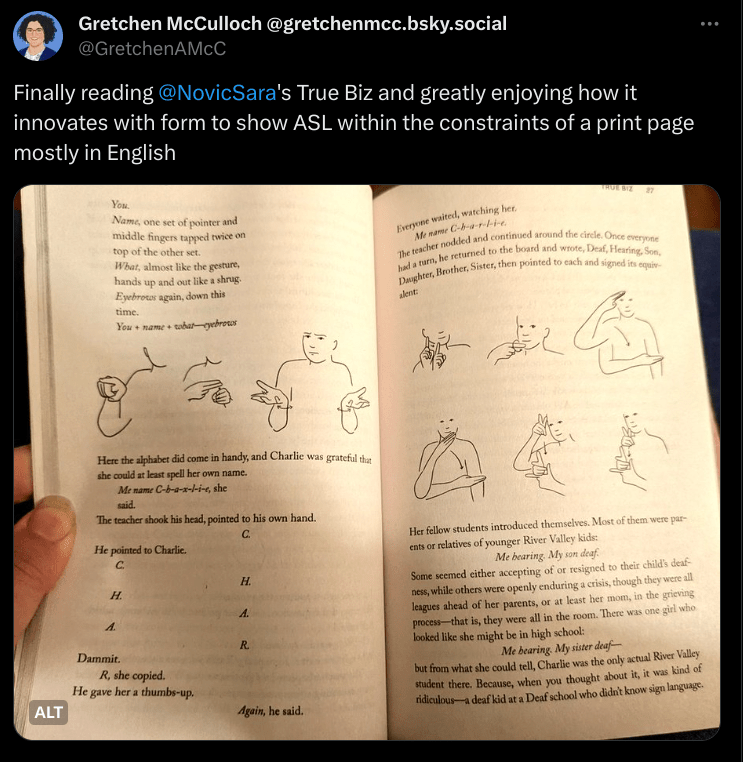
The most recent of those books, which I read this month, was True Biz by Sara Novic and made a thread with some linguistically interesting snippets from it. Definitely recommend!

Finally reading @NovicSara's True Biz and greatly enjoying how it innovates with form to show ASL within the constraints of a print page mostly in English. 
You. Name, one set of pointer and middle fingers tapped twice on top of the other set. What, almost like the gesture, hands up and out like a shrug. Eyebrows again, down this time. 
You + name + what—eyebrows.
(line drawing of person doing said signs on the page of a book) 
Here the alphabet did come in handy, and Charlie was grateful that she could at least spell her own name. 
Me name C-h-a-x-l-i-e, she said. 
The teacher shook his head, pointed to his own hand. C. He pointed to Charlie. C. H. A. R.
Dammit. 
R, she copied. 
He gave her a thumbs up. 
Again, he said.
Everyone waited, watching her. 
Me name C-h-a-r-l-i-e
The teacher nodded and continued around the circle. Once everyone had a turn, he returned to the board and wrote, Deaf, Hearing, Son, Daughter, Brother, Sister, then pointed to each and signed its equivalent. 
(line drawings of signs)
Her fellow students introduced themselves. Most of them were parents or relatives of younger River Valley kids. 
Me hearing. My son deaf.

Selected Tweets:

May 2022: 10th blogiversary and Japanese translation of Because Internet

In May, I hit my 10-year blogiversary on All Things Linguistic. I celebrated with two linkposts, one of the usual highlights from the past year and another, shorter post of more zoomed-out highlights from the past decade.

I participated for the second year running as a contestent in Webster’s War of the Words, a virtual game show fundraiser for the Noah Webster House.

Promotional graphic of Gretchen as a contestant for Webster's War of the Words virtual game show, including logo, headshot, and bio.

The main episode of Lingthusiasm was Tea and skyscrapers – When words get borrowed across languages. The bonus episode was What makes a swear word feel sweary? A &⩐#⦫& Liveshow, an edited recording of our online liveshow from April.

It’s delightfully surreal when an author whose books you’re enjoying also likes your book!

The #103papers project continued, in which I read one paper per language for the 103 languages identified as having papers published about them in the four major child language acquisition journals, based on a survey paper by Kidd&Garcia. Here’s a bit from a paper about Greenlandic showing that kids love morphology!

Selected tweets

Selected blog posts

This month I received my author copies of Because Internet in Japanese, translated by Toshio Chiba, which kept the bright yellow/blue cover. You can get it at Filmart or Amazon.co.jp.

Image of Japanese editions of BECAUSE INTERNET on top of blue fabroc covered in symbols. One copy is in its yellow dust jacket; one shows the blue cover inside the jacket.

December 2021: pigeon calls and a bookmas tree

This month, I did a virtual event with Argo Bookshop where I talked with Rosemary Mosco about her book, A Pocket Guide to Pigeon Watching (I am especially pleased with the “linguistic tie-in” portion of the event where I got Rosemary to teach me how to make various pigeon calls and the audience played along, very much vibes of intro phonetics class).

I did an interview on the Notion podcast with Devon Zuegel. Here’s a quote from that:

“If you see it as, okay, language is always a moving target, it’s a living thing that exists in the minds of living beings, and nothing about human life or human society, or human culture is exactly the same from one generation to the next, and language just comes along as part of that.”

Notion: Gretchen McCulloch talks about why we talk the way we do online

The main episode of Lingthusiasm was Where to get your English etymologies. The bonus episode was Linguistics puzzles for fun and olympiad glory.

I also went to WorldCon in Washington DC this December, which I didn’t join in time to be on any panels but I did meet several people who liked Because Internet and signed books for them!

Selected tweets:

Selected blog posts:

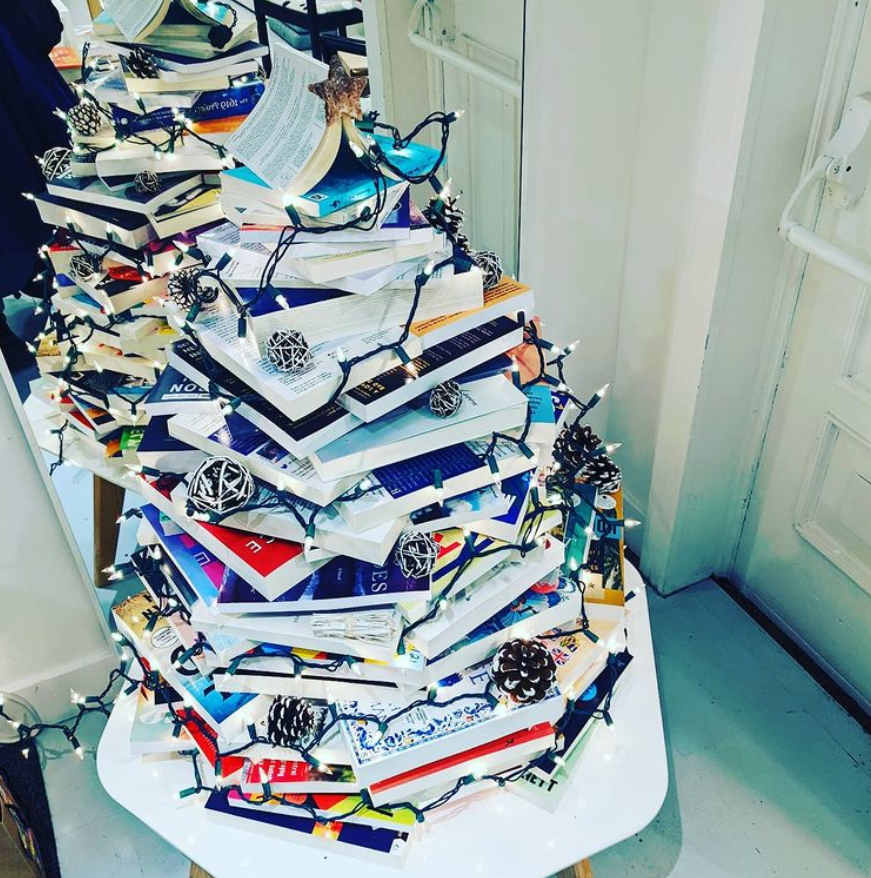
This month’s image is a charming bookmas tree from Etat de Style, a bookstore in Montreal.

Stacked book tower covered in holiday lights, pinecones, and ornaments.

November 2021: 5th anniversary of Lingthusiasm and a new website

It’s Lingthusiasm’s fifth anniversary! I’ve officially been making a podcast that’s enthusiastic about linguistics with my cohost Lauren Gawne and our linguistically enthusiastic team for five years now!

In celebration, we redid the Lingthusiasm website to make it work better on mobile and so it would be easier for both new and recurring listeners to find things like where to start, transcripts, bonus episodes, and more. It looks so good now thanks to the tremendous behind-the-scenes efforts of Liz McCullough (different spelling, no relation!) and the new icon art by Lucy Maddox!

I also wrote an incredibly long meta post about the website design process for Lingthusiasm, which…you probably already know if you’re the type of person who likes long meta posts about the implicit social functions of things in everyday life.

Podcasts have what’s often called a discoverability problem: it’s hard for prospective listeners who might like a particular podcast to know what’s out there.

I propose, however, that this problem is not unique to podcasts, and that we could understand the nature of this problem better by calling it opacity: the degree to which you’re able to try before you buy without committing a substantial chunk of time, money, or effort.

For example, books have a higher opacity than newspapers, despite both being text, because it’s easier to read through some news articles before buying a physical paper or online subscription. Books, even when you can leaf through the first few pages, are often designed to be a unified rather than a modular experience, so you don’t know before committing to it if the premise that seems intriguing on page 1 is going to pay off well a few chapters later. Even if you’re getting access to the book itself as a gift or a loan, the time that it takes to figure out whether you’re enjoying it is still rather daunting. 

How we made a better podcast website for Lingthusiasm

The main episode of Lingthusiasm was Cool things about scales and implicature. The bonus episode was Linguistic 〰️✨ i l l u s i o n s ✨〰️ (like optical illusions but for language!). We also sent out the Lingthusiastic sticker packs in the mail!

Also, we put some Lingthusiasm transcripts into a neural net and apparently the robots think I do linguist standup now.

Selected tweets:

Selected blog posts:

This month’s image is from the website redesign: our artist Lucy Maddox did this exceedingly cute sketch of me and Lauren as the icon for our new “about” page!

Colored silhouette line art of Gretchen and Lauren from Lingthusiasm website redesign.

October 2021: Unicode Conference!

I finally went to some physical conferences again this month!

More specifically, I went to California for two conferences, Sotheby’s Level Up in Los Angeles and the Unicode Conference in the San Francisco Bay Area, where I did a keynote called “Taking Playfulness Seriously – When character sets are used in unexpected ways” (slides here!).

Here’s a meme-ish slide I made for my Unicode talk, about how tech tools need to work with and support users’ desires to be playful with language and symbols rather than pretending that people aren’t going to repurpose official tools for entertainment purposes, because ignoring this technological “desire path” just ends up creating a bad experience for users.

A park with two paths through it. The paved path is labelled "stop using our serious unicode characters for your fun games" and then there's a dirt path that clearly a lot of people have used instead.

If you want to watch the Unicode talk, it’s not online as itself, but a few days later I did a talk on the same topic for Bay Area NLP, for which the video is here.

I also gave a virtual talk for some internal folks at YouTube, which is not online.

It was so great to see and meet a different assortment of people from my usual this month! I also got to do fun things like drop in on Spectator Books Oakland, which I happened to be walking by when I was in California so I signed their copy of Because Internet! (I think this signed edition has already been claimed by now, but they said they’d get more copies in later if you happen to be in the area. And as ever, you can always order signed Because Internets via Argo Bookshop in Montreal, if having a signed copy makes you excited enough to want to pay for shipping.)

The main episode of Lingthusiasm was Corpus linguistics and consent – Interview with Kat Gupta. The bonus episode was Lingwiki and linguistics on Wikipedia. We also saw a lot of people sign up for the limited-time Lingthusiastic sticker pack!

Selected tweets:

Selected blog posts:

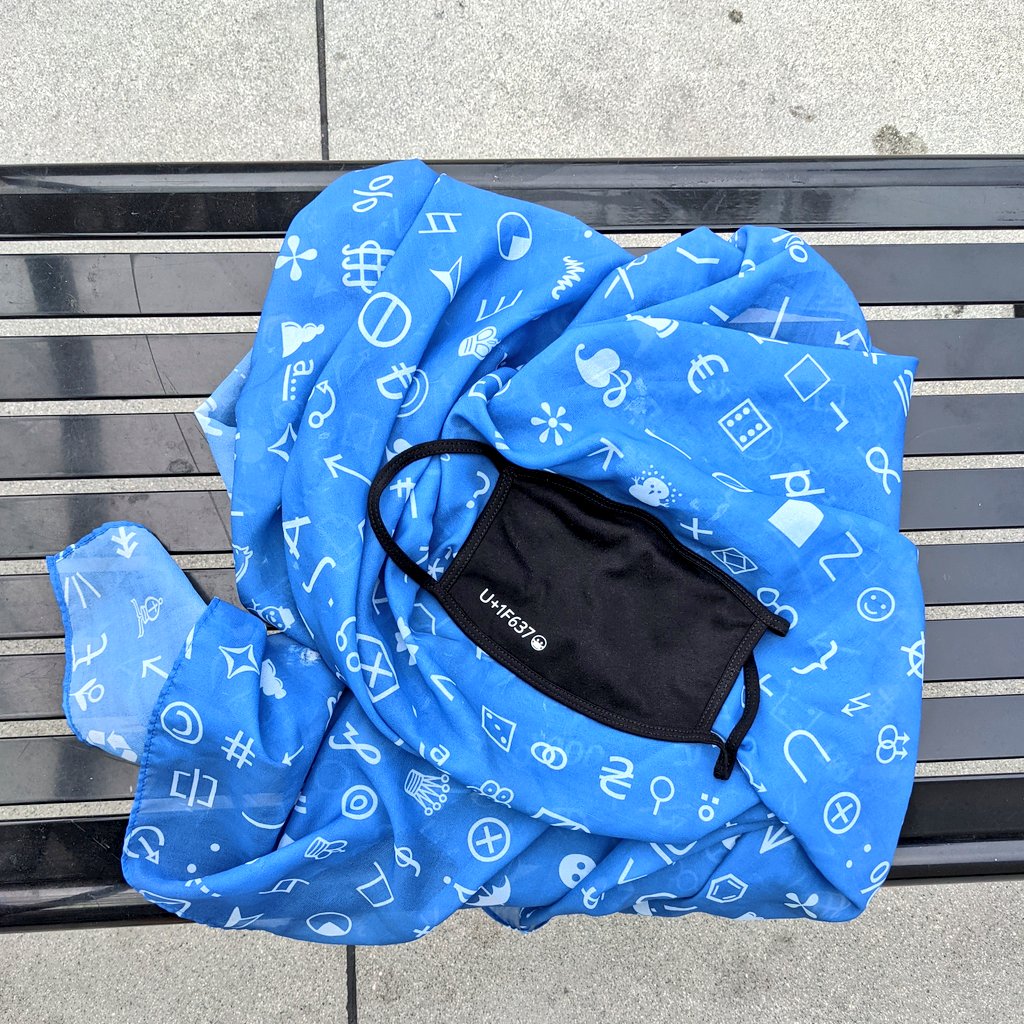
This month’s image is from the Unicode Conference, which put U+1F637 (the Unicode encoding for the masked face) on its masks instead of like, a logo. I just. I’m so pleased about this. Plus my esoteric symbols scarf which everyone at Unicode did appreciate as much as I’d been hoping for, thank you.

June 2021: texting periods, LingComm21 meta posts, and finally a new bookshelf!

I’m quoted in a New York Times Wordplay piece about ending texts with a period. Now that Because Internet has been out for two years, I can attest that people have successfully used it as a way of opening up cross-generational conversations about changing texting norms.

Gretchen McCulloch, the Canadian linguist and author of “Because Internet,” dedicated an entire chapter of her book to “typographical tone of voice,” which explores not only periods and ellipses as signifiers of tone, but also TYPING IN ALL CAPS, which is seen as yelling; using *asterisks* and ~tildes~ for emphasis; the all lowercase “minimalist typography,” which can indicate a kind of deadpan, sarcastic monotone; and, of course, tYp1nG l1k3 th!z. (This is called “l33t [elite] speak,” and while it was once a sincere and popular way of spicing up texts, it is now employed almost exclusively in irony.)

No More Periods When Texting. Period.

For anyone else who’s been trying to figure out how to do virtual events that are actually social, the organizing committee of LingComm21 has written a six-part series on how we designed the conference:

  1. Why virtual conferences are antisocial (but they don’t have to be)
  2. Designing online conferences for building community
  3. Scheduling online conferences for building community
  4. Hosting online conferences for building community
  5. Budgeting online conferences or events
  6. Planning accessible online conferences

I was a contestant on Webster’s War of the Words, a virtual quiz show fundraiser for the Noah Webster House, and also attended two online conferences, the Dictionary Society of North America and the annual meeting of the Canadian Linguistics Association.

The main episode of Lingthusiasm was an interview with Jade Abbott and Bonaventure Dossou from Masakhane, a grassroots initiative to make natural language processing tools in African languages, for Africans, by Africans. The bonus episode was about the linguistics of Pokemon names, looking at highly important Pokemonastics research like what makes a name sound cuddly or powerful. Also, Lingthusiasm now has a LinkedIn page, in case that’s a thing that’s been missing from your life. You’re welcome?

Selected tweets:

Selected blog posts:

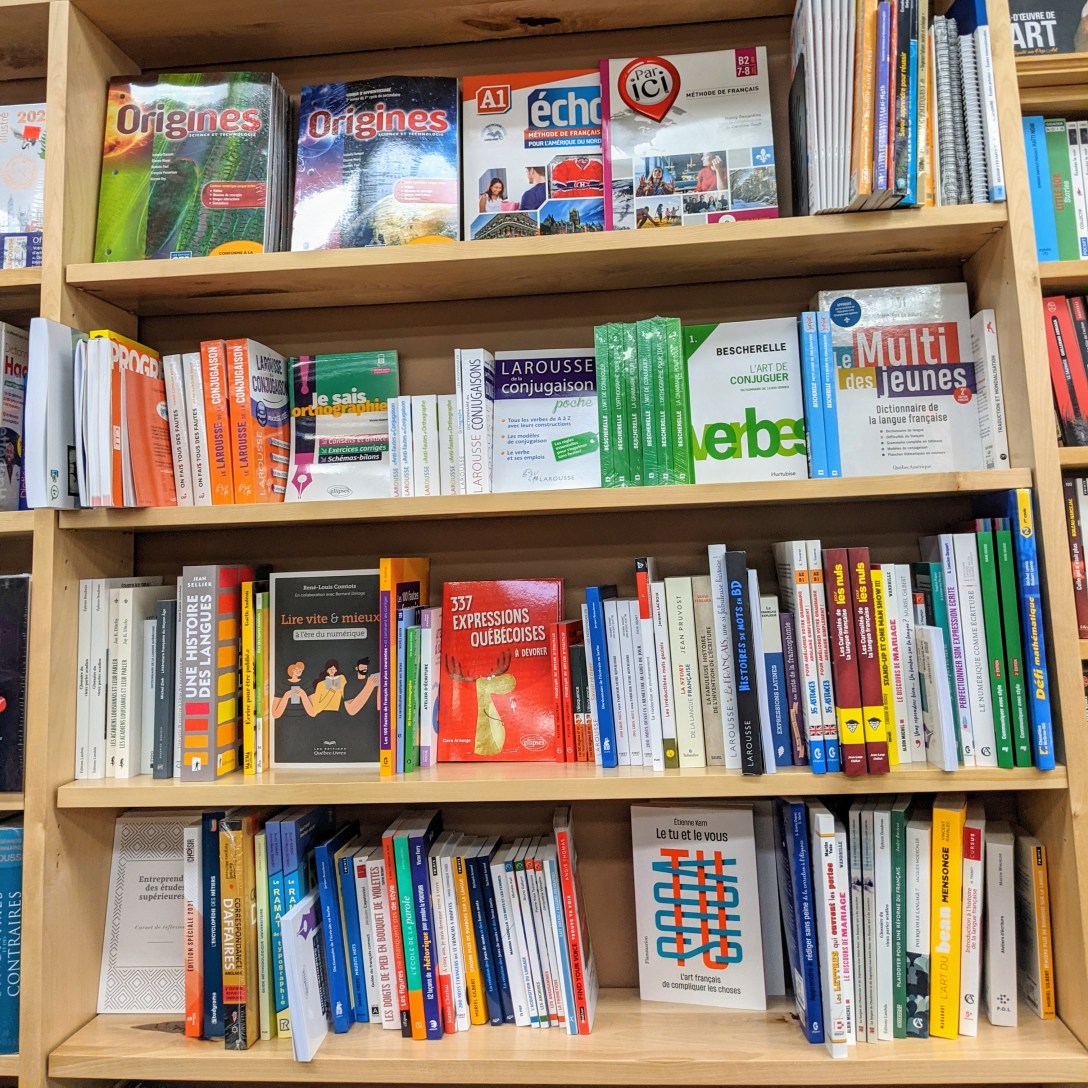
This month’s image is, finally, inside a new bookshop again! This is from Librairie l’Alphabet in Rimouski, admittedly definitely a linguistics section that overlaps considerably with “reference” but containing a few French-language books I hadn’t seen before.

A bookshelf containing linguistics and reference books in French, including 337 Expressions Quebecoises, Le tu et le vous, and Une Histoire des Languages.

May 2021: 9th blogiversary and pfinally pfizer’d

I hit my 9th blogiversary on All Things Linguistic! Hard to believe I’m coming up on almost an entire decade of blogging now, but at any rate, here’s the traditional blogiversary post with highlights of the past year. It feels like I compensated for the isolation of the whole global pandemic situation this past year by working on a lot of projects with people through the internet, most notably Crash Course Linguistics and the LingComm21 conference, plus of course ongoing projects like Lingthusiasm episodes and Because Internet coming out in paperback.

In the aftermath of #LingComm21, we did a couple tours of the custom Gather space that we made for the conference. The tours are finished now, but if you want to see people’s screencaps of the parts of the space and the conference that they found memorable, you can check the photos tab of the #LingComm21 hashtag.

The main episode of Lingthusiasm was about negation (transcript) — or shall I say, it wasn’t NOT about negation — and the bonus episode was about “uh-huh”, nodding, thumbs up, and other kinds of backchannelling (the edited audio-only version of our liveshow last month).

Pfinally, some pfantastic inpformation:

(See the thread for further suggestions on how you can adapt your speaking style if you received a vaccine from a different manufacturer!)

Media:

Selected tweets:

Selected blog posts:

We finally started going out of lockdown here this month, so while I haven’t yet managed any new bookshop or travel photos, I did at least get to have a drink outside after the sun went down.

January 2021: Linguistics, Language and the Public Award, end of Crash Course Linguistics, and a cappella song about Because Internet

I started off the year as usual at the Linguistic Society of America annual meeting, at which I was honoured to be the recipient of the Linguistics, Language, and the Public Award. I put up my acceptance speech as a blog post (and also a reminder that I wrote a series on how to have a career sorta like mine). Although this year was virtual and Word of the Year had been in December, it was still great to see everyone in the unofficial Gather space that I made for the conference (thanks to everyone who helped brainstorm ideas for what to call a fantasy linguistics coffeeshop). Also thanks to Christian Brickhouse and Lauren Collister for running the annual Wikipedia editathon with me, which we also did in Gather and it worked well there.

The final Crash Course Linguistics videos and accompanying resource posts on Mutual Intelligibility came out!

There’s also now a directory of all of the Mutual Intelligibility posts, a whole year’s worth of compiled resources, which we put up to conclude the project. Many thanks to everyone who read and contributed to the project, especially our editor Liz McCullough.

The main Lingthusiasm episode this month was about how writing is a technology (a companion to the final Crash Course episode), and the bonus was our 100th episode total, a “director’s cut” of excellent deleted scenes from previous episodes that we’d had to cut for time. It’s also the one-year anniversary of launching the Lingthusiasm patron Discord, which has since become a place that’s lively and active but not too much to keep up with, in my opinion an ideal state for an online community.

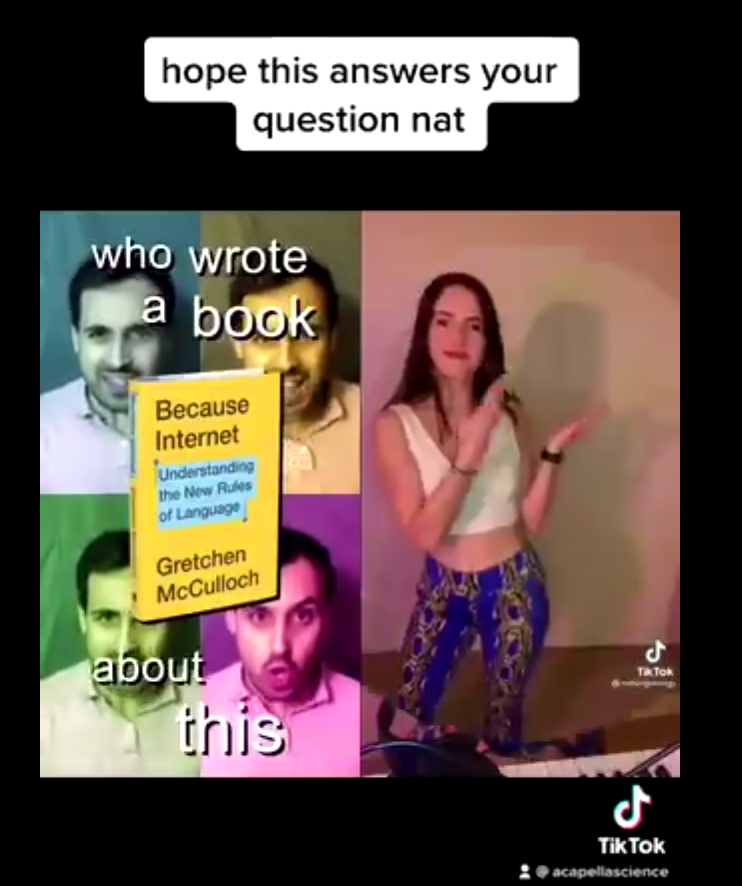
Someone made a musical tiktok video asking why adults over 40 use ellipsis so much, a lot of people tagged me in it so I tweeted about it, and then the delightful A Capella Science made an extremely catchy response video, also in music, with the answer:

Media:

Selected tweets:

Selected blog posts:

This month’s image is a screencap from the A Cappella Science video about Because Internet, which I still utterly cannot get over. Amazing.

2020 Year in Review

Crossposted from my blog, All Things Linguistic.

2020 wasn’t the year anyone was expecting, and I did much less travel than in previous years. But, while I was social distancing at home like everyone else, I did at least keep doing enjoyable linguistics things: Crash Course Linguistics videos went from early planning stages to nearly complete, Because Internet came out in paperback, and my podcast Lingthusiasm launched two other projects to contribute to the pop linguistics ecosystem: LingComm Grants and Mutual Intelligibility.

Because Internet

Because Internet, my book about internet language which hit the NYT bestseller list last year, came out in paperback this year! Links to get it in all of the formats, including how to get signed copies.

Here are some photos of the new paperback edition, same bright yellow cover, now with 10x more nice quotes from people. I also wrote an old-school reflexive blog post about what it’s like to hit the final milestone in a book journey that began in 2014.

Crash Course Linguistics

I worked on these 16 fun intro linguistics videos, 10-12 minutes long each, along with a large team, including linguists Lauren Gawne and Jessi Grieser, host Taylor Behnke, the animation team at Thought Cafe, and of course the production team at Crash Course itself. Writing the scripts ended up being our first lockdown project in the spring, and then reviewing the filmed and animated episodes for accuracy a second lockdown project in the fall. The final few videos will be appearing in early 2021 — you can watch them all at this playlist.

Other Writing

Wired Resident Linguist column:

Language Files videos, with Tom Scott and Molly Ruhl:

Lingthusiasm

My fourth year of producing a podcast that’s enthusiastic about linguistics with Lauren Gawne! Regular episodes:

  1. Making machines learn language – Interview with Janelle Shane
  2. This time it gets tense – the grammar of time
  3. What makes a language easy? It’s a hard question
  4. The grammar of singular they – Interview with Kirby Conrod
  5. Schwa, the most versatile English vowel
  6. Tracing languages back before recorded history
  7. Hey, no problem, bye! The social dance of phatics
  8. The happy fun big adjective episode
  9. Who you are in high school, linguistically speaking – Interview with Shivonne Gates
  10. How translators approach a text
  11. Climbing the sonority mountain from A to P
  12. Small talk, big deal

And 12 bonus episodes, with thanks to our patrons for keeping the show sustainable:

  1. What might English be like in a couple hundred years?
  2. Generating a Lingthusiasm episode using a neural net
  3. Teaching linguistics to yourself and other people
  4. When letters have colours and time is a braid – The linguistics of synesthesia
  5. A myriad of numbers – Counting systems across languages
  6. Doing linguistics with kids
  7. Tones, drums, and whistles – linguistics and music
  8. LingComm on a budget (plus the Lingthusiasm origin story)
  9. The quick brown pangram jumps over the lazy dog
  10. The most esteemed honorifics episode
  11. Crash Course Linguistics behind the scenes with Jessi Grieser
  12. Q&A with lexicographer Emily Brewster of Merriam-Webster

We started a Lingthusiasm Discord server, a place for people who are enthusiastic about linguistics to find each other and talk! And we released new schwa-themed merch with the (admittedly aspirational these days) slogan Never Stressed.

Lingthusiasm also sponsored two other projects this year: LingComm Grants and Mutual Intelligibility.

LingComm Grants – We gave out four $500 grants to up-and-coming linguistics communications projects. Thank you again to everyone who applied, and do check out the projects of the winners of the 2020 LingComm Grants.

Mutual Intelligibility – A newsletter to connect linguistics instructors with existing linguistics resources suitable for teaching online in a bite-sized, easy-to-digest fashion, with considerable help from the editing and organizational skills of Liz McCullough.

Conferences

I did do a tiny bit of travel this year, my usual January trip to the Linguistics Society of America annual meeting (this year in New Orleans) and February trips to Comma Con (I gave a keynote about the future of language online), Social Science FooCamp, PanLex at Long Now, the Internet Archive offices (all San Fransisco Bay Area) and the American Association for the Advancement of Science (AAAS) annual meeting (Seattle).

Virtual conferences and talks:

Media and internet crossovers

Selected media

Selected twitter threads

Books I enjoyed:

Helpful threads:

General fun:

Selected blog posts

I celebrated my eighth blogiversary on All Things Linguistic! Here are some of my favourite posts from this year:

Linguistics jobs and other advice:

Languages:

Linguist fun:

Missed out on previous years? Here are the summary posts from 201320142015201620172018, and 2019. If you’d like to get a much shorter monthly highlights newsletter via email, with all sorts of interesting internet linguistics news, you can sign up for that at gretchenmcc.substack.com.