This month, I went to Singapore! It’s the beginning of my multi-month trip that’ll also take me to Australia in November and New Zealand in December. I stayed with Suzy J Styles, gave a talk about linguistics communication at Nanyang Technical University, and met up with lots of lovely linguists who made sure that I tried many delicious Singaporean foods (thank you!). Also I got to hear people speaking Singlish, which is indeed as neat as everyone says it is.
Currently going through a cultural clash on "do you greet someone you're about to engage in a transaction with"
My French-influenced conditioning from Montreal is Absolutely Must Exchange Bonjours First
In Singapore a greeting is apparently a kinda baffling waste of time! https://t.co/zgegowFeyE
— Gretchen McCulloch @gretchenmcc.bsky.social (@GretchenAMcC) October 29, 2022
This month’s shenanigans involved finishing my series of twitter polls in order to determine the least confusing way (okay they’re all confusing, but) to spell the clipped form of “usual”.
We have a winner!
"uzhe" narrowly beats out close contenders "yoozh" and "uzh" for the least confusing possible clipped form for "usual"
Now if you need to write it, you can know if you're chosing the marginally least confusing option of an overall very confusing field pic.twitter.com/2ke8TPJVv3
— Gretchen McCulloch @gretchenmcc.bsky.social (@GretchenAMcC) October 7, 2022
This month’s image is a joke Halloween costume design that I made as part of a Halloween costume meme going around. But seriously if anyone does this for real please tell me, I want to know:
The main episode of Lingthusiasm was Episode 72: What If Linguistics, in which Randall Munroe of xkcd asked us his very good absurd hypothetical questions about linguistics. Here’s a completely real and normal photograph of what that looked like:
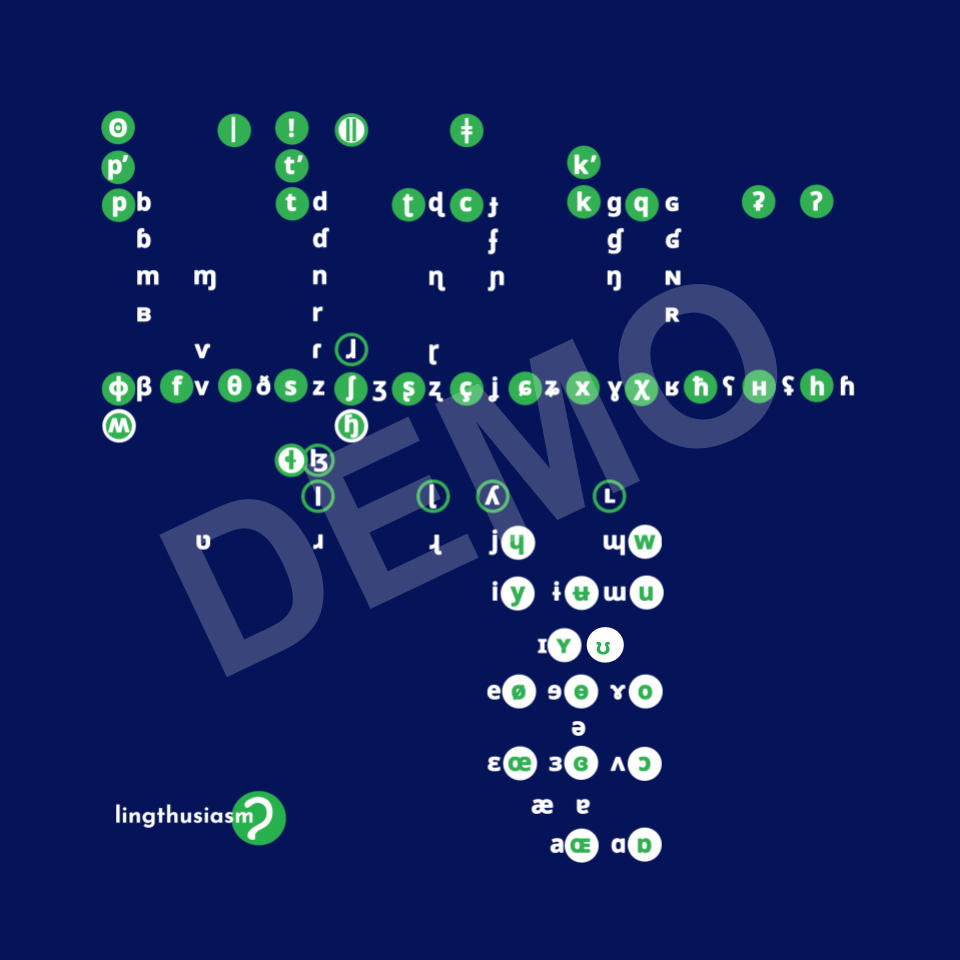
This month, we rethought the structure of the International Phonetic Alphabet.
Okay, let me explain.
The IPA is typically presented in a chart that shows the sounds of languages of the world arranged in two dimensions: from top to bottom as the mouth is more and more open and from left to right as the sound is produced from the front of the mouth to the back. It’s elegant, it’s informative, it’s a highly familiar reference diagram for linguists. So my cohost Lauren Gawne and I thought it would be nifty to create a more aesthetically attractive version of this already really neat technical diagram which is typically presented in rather boring technical greyscale, as practical-yet-elegant merch for our podcast, Lingthusiasm. Almost a year ago, we sent off an email to our resident artist, Lucy Maddox….and now, finally, here we are.
In the process, we’ve learned a whole lot about the history of the International Phonetic Alphabet (longer version in the thread below!)
Like here’s this absolutely jumbled IPA version from 1899 which is both upside-down and backwards (by modern standards) and also has the headings in phonetically transcribed German but tbh the columns are kinda sleek, I like it: pic.twitter.com/hLhAjFc11g
— Gretchen McCulloch @gretchenmcc.bsky.social (@GretchenAMcC) August 19, 2022
We’ve also realized that we have some questions about parts of the IPA chart layout that we’d been taking for granted. For example: why is there a third chart for the non-pulmonic consonants like clicks and implosives, when they have the same places of articulation as the main, pulmonic consonant chart and could surely just be rows there? And, wouldn’t it be sort of nifty to put the vowels back in the same chart as the consonants again, when they used to hang out there for decades? This started as an art project, but any good art also provokes…questions. Longer version and speculations in this blog post.
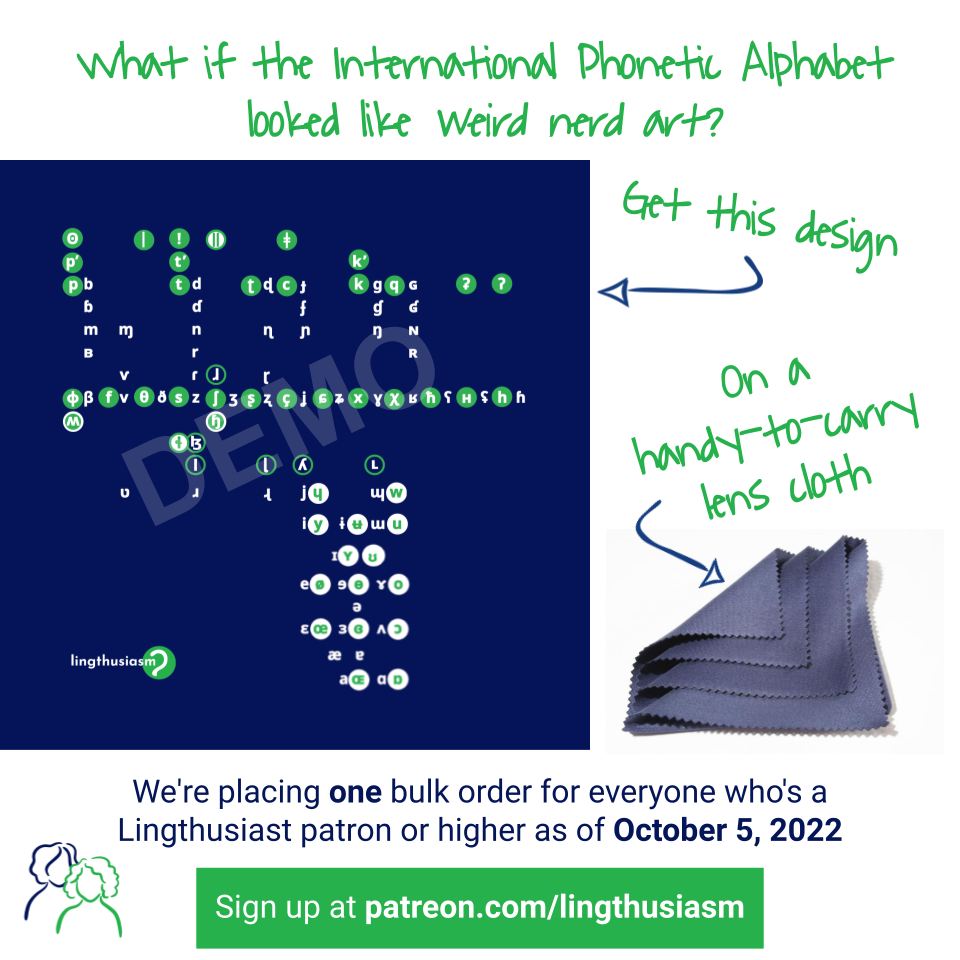
At any rate, here’s what it looks like when we put all of the symbols on the same chart!
We also thought, wouldn’t it be ideal if this eclectic nerd art IPA design came in a convenient format for carrying around with you? One that might even be useful for other purposes? So we’re getting it imprinted onto microfibre lens cloths (useful for cleaning glasses, sunglasses, camera lenses, and phone/computer screens). The thing is, lens cloth printing companies only take orders in the hundreds or preferably thousands, so we’ve decided to place one massive order for everyone who’s a patron at the Lingthusiast tier as of October 5th, 2022. This is our most popular tier, which also gets you our whole archive of monthly bonus episodes and access to the Lingthusiasm patron Discord server — if you’ve been on the fence about becoming a patron, now would be a really good time for it. (Higher tiers can get several lens cloths, if you want spares or to share with friends.)
Technically speaking, next month’s bonus episode is an interview with Lucy Maddox about the IPA chart redesign and being a linguist/artist but we’ve made that bonus episode free for a limited time until the IPA lens cloth special offer is closed on October 5th, so you should go listen to that now if you’re interested!
I also finished the #103papers project this month, reading 1 paper each for the 103 languages identified by Kidd&Garcia in the top 4 journals about child language acquisition. More on the big picture from what I learned later, but in the meantime, here’s a neat thing I learned:
A deaf child from age 2-5 who wasn't exposed to any signed languages produced home signs that were drawn from but more systematic and combinatorial than his hearing mother's gestures
— Gretchen McCulloch @gretchenmcc.bsky.social (@GretchenAMcC) August 14, 2022
LingComm, the International Conference on Linguistics Communication, has put out its participant/volunteer survey for the next conference in February 2023. I’m not organizing it this year, but this year’s committee is fantastic and I look forward to seeing there many linguists who do communication with broader audiences and journalists, podcasters, youtubers, and other communicators who do linguistics — if that’s you, do check it out!
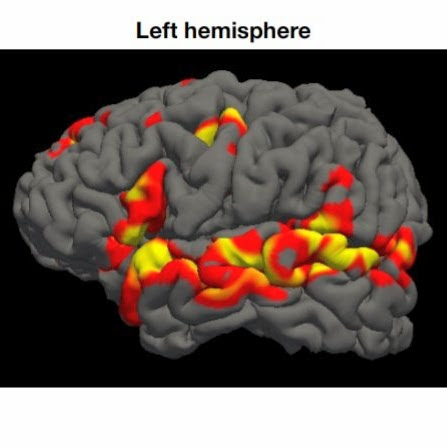
This month’s Lingthusiasm episodes were a special double feature from my trip to Boston to get my brain scanned and finally discover whether I am one of the extremely special left-handed people who has their language centres on the right or both sides of the brain instead of the left. Spoiler: I am not, mine is on the right, just like most other people, left- and right-handed.
The #103papers reading project is still (still!) going on, in which I finally got through the enormous Indo-European section and learned some things about languages like Lazuri:
Parents used more gestures (to show, offer, request) when speaking Lazuri (ancestral language) to their 15-48mo children than when speaking Turkish (dominant language), and kids gestured-to more spoke more Lazuri back
This month’s image is a picture of my brain doing language!! Okay, admittedly, it looks a lot like all of the other brain scans that people get, but this one’s mine!!!
This month I attended a local literary speculative fiction con, Scintillation, where I was on panels about swearing in science fiction and fantasy and the delightful Steerswoman books, as well as doing a dramatic reading from Ryan North’s Romeo and/or Juliet book.
Some linguists got very excited about a very cool linguistics paper by the late Anne Cutler, which I won’t spoil (because it really does have spoilers, but trust me you don’t need any particular linguistics background to get why it’s cool) and as a result we also managed to track down Anne Cutler’s Christmas Letter, which is mentioned in the paper. (The full twitter thread, linked to from below, is also worth reading afterwards.)
This is quite possibly the most brilliant linguistics paper I've ever read. https://t.co/PGP36oyCCl
I also spent the entire month in the Indo-European section of the #103papers reading project. (And then some – 39 Indo-European languages in this sample.) Here’s a paper about Italian with very charming examples:
Italian children w caregivers were secretly recorded in the toy section. 4 yos mostly expressed desire (Look! I want it!) whereas 6 yos started bargaining (aren't these lovely?) and 8 yos negotiated (mine is too small, how much is it)
This month’s picture is Because Internet hanging out at the staff picks section with some book friends at my local independent bookstore, Argo Bookshop! Argo’s owners were linguists in a previous life and it’s well worth a visit if you’re in Montreal.
This month, I started a new reading project! It’s inspired by a paper by Evan Kidd and Rowena Garcia that came out last year, and which surveys the languages represented by all of the papers published in the four main child language acquistion research journals. Kidd & Garcia find that these journals contain papers about 103 languages; while this number is small compared to the total number of languages in the world (over 7000) and even the number of languages typically found in other cross-linguistic studies (the language maps at WALS often report data from 400-1200 languages), it does make for a relatively manageable reading list.
So that’s what I’m doing: reading one paper per language from this list, and posting a screenshot of the abstract and a my own tweet-length summary in this thread on twitter. At the rate of one paper per day, not quite every day, it’ll probably take me about four months. I’ve been missing going to conferences and finding out what people are working on in an informal fashion, which is different from diving in the literature to try and find out something specific for a lingcomm project, so this is an attempt to “refill the well” a bit.
Ever since the Kidd&Garcia paper came out surveying which languages are represented in major child language journals, I've been thinking "huh, 103 languages…this sounds like a #100papers project"
We also announced the winners of the LingComm Grants, giving out a total of 5 Project Grants (including the Kirby Conrod Project Grant for projects related to gender and lingcomm) and 12 Startup Grants. You can see the full list of grantees here, and stay tuned for more about their exciting linguistics communication projects as they get to work on them in the coming months.
I set up a survey for anyone who’s been using Because Internet for teaching – put in what you’ve been doing and I’ll compile and share it with other instructors!
Do you tell students to read Because Internet? Would you like to help other instructors?
By popular request, I've made a quick survey about how people teach with Because Internet!
If we get enough responses I'll compile it into a helpful summary post!https://t.co/NxqialNqXv
I finally went to some physical conferences again this month!
More specifically, I went to California for two conferences, Sotheby’s Level Up in Los Angeles and the Unicode Conference in the San Francisco Bay Area, where I did a keynote called “Taking Playfulness Seriously – When character sets are used in unexpected ways” (slides here!).
I believe it is customary, when attending the Unicode Conference, to cosplay as your favourite Unicode characters pic.twitter.com/ocbdxY8gC6
Here’s a meme-ish slide I made for my Unicode talk, about how tech tools need to work with and support users’ desires to be playful with language and symbols rather than pretending that people aren’t going to repurpose official tools for entertainment purposes, because ignoring this technological “desire path” just ends up creating a bad experience for users.
If you want to watch the Unicode talk, it’s not online as itself, but a few days later I did a talk on the same topic for Bay Area NLP, for which the video is here.
I also gave a virtual talk for some internal folks at YouTube, which is not online.
It was so great to see and meet a different assortment of people from my usual this month! I also got to do fun things like drop in on Spectator Books Oakland, which I happened to be walking by when I was in California so I signed their copy of Because Internet! (I think this signed edition has already been claimed by now, but they said they’d get more copies in later if you happen to be in the area. And as ever, you can always order signed Because Internets via Argo Bookshop in Montreal, if having a signed copy makes you excited enough to want to pay for shipping.)
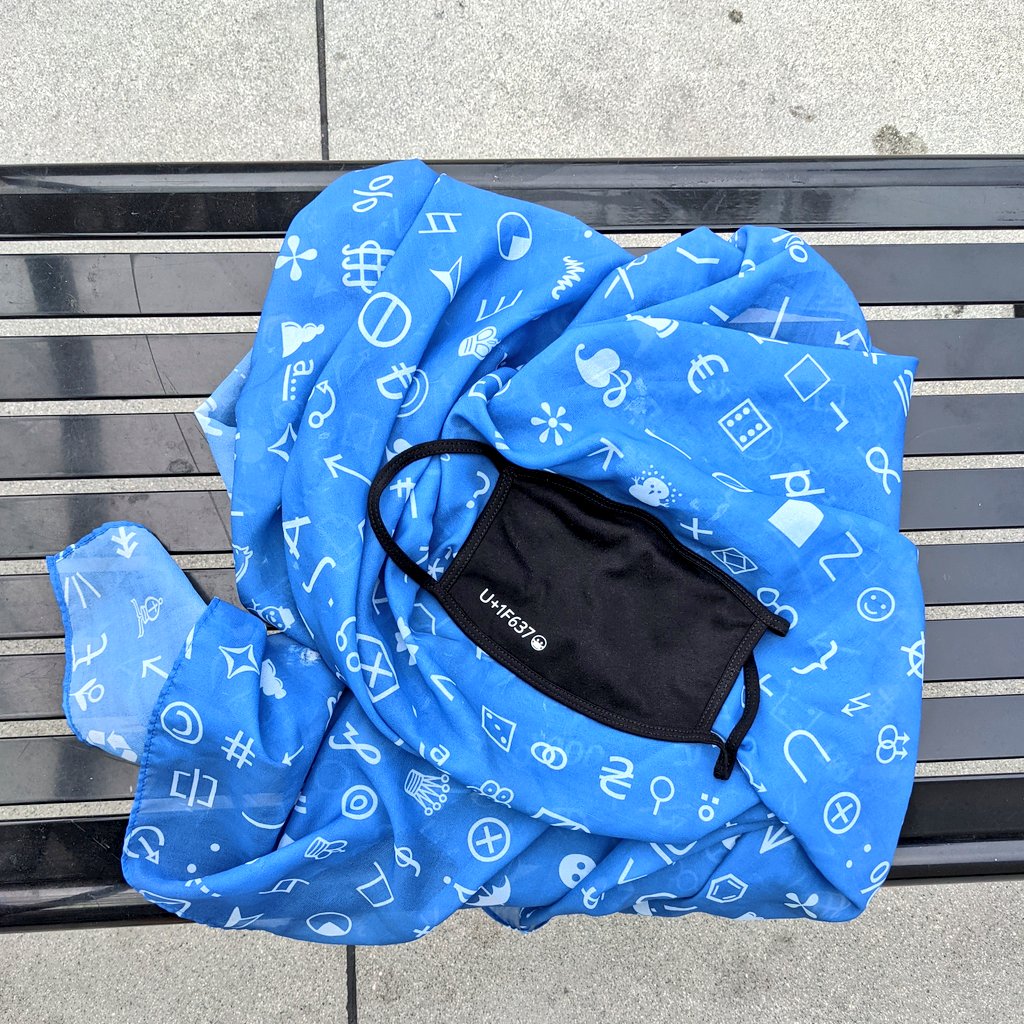
This month’s image is from the Unicode Conference, which put U+1F637 (the Unicode encoding for the masked face) on its masks instead of like, a logo. I just. I’m so pleased about this. Plus my esoteric symbols scarf which everyone at Unicode did appreciate as much as I’d been hoping for, thank you.
I did some back-to-school virtual university talks this month! I talked about The Internet is Making English Better at Yale with Claire Bowern and about Internet Linguistics and Memes as Internet Folklore with a student at the University of Oklahoma.











You must be logged in to post a comment.