July, August, & September 2025: ASL Camp and Arroba Lengua

This summer, I went to ASL camp! I spent a week at Bob Rumball Camp of the Deaf, in Parry Sound, Ontario, at their ASL Adult Immersion Summer Camp, voices off for 6 nights and 7 days! This was my first time doing any sort of language immersion camp in my various experiences learning languages, and I definitely see why people like them, I really felt liked I levelled up significantly in my signing with that much concentrated practice (and I slept very soundly in the dorm beds since my brain felt so full from learning). And I made friends and got to learn from a left-handed ASL teacher for the first time, which was helpful for me as a lefty!

Also, the Spanish-language translation of Because Internet was released. You can get Arroba Lengua — not a literal translation of the title, but Spanish Internet slangification with a similar vibe — from Piodepagina, Casadellibro, and other places Spanish-language books are sold (note that the ebook edition may be more readily available if you’re outside Europe). And for lots of juicy details about the translation process, see our Lingthusiasm bonus episode where Lauren Gawne and I interview Miguel Sánchez Ibáñez, the translator

More media milestones

Let’s start with the big news: The first Crash Course Linguistics video has hit a million views! If you want some fun 10 min linguistics videos to watch, here’s a great place to start.

In way smaller news, Because Internet is on one of Penguin Random House’s “credibility bookshelf” zoom backgrounds

And somewhere in between: Because Internet made an appearance in an episode of Words Unraveled. @efrex.bsky.social made a nice callout to my interview on Let’s Learn Everything. And Linguistic Discovery would like to remind you that the internet is encouraging, not ruining, writing

Lingthusiasm

We launched two new Lingthusiasm merch designs:

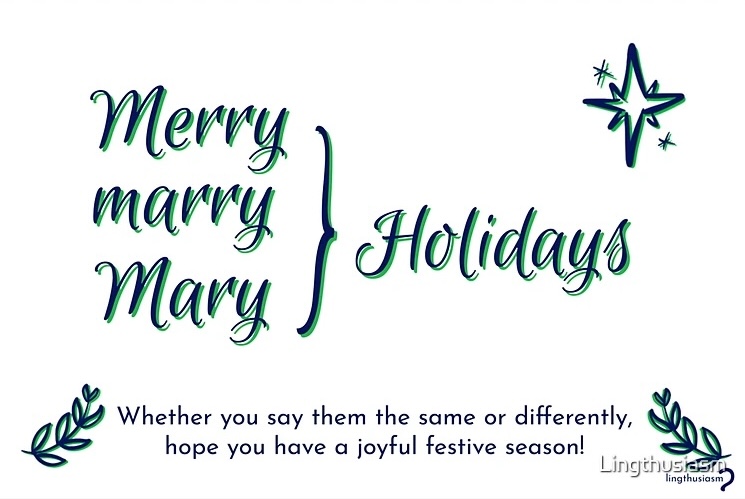
{Merry, marry, Mary} Holidays

Whether you say them the same or differently, hope you have a joyful festive season!
The Lingthusiasm podcast logo

Lingthusiam put out six episodes, including three interviews. 

Speaking of interviews, we have more than twenty interview episodes now, and you can find them all together on our topics page, where they have their own category. We also have over 100 bonus episodes for patrons, with a few interviews there as well.

Lingcomm

It was a big few months for communicating about lingcomm. Maybe we can call that lingcommcomm? Or maybe not… 

I presented at Lingstitute 2025, the LSA summer institute, about 101 ways to communicate linguistics with a broader audience — some of which we brainstormed together in this bluesky thread.

I started a new series of interviews on the lingcomm.org blog about community collaboration linguistics projects that don’t have much of a web presence. First interview: Lingcomm IRL with Girl Scouts, an interview with Nikole Patson.

The lingcomm mailing list now has over 100 members! If you’re a lingcomm practitioner who wants to hear about lingcomm conferences, events, journal special issues, and so on, please feel free to subscribe!

Lingthusiasm cohost creator Lauren Gawne put out her yearly list of linguistics and language podcasts. Know of a good one she missed? Please let her know!  

New favorite linguistic data

Miscellaneous posts

The lingthusiasm podcast logo, zoomed in to reveal many smaller pictures

This quarter’s image is a schwa and a kiki and a nondetatched rabbit part and a vowel space and a microphone and…

2024 Year in Review

In 2024, I traveled to Europe to speak at several events, including the launch of the Spanish translation of Because Internet. I started studying American Sign Language through the Lethbridge Layton Mackay Rehabilitation Centre in Montreal — my first time in a language classroom since university and it’s been really fun! The 2024 lingcomm grants were awarded. And I collaborated with the Crash Course Linguistics team on a research article about the series.

This year the podcast and I got some fun tidbits of pop culture recognition. Lingthusiasm was featured in the New York Times’ list of 5 Podcasts for Word Nerds, and Puzzmo’s daily crossword referenced my book Because Internet.

And speaking of which, Lauren Gawne and I kept making the podcast, along with some new merch featuring rabbits and fun personality quiz. I also started working with Leah Velleman on these update posts and assorted other Lingthusiasm and behind-the-scenes projects. 

Conferences

Most of my conference attendance this year was in a big trip through Europe, where I attended: 

I also went to the centennial Linguistic Society of America annual meeting in New York City.

Writing

A Spanish translation of Because Internet was released, bringing the translations list to four, with Chinese (simplified), Japanese, and Korean. If anyone reads it in several versions and wants to tell me about the linguistic choices the translators made (especially as I don’t speak the latter three languages), feel free to nerd out with me about it on bluesky

In 2020-21, I was a co-writer and script consultant for a project to make 16 videos for Crash Course Linguistics, the first video of which now has over a million views! The team behind these videos has also written an academic article about our process in making them, which appeared this year (yup, that’s how academic publishing goes). It’s called Creating Inclusive Linguistics Communication: Crash Course Linguistics and appears as a chapter in Inclusion in Linguistics (full text), an open-access academic book edited by Anne H. Charity Hudley, Christine Mallinson, and Mary Bucholtz. The other articles in this book and its companion Decolonizing Linguistics are also well worth checking out if you’re on the more academic side of things. 

Interviews 

Lingthusiasm

Lingthusiasm, my podcast with Lauren Gawne, celebrated our seventh anniversary! There were some fun podcast events this year above and beyond the usual episodes. Bethany Gardiner made vowel space plots for me and my cohost Lauren, and you can see more about them and how they were made on github. We created a Highly Scientific™ ‘Which Lingthusiasm episode are you?’ quiz. We put out some new merch, including gavagai shirts, scarves, and stickers to go with our episode on a famous thought experiment about a rabbit. And while we can’t take credit for this one, you can get people gift memberships now, in case there’s a linguistics fan in your life who would like to listen to the bonus episodes.

Lingthusiasm episodes

  1. No such thing as the oldest language
  2. Connecting with oral culture
  3. What visualizing our vowels tells us about who we are
  4. Scoping out the scope of scope
  5. Brunch, gonna, and fozzle — The smooshing episode
  6. How nonbinary and binary people talk — Interview with Jacq Jones
  7. The perfectly imperfect aspect episode
  8. Lo! An undetached collection of meaning-parts!
  9. Welcome back aboard the metaphor train!
  10. OooOooh~~ our possession episode oOooOOoohh 👻
  11. Helping computers decode sentences — Interview with Emily M. Bender
  12. A politeness episode, if you please

Bonus episodes

  1. Themself, Basque ergativity cartoons, and bad swearing ideas — Deleted scenes from Kirby Conrod, Itxaso Rodriguez-Ordoñez, and Jo Walton and Ada Palmer
  2. Are thumbs fingers and which episode of Lingthusiasm are you? — Survey results and a new personality quiz
  3. How we made vowel plots with Bethany Gardner
  4. Inner voice, mental pictures, and other shapes for thoughts
  5. Secret codes and the joy of cryptic word puzzles
  6. Linguistic mixups — spoonerisms, mondegreens, and eggcorns
  7. The best and worst comparatives episode
  8. Don’t you love to do a “do” episode?
  9. Behind the Scenes on the Tom Scott Language Files
  10. Xenolinguistics 👽
  11. Linguistic Travel – Estonia, Mundolingua, and Martha’s Vineyard
  12. Metaphors be with you! Lingthusiasm x Let’s Learn Everything crossover episode

Reading, listening, and other media

Selected social media posts

General linguistics

Fun moments

New favorite linguistic examples

Helpful threads and posts

Missed out on previous years? Here are the summary posts from 2013, 2014, 2015, 2016, 2017, 2018, 2019, 2020, 2021,2022, and 2023. If you’d like to get a much shorter quarterly highlights newsletter via email, with all sorts of interesting internet linguistics news and links, you can sign up for that at gretchenmcc.substack.com.

2023 Year in Review

In 2023, I switched to bluesky from twitter, which is still going strong. I also spent a month at the LSA summer institute, went to assorted other conferences, and kept doing the podcast. In other words, just like, a pretty normal year, which wasn’t nearly as shaped by the pandemic as the previous few years have been.

Conferences

  • I started the year in Denver, Colorado at the annual meeting of the Linguistic Society of America, where I co-hosted the Five Minute Linguist competition with Jessi Grieser and saw many excellent linguist friends! 
  • I attended the second International Conference on Linguistics Communication, #LingComm2023, which I was so pleased to see in the hands of a fantastic new organizing committee. They did ask me to give the opening keynote, which I’ve posted the text of as a blog post: What we can accomplish in 30 years of lingcomm.
  • I was on panels at Scintillation, a local literary SFF convention, one about magic words and one about reading Lois McMaster Bujold’s Vorkosigan books.
  • I went to UMass Amherst for Lingstitute 2023, where I did a talk on linguistics communication, emceed the Three Minute Thesis competition, recorded two interviews for Lingthusiasm, and did a talk at a workshop called Bridging fieldwork, corpus, and experimental methods to study sociolectal variation.
  • I also got a cool tour of the Merriam-Webster headquarters while I was in the area!
  • October: I attended NWAV51 in Queens, New York.
  • November: I attended Patreon CreatorFest in Los Angeles.

Other projects

Lingthusiasm

Lingthusiasm, my podcast with Lauren Gawne, celebrated our seventh anniversary with a second listener survey and some new merch: the slogan Etymology isn’t Destiny and posters and other items with a colourful yet minimal layout of the International Phonetic Alphabet on them.

People often ask Lingthusiasm to recommend interesting books about linguistics that don’t assume prior knowledge of linguistics, so we’ve come up with a list of 12 books that we personally recommend, including both nonfiction and fiction books with linguistically interesting elements! Get this list of our top 12 linguistics books by signing up for Lingthusiasm’s free email list (which will otherwise send you an email once a month when there’s a new episode — this is something we’re doing to help continue to reach people amid the rising fragmentation of the social media ecosystem).

I did an experimental bluesky thread matching people with the Lingthusiasm episode that matches their personality best based on the vibes of their profile, which people were surprisingly keen on! Since I was eventually getting more replies than I could keep up with, this ended up turning into making a Which Lingthusiasm episode are you? personality quiz.

Lauren and I published a new open-access academic paper: Communicating about linguistics using lingcomm-driven evidence: Lingthusiasm podcast as a case study. It’s in Language and Linguistic Compass, an open access linguistics journal, and you can read it in full here.

Lingthusiasm episodes 

  1. Where language names come from and why they change
  2. How kids learn language in Singapore – Interview with Woon Fei Ting
  3. Bringing stories to life in Auslan – Interview with Gabrielle Hodge (our second bilingual video episode, in Auslan and English with an interpreter and captions)
  4. Tone and Intonation? Tone and Intonation!
  5. Word Magic
  6. The verbs had been being helped by auxiliaries
  7. Frogs, pears, and more staples from linguistics example sentences
  8. How kids learn Q’anjob’al and other Mayan languages – Interview with Pedro Mateo
  9. Look, it’s deixis, an episode about pointing!
  10. Ergativity delights us
  11. Revival, reggaeton, and rejecting unicorns – Basque interview with Itxaso Rodríguez-Ordóñez
  12. If I were an irrealis episode

Bonus episodes

  1. Parrots, art, and what even is a word – Deleted scenes from Kat Gupta, Lucy Maddox, and Randall Munroe interviews
  2. Singapore, New Zealand, and a favourite linguistics paper – 2023 Year Ahead Chat
  3. When books speculate on the future of English
  4. Neopronouns, gender-neutral vocab, and why linguistic gender even exists – Liveshow Q&A with Kirby Conrod
  5. 2022 Survey Results – kiki/bouba, synesthesia fomo, and pluralizing emoji
  6. Linguistic jobs beyond academia
  7. LingthusiASMR – The Harvard Sentences
  8. How we make Lingthusiasm transcripts – Interview with Sarah Dopierala
  9. Field Notes on linguistic fieldwork – Interview with Martha Tsutsui Billins
  10. Postcards from linguistics summer camp
  11. Linguistic Advice – Challenging grammar snobs, finding linguistics community, accents in singing, and more
  12. Frak, smeg, and more swearing in fiction – Ex Urbe Ad Astra interview with Jo Walton and Ada Palmer

Books

Selected posts from tumblr, twitter, and bluesky

General linguistics

General interest

Cool existing and hypothetical studies 

New favourite linguistics example sentences

Helpful threads and posts

Missed out on previous years? Here are the summary posts from 2013, 2014, 2015, 2016, 2017, 2018, 2019, 2020, 2021, and 2022. If you’d like to get a much shorter quarterly highlights newsletter via email, with all sorts of interesting internet linguistics news, you can sign up for that at gretchenmcc.substack.com.

August-September 2023: Etymology isn’t Destiny merch and an academic article about lingcomm

I joined onto a fun project this month, Zach Weinersmith of the webcomic Saturday Morning Breakfast Cereal is running a Kickstarter for his book, The Universe: Abridged Beyond the Point of Usefulness, and one of the bonus rewards is an audiobook of his other book, Shakespeare’s Sonnets: Abridged Beyond the Point of Usefulenss. I’ll be the one reading the highly abridged sonnets, which I’m looking forward to!

I wrote down assorted thoughts about I think about framing a plenary talk, which began as a bluesky thread and I’ve now archived as a blog post.

The main episodes of Lingthusiasm were How kids learn Q’anjob’al and other Mayan languages – Interview with Pedro Mateo Pedro, in which we talk about expanding research on how children learn languages to a broader range of sociocultural settings, and Look, it’s deixis, an episode about pointing!, in which we talk about how pointing varies across societies and species (domestic dogs can understand a point, but wolves cannot), and how linguistic pointing relates to the eternal confusion about which Tuesday is next Tuesday.

The bonus episodes feature two names you might recognize from the end credits of Lingthusiasm episodes: How we make Lingthusiasm transcripts – Interview with Sarah Dopierala, in which we talk about how Sarah’s background in linguistics helps her with the technical words and phonetic transcriptions in Lingthusiasm episodes, her own research into converbs, and the linguistic tendencies that she’s noticed from years of transcribing Lauren and Gretchen (guess which of us uses more quotative speech!) and Field Notes on linguistic fieldwork – Interview with Martha Tsutsui Billins, in which we talk about the process of doing linguistic fieldwork and interviewing dozens of linguists about it for her own podcast, Field Notes.

We also announced new Lingthusiasm merch! We love reading up on an interesting etymology, but the history of a word doesn’t have to define how it’s used now – and to celebrate that we have new merch with the motto ‘Etymology isn’t Destiny’. Our artist, Lucy Maddox has brought these words to life in a beautiful design in blackwhitenavy blueLingthusiasm green, and rainbow gradient. The etymology isn’t destiny design is available on lots of different colours and styles of shirts, hoodies, tank tops, t-shirts: classic fit, relaxed fit, curved fit. Plus mugs, notebooks, stickers, water bottles, zippered pouches, and more!

Finally, Lauren Gawne and I published an academic article about Communicating about linguistics using lingcomm-driven evidence: Lingthusiasm podcast as a case study. It’s in Language and Linguistic Compass, an open access linguistics journal, and you can read it in full here. Here’s the abstract:

Communicating linguistics to broader audiences (lingcomm) can be achieved most effectively by drawing on insights from across the fields of linguistics, science communication (scicomm), pedagogy and psychology. In this article we provide an overview of work that examines lingcomm as a specific practice. We also give an overview of the Lingthusiasm podcast, and discuss four major ways that we incorporate effective communications methodologies from a range of literature in the production of episodes. First, we discuss how we frame topics and take a particular stance towards linguistic attitudes, second, we discuss how we introduce linguistic terminology and manage audience cognitive load, third, we discuss the role of metaphor in effective communication of abstract concepts, and fourth, we discuss the affective tools of humour and awe in connecting audiences with linguistic concepts. We also discuss a 2022 survey of Lingthusiasm listeners, which highlights how the audience responds to our design choices. In providing this summary, we also advocate for lingcomm as a theoretically-driven area of linguistic expertise, and a particularly effective forum for the application of linguistics.

Selected tweets on Twitter:

Selected bluesky tweets:

This month’s image is from the new Etymology isn’t Destiny merch, which I think looks so good in the rainbow gradient on a dark background! I’ve enjoyed seeing some people with it already in real life and here it is on a tote bag:

"Etymology isn't destiny" in swoopy rainbow gradient text on a black tote bag hanging from a wooden hook.

May 2023: Spanish Because Internet, True Biz, and Word Magic

This month, I announced that there’s going to be a Spanish-language edition of Because Internet coming at some point in 2024! Spanish has been the translation that people have requested from me the most and I’m delighted that Álex Herrero and the other folks at Pie de Página are making it happen.

The main episode of Lingthusiasm was Word Magic, in which we discuss the linguistics of the magical systems in several recent fantasy novels we like, including Babel by R.F. Kuang, Carry On by Rainbow Rowell, and the Scholomance series by Naomi Novik, as well as the ways that you can change the state of the real world with words using the linguistic concept of performatives, such as agreeing to contracts, placing bets, and naming. The bonus episode was about reviewing the results of our 2022 listener survey, including answers to questions on whether knowing about the kiki/bouba effect as a meme influences your results on the kiki/bouba test, synesthesia, and whether people pluralize “emoji” as “emoji” or “emojis”.

People often ask Lingthusiasm to recommend interesting books about linguistics that don’t assume prior knowledge of linguistics, so we’ve come up with a list of 12 books that we personally recommend, including both nonfiction and fiction books with linguistically interesting elements! Get this list of our top 12 linguistics books by signing up for Lingthusiasm’s free email list (which will otherwise send you an email once a month when there’s a new episode — this is something we’re doing to help continue to reach people amid the rising fragmentation of the social media ecosystem).

The most recent of those books, which I read this month, was True Biz by Sara Novic and made a thread with some linguistically interesting snippets from it. Definitely recommend!

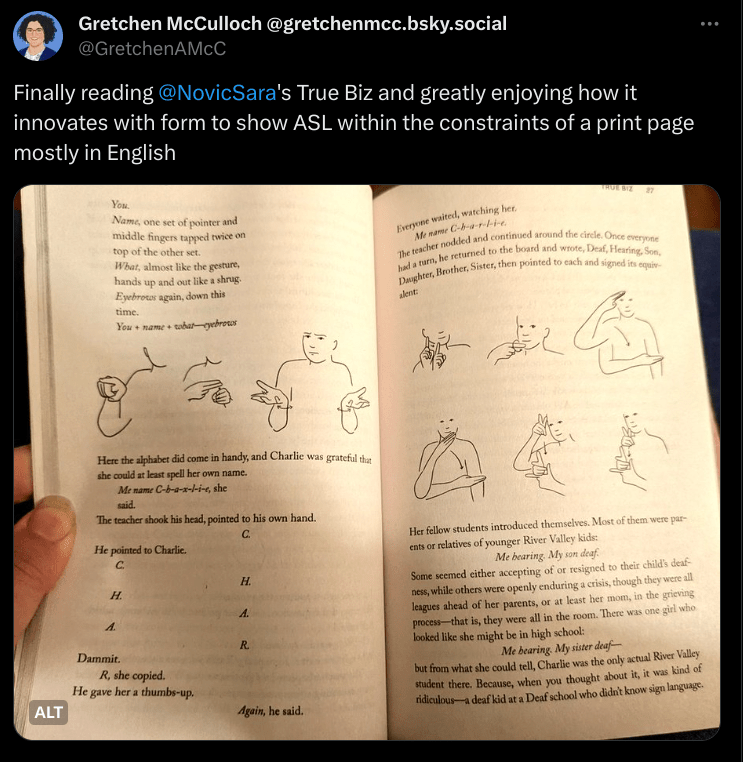
Finally reading @NovicSara's True Biz and greatly enjoying how it innovates with form to show ASL within the constraints of a print page mostly in English. 
You. Name, one set of pointer and middle fingers tapped twice on top of the other set. What, almost like the gesture, hands up and out like a shrug. Eyebrows again, down this time. 
You + name + what—eyebrows.
(line drawing of person doing said signs on the page of a book) 
Here the alphabet did come in handy, and Charlie was grateful that she could at least spell her own name. 
Me name C-h-a-x-l-i-e, she said. 
The teacher shook his head, pointed to his own hand. C. He pointed to Charlie. C. H. A. R.
Dammit. 
R, she copied. 
He gave her a thumbs up. 
Again, he said.
Everyone waited, watching her. 
Me name C-h-a-r-l-i-e
The teacher nodded and continued around the circle. Once everyone had a turn, he returned to the board and wrote, Deaf, Hearing, Son, Daughter, Brother, Sister, then pointed to each and signed its equivalent. 
(line drawings of signs)
Her fellow students introduced themselves. Most of them were parents or relatives of younger River Valley kids. 
Me hearing. My son deaf.

Selected Tweets:

March-April 2023: Bluesky, Barbie bouba/kiki, and Bea Wolf

In April, I made an account on bluesky and enjoyed some wordplay there, which is still (so far) going strong as a twitter replacement.

The main episodes of Lingthusiasm these two months were Bringing stories to life in Auslan – Interview with Gabrielle Hodge, which was our second bimodal bilingual episode, this time in Auslan and English, as well as Tone and Intonation? Tone and Intonation!

The bonus episodes were When books speculate on the future of English and Neopronouns, gender-neutral vocab, and why linguistic gender even exists – Liveshow Q&A with Kirby Conrod.

I did a fun thread on Bea Wolf, Zach Weinersmith’s retelling of Beowulf as a kid’s graphic novel, analyzing how the alliterative metre works:

Selected tweets, while we’re still doing this thing, I guess:

Blog posts:

This month’s image is from the Barbie movie meme generator, but make it bouba/kiki.

Barbie meme generator with pink spikes shape and pink blobby shape and caption: this Barbie is bouba...or kiki.

February 2023: LingComm23 and liveshow

This month was the second International Conference on Linguistics Communication, #LingComm2023. I was extremely delighted to not be on the organizing committee this time and to get to participate in the excellent panels and posters and meetups organized by Laura Wagner and the rest of this year’s organizing committee. They did ask me to give the opening keynote, which I’ve posted the text of as a blog post. Here’s a little bit from it:

People who are readers read more than one book a year — and they read way more than one article. People who like podcasts listen to more than one podcast. People who like video subscribe to more than one account. People who like museums go to more than one museum. When I look at topics like pop history and pop science, god, they have SO MANY books and podcasts and scicomm accounts and museums and documentaries. This is my 30 year goal, that linguistics has a thriving ecosystem of so many ways that people can engage with it. 

Our competition isn’t each other, it’s all the other things people could be doing with their time and not even necessarily enjoying them. It’s doomscrolling, it’s aimlessly opening Netflix, it’s playing silly little games on your phone. 

The goal of doing lingcomm isn’t about ego, in trying to make one person into a celebrity. Frankly, I just think there are far more efficient ways of trying to become rich and famous. You know, have you considered making some weird food videos? Maybe having a weird looking pet and posting photos of it? I think those do pretty well. And like, I know we could all be getting more attention right now if we were willing to spout hot takes about how Insert Group Here are ruining language. We’re here because we’ve chosen not to do that. We’re here because we’ve chosen service to the harder path, the ethical path, the more rewarding path, of feeding people with language information that liberates them, that challenges them, rather than the easy path of stoking their insecurities and validating their prejudices. 

I hope that one of the things that the lingcomm conference becomes known for over the next 30 years is as a place to find collaborators to join you in this ethos of serving the public with lingcomm, whether that’s students excitedly hatching ideas with each other like I did in my friend’s car, or journalists and linguists connecting with each other to publish really great news stories, or more established projects finally meeting other people in their niche and thinking about how they could collaborate. 

What we can accomplish in 30 years of lingcomm: Opening keynote of #LingComm23

The main episode of Lingthusiasm was about How kids learn language in Singapore – Interview with Woon Fei Ting. The bonus episode was Singapore, New Zealand, and a favourite linguistics paper – 2023 Year Ahead Chat. We also did a liveshow through the Lingthusiasm patron Discord server about language and gender with special guest Dr. Kirby Conrod.

Selected tweets:

Blog posts:

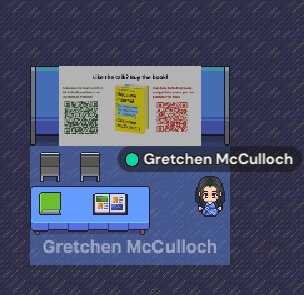
Here’s my little Gather avatar standing at a booth containing a miniature Because Internet at #LingComm23!

Image of virtual Lingcomm booth for Gretchen McCulloch. Blue background that mimics carpet and a blue square with pixel chairs and table. Displays QR codes and Because Internet and an avatar of Gretchen.

January 2023: Denver and deleted scenes

I started the year in Denver, Colorado at the annual meeting of the Linguistic Society of America, where I co-hosted the Five Minute Linguist competition with Jessi Grieser and saw many excellent linguist friends! It was so great to see people in person after several years of virtual events. I was also on a linguistics jobs panel organized by the student committee.

The main episode of Lingthusiasm was Where language names come from and why they change. The bonus episode was Parrots, art, and what even is a word – Deleted scenes from Kat Gupta, Lucy Maddox, and Randall Munroe interviews.

We announced another Lingthusiasm liveshow! February 18th (Canada) slash 19th (Australia)! (What time is that for me?) We return to one of our fan-favourite topics and answer your questions about language and gender with returning special guest Dr. Kirby Conrod! (See Kirby’s previous interview with us about the grammar of singular they.)

Selected tweets:

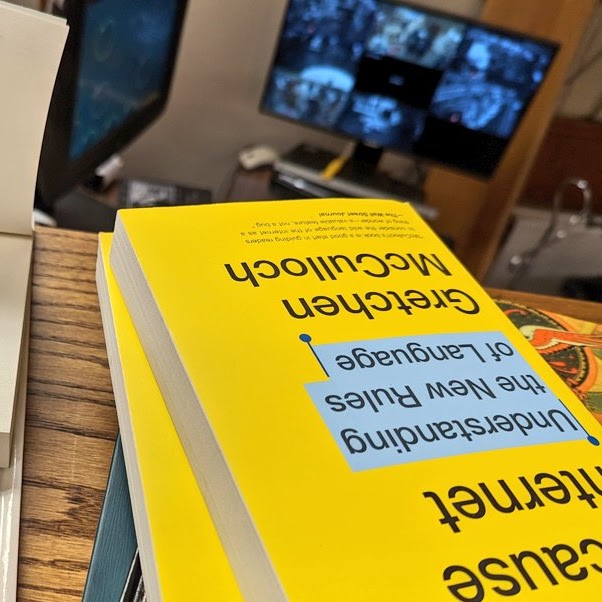
This month’s image is from while I was in Colorado: I dropped by Boulder Books with Janelle Shane and we found both of our books there and left them with signed copies!

Two closed copies of Because Internet (just signed!)

December 2022: New Zealand and “Uzhe” in The Atlantic

This month, I wrote a piece for The Atlantic for the first time! It’s about when the connection between spelling and pronunciation breaks down.

You walk into your favorite coffee shop. You greet the familiar barista, who knows your daily order. You say “Hi, I’ll have the”—wait, I can’t figure out how to write the next word. You know, “the usual,” but shorter. Hip! Casual! I’ll have the … uzhe. I mean, the yoozhThe youj?!

Why does this shortened form of usual, which rolls off the tongue when it’s spoken, cause so much confusion when we try to write it down? When I offered my Twitter followers 32 different options for spelling the word, nobody was fully satisfied with any of them. Youge to rhyme with rougeYusz as if it’s Polish? Usjhe in a desperate hope that some letter, somewhere, would cue the appropriate sound? The only thing everyone could agree on was that all of them felt weird.

How Do You Spell the Short Version of “Usual”? (Gretchen McCulloch in The Atlantic)

I spent much of the month in New Zealand, also for the first time! I gave a talk about Using lingcomm to design meaningful stories about linguistics, co-authored with Lauren Gawne, at the New Zealand Linguistics Society annual meeting in Dunedin, then went to Christchurch to give a department talk (Data-driven approaches to lingcomm: A case study of internet linguistics) at the University of Canterbury, and then went to Wellington to visit a non-linguist friend and see some birds! It was really fun to get to meet lots of linguists and hear what people are working on!

Some of my ideas from Because Internet were featured in a Vox meme explainer, which was fun to see!

When people refer to “Gen Z humor” or “TikTok humor,” what they’re really talking about is the chaotic, meaningless-seeming mishmashes of various references that are impenetrable to anyone not chronically online. But that’s just an extension of what the Washington Post once dubbed “millennial humor,” which should actually be called “Gen X humor,” considering the ages of the first internet forum posters who realized that weird, meaningless references made for good comedy. Instead, in her book Because Internet: Understanding the New Rules of Language, the internet linguist Gretchen McCulloch has what I think is a far better way of categorizing internet users: She divides people according to when they truly “got online.”

Toward a unified theory of “millennial cringe” (Rebecca Jennings in Vox)

The main episode of Lingthusiasm was Love and fury at the linguistics of emotions. The bonus episode was Speakest Thou Ye Olde English? We also got some, ahem, entertaining end-of-year stats from Spotify.

Finally, look, I can’t take a whole lot of credit for these two excellent things existing, but I am very pleased to have played a role in connecting the two.

Selected tweets:

Blog

This month’s image is one of the many examples of Māori language I saw on public signage, beginning with a user interface option on Air New Zealand in-flight displays.

The screen on the back of an airplane seat with widgets displaying in Te Reo Māori. In large letters: Kia whaka-ngahautia koe

November 2022: Melbourne and Mastodon

I spent November in Melbourne, Australia, where I gave a talk about linguistics communication at La Trobe University, did lots of hanging out and behind the scenes work with my Lingthusiasm cohost, Lauren Gawne, and met up with various other delightful linguists, including attending the annual meeting of the Australian Linguistic Society at Melbourne University. All of which were extremely good, modulo a tiny bit of accent-based name confusion:

Also, this is what happens when you hang out with linguist friends from a variety of places: you can no longer trust that anyone’s linguistic forms are characteristic of where they’ve lived, because you’re probably picking up things from each other.

Twitter began getting weird and unstable, so if you want to make sure that you have linguistics in your feed wherever else you might end up, I’m also on Mastodon (which I’ve been on for a few years but a bit more active there lately), Instagram, and Tumblr. Plus, of course, this email newsletter, which you can read at gretchenmcculloch.com and/or get in your email if you don’t want to trust the vagarities of algorithms to put it in front of you. (If you’re doing that already, thank you!). Anyway, though expectations of twitter’s demise seem a bit premature, I did a greatest hits thread anyway.

The main episode of Lingthusiasm was Episode 74: Who questions the questions? The bonus episode was Bonus 69: 103 ways for kids to learn languages. Lingthusiasm celebrated our 6th anniversary of podcasting and got a Mastodon account this month, as did my cohost Lauren Gawne, so you can follow the whole trifecta there if you like. The Lingthusiasm listener survey is open until December 15, 2022 (and will run again next year if you didn’t get to it the first time around).

Selected tweets:

Blog posts:

This month’s image is from a cafe in Melbourne where I was getting coffee (well, a flat white and an iced tea) with Lauren Gawne, the beginning of a month of hanging out and scheming and considerably better weather than Montreal.

A flat white coffee and an iced tea on a green outdoor cafe table also featuring a vase of wildflowers, water jug, knives and forks