This month, I announced that there’s going to be a Spanish-language edition of Because Internet coming at some point in 2024! Spanish has been the translation that people have requested from me the most and I’m delighted that Álex Herrero and the other folks at Pie de Página are making it happen.
The main episode of Lingthusiasm was Word Magic, in which we discuss the linguistics of the magical systems in several recent fantasy novels we like, including Babel by R.F. Kuang, Carry On by Rainbow Rowell, and the Scholomance series by Naomi Novik, as well as the ways that you can change the state of the real world with words using the linguistic concept of performatives, such as agreeing to contracts, placing bets, and naming. The bonus episode was about reviewing the results of our 2022 listener survey, including answers to questions on whether knowing about the kiki/bouba effect as a meme influences your results on the kiki/bouba test, synesthesia, and whether people pluralize “emoji” as “emoji” or “emojis”.
People often ask Lingthusiasm to recommend interesting books about linguistics that don’t assume prior knowledge of linguistics, so we’ve come up with a list of 12 books that we personally recommend, including both nonfiction and fiction books with linguistically interesting elements! Get this list of our top 12 linguistics books by signing up for Lingthusiasm’s free email list (which will otherwise send you an email once a month when there’s a new episode — this is something we’re doing to help continue to reach people amid the rising fragmentation of the social media ecosystem).
This month was the second International Conference on Linguistics Communication, #LingComm2023. I was extremely delighted to not be on the organizing committee this time and to get to participate in the excellent panels and posters and meetups organized by Laura Wagner and the rest of this year’s organizing committee. They did ask me to give the opening keynote, which I’ve posted the text of as a blog post. Here’s a little bit from it:
People who are readers read more than one book a year — and they read way more than one article. People who like podcasts listen to more than one podcast. People who like video subscribe to more than one account. People who like museums go to more than one museum. When I look at topics like pop history and pop science, god, they have SO MANY books and podcasts and scicomm accounts and museums and documentaries. This is my 30 year goal, that linguistics has a thriving ecosystem of so many ways that people can engage with it.
Our competition isn’t each other, it’s all the other things people could be doing with their time and not even necessarily enjoying them. It’s doomscrolling, it’s aimlessly opening Netflix, it’s playing silly little games on your phone.
The goal of doing lingcomm isn’t about ego, in trying to make one person into a celebrity. Frankly, I just think there are far more efficient ways of trying to become rich and famous. You know, have you considered making some weird food videos? Maybe having a weird looking pet and posting photos of it? I think those do pretty well. And like, I know we could all be getting more attention right now if we were willing to spout hot takes about how Insert Group Here are ruining language. We’re here because we’ve chosen not to do that. We’re here because we’ve chosen service to the harder path, the ethical path, the more rewarding path, of feeding people with language information that liberates them, that challenges them, rather than the easy path of stoking their insecurities and validating their prejudices.
I hope that one of the things that the lingcomm conference becomes known for over the next 30 years is as a place to find collaborators to join you in this ethos of serving the public with lingcomm, whether that’s students excitedly hatching ideas with each other like I did in my friend’s car, or journalists and linguists connecting with each other to publish really great news stories, or more established projects finally meeting other people in their niche and thinking about how they could collaborate.
I started the year in Denver, Colorado at the annual meeting of the Linguistic Society of America, where I co-hosted the Five Minute Linguist competition with Jessi Grieser and saw many excellent linguist friends! It was so great to see people in person after several years of virtual events. I was also on a linguistics jobs panel organized by the student committee.
You walk into your favorite coffee shop. You greet the familiar barista, who knows your daily order. You say “Hi, I’ll have the”—wait, I can’t figure out how to write the next word. You know, “the usual,” but shorter. Hip! Casual! I’ll have the … uzhe. I mean, the yoozh. The youj?!
Why does this shortened form of usual, which rolls off the tongue when it’s spoken, cause so much confusion when we try to write it down? When I offered my Twitter followers 32 different options for spelling the word, nobody was fully satisfied with any of them. Youge to rhyme with rouge? Yusz as if it’s Polish? Usjhe in a desperate hope that some letter, somewhere, would cue the appropriate sound? The only thing everyone could agree on was that all of them felt weird.
I spent much of the month in New Zealand, also for the first time! I gave a talk about Using lingcomm to design meaningful stories about linguistics, co-authored with Lauren Gawne, at the New Zealand Linguistics Society annual meeting in Dunedin, then went to Christchurch to give a department talk (Data-driven approaches to lingcomm: A case study of internet linguistics) at the University of Canterbury, and then went to Wellington to visit a non-linguist friend and see some birds! It was really fun to get to meet lots of linguists and hear what people are working on!
Some of my ideas from Because Internet were featured in a Vox meme explainer, which was fun to see!
When people refer to “Gen Z humor” or “TikTok humor,” what they’re really talking about is the chaotic, meaningless-seeming mishmashes of various references that are impenetrable to anyone not chronically online. But that’s just an extension of what the Washington Post once dubbed “millennial humor,” which should actually be called “Gen X humor,” considering the ages of the first internet forum posters who realized that weird, meaningless references made for good comedy. Instead, in her book Because Internet: Understanding the New Rules of Language, the internet linguist Gretchen McCulloch has what I think is a far better way of categorizing internet users: She divides people according to when they truly “got online.”
Finally, look, I can’t take a whole lot of credit for these two excellent things existing, but I am very pleased to have played a role in connecting the two.
Gretchen told me I would like the Steerswoman novels by @rkirstein, but that she couldn’t explain why they were up my alley without spoiling the plot. Now that I’ve read them (four books, starting with The Steerswoman), I’m recommending them to my friends the same way. https://t.co/rSIxnCmLLz
This month’s image is one of the many examples of Māori language I saw on public signage, beginning with a user interface option on Air New Zealand in-flight displays.
I spent November in Melbourne, Australia, where I gave a talk about linguistics communication at La Trobe University, did lots of hanging out and behind the scenes work with my Lingthusiasm cohost, Lauren Gawne, and met up with various other delightful linguists, including attending the annual meeting of the Australian Linguistic Society at Melbourne University. All of which were extremely good, modulo a tiny bit of accent-based name confusion:
number of times I've been utterly foiled recently by people with post-vocalic r in their names introducing themselves non-rhotically and somehow I just?? need to hallucinate in the r for my own accent??
3
please have pity on your poor rhotic friends, ubiquitous nametags when
— Gretchen McCulloch @gretchenmcc.bsky.social (@GretchenAMcC) December 1, 2022
Also, this is what happens when you hang out with linguist friends from a variety of places: you can no longer trust that anyone’s linguistic forms are characteristic of where they’ve lived, because you’re probably picking up things from each other.
Why I both love and mistrust linguists when it comes to language usage data:
Friend: oh and there's a washroom over there if you need it Me: wow, interesting, you have "washroom" here, that's also the term in Canada Friend: no I was just using it for your benefit
— Gretchen McCulloch @gretchenmcc.bsky.social (@GretchenAMcC) November 2, 2022
Twitter began getting weird and unstable, so if you want to make sure that you have linguistics in your feed wherever else you might end up, I’m also on Mastodon (which I’ve been on for a few years but a bit more active there lately), Instagram, and Tumblr. Plus, of course, this email newsletter, which you can read at gretchenmcculloch.com and/or get in your email if you don’t want to trust the vagarities of algorithms to put it in front of you. (If you’re doing that already, thank you!). Anyway, though expectations of twitter’s demise seem a bit premature, I did a greatest hits thread anyway.
This month’s image is from a cafe in Melbourne where I was getting coffee (well, a flat white and an iced tea) with Lauren Gawne, the beginning of a month of hanging out and scheming and considerably better weather than Montreal.
This month, I went to Singapore! It’s the beginning of my multi-month trip that’ll also take me to Australia in November and New Zealand in December. I stayed with Suzy J Styles, gave a talk about linguistics communication at Nanyang Technical University, and met up with lots of lovely linguists who made sure that I tried many delicious Singaporean foods (thank you!). Also I got to hear people speaking Singlish, which is indeed as neat as everyone says it is.
Currently going through a cultural clash on "do you greet someone you're about to engage in a transaction with"
My French-influenced conditioning from Montreal is Absolutely Must Exchange Bonjours First
In Singapore a greeting is apparently a kinda baffling waste of time! https://t.co/zgegowFeyE
— Gretchen McCulloch @gretchenmcc.bsky.social (@GretchenAMcC) October 29, 2022
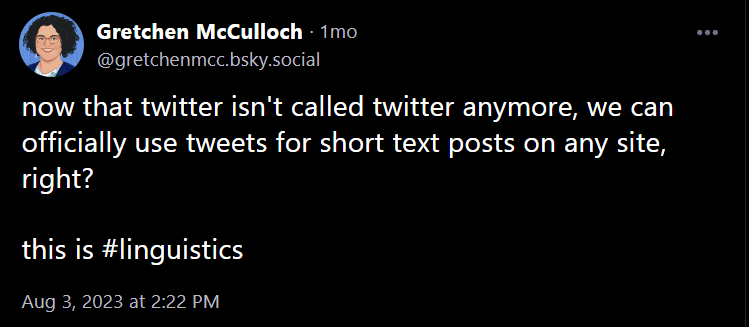
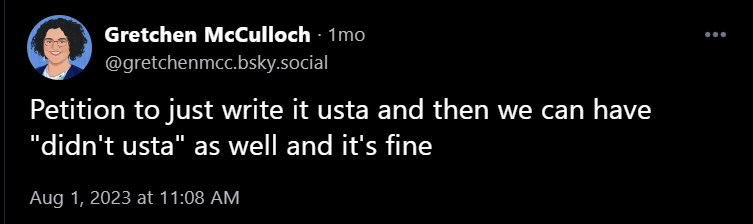
This month’s shenanigans involved finishing my series of twitter polls in order to determine the least confusing way (okay they’re all confusing, but) to spell the clipped form of “usual”.
We have a winner!
"uzhe" narrowly beats out close contenders "yoozh" and "uzh" for the least confusing possible clipped form for "usual"
Now if you need to write it, you can know if you're chosing the marginally least confusing option of an overall very confusing field pic.twitter.com/2ke8TPJVv3
— Gretchen McCulloch @gretchenmcc.bsky.social (@GretchenAMcC) October 7, 2022
This month’s image is a joke Halloween costume design that I made as part of a Halloween costume meme going around. But seriously if anyone does this for real please tell me, I want to know:
The main episode of Lingthusiasm was Episode 72: What If Linguistics, in which Randall Munroe of xkcd asked us his very good absurd hypothetical questions about linguistics. Here’s a completely real and normal photograph of what that looked like:
This month, we rethought the structure of the International Phonetic Alphabet.
Okay, let me explain.
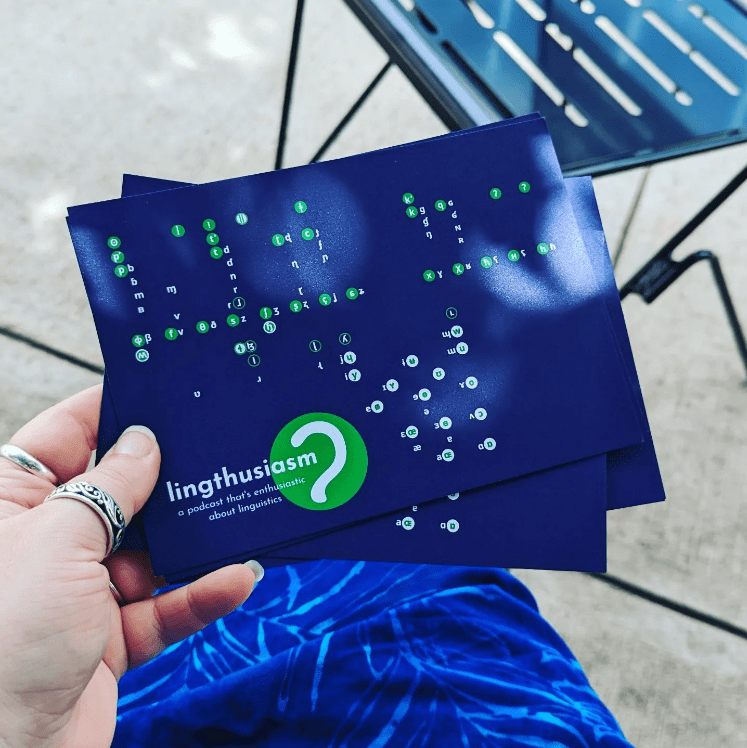
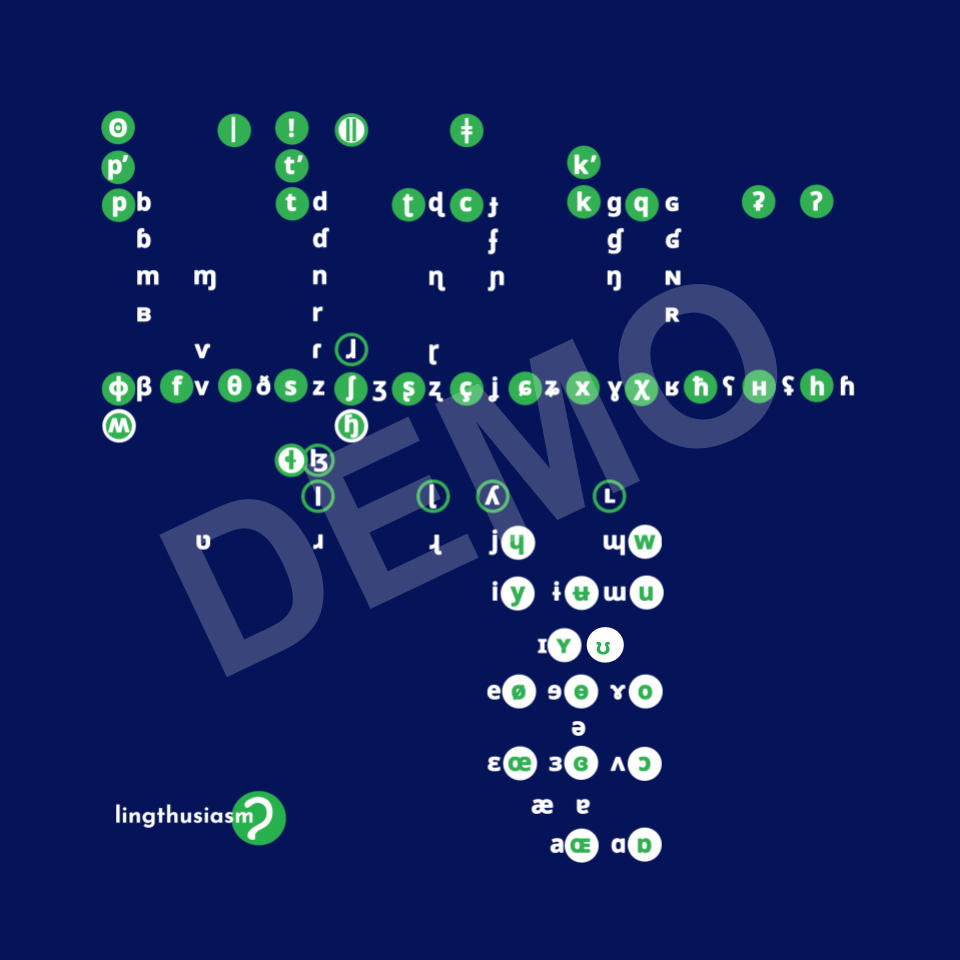
The IPA is typically presented in a chart that shows the sounds of languages of the world arranged in two dimensions: from top to bottom as the mouth is more and more open and from left to right as the sound is produced from the front of the mouth to the back. It’s elegant, it’s informative, it’s a highly familiar reference diagram for linguists. So my cohost Lauren Gawne and I thought it would be nifty to create a more aesthetically attractive version of this already really neat technical diagram which is typically presented in rather boring technical greyscale, as practical-yet-elegant merch for our podcast, Lingthusiasm. Almost a year ago, we sent off an email to our resident artist, Lucy Maddox….and now, finally, here we are.
In the process, we’ve learned a whole lot about the history of the International Phonetic Alphabet (longer version in the thread below!)
Like here’s this absolutely jumbled IPA version from 1899 which is both upside-down and backwards (by modern standards) and also has the headings in phonetically transcribed German but tbh the columns are kinda sleek, I like it: pic.twitter.com/hLhAjFc11g
— Gretchen McCulloch @gretchenmcc.bsky.social (@GretchenAMcC) August 19, 2022
We’ve also realized that we have some questions about parts of the IPA chart layout that we’d been taking for granted. For example: why is there a third chart for the non-pulmonic consonants like clicks and implosives, when they have the same places of articulation as the main, pulmonic consonant chart and could surely just be rows there? And, wouldn’t it be sort of nifty to put the vowels back in the same chart as the consonants again, when they used to hang out there for decades? This started as an art project, but any good art also provokes…questions. Longer version and speculations in this blog post.
At any rate, here’s what it looks like when we put all of the symbols on the same chart!
We also thought, wouldn’t it be ideal if this eclectic nerd art IPA design came in a convenient format for carrying around with you? One that might even be useful for other purposes? So we’re getting it imprinted onto microfibre lens cloths (useful for cleaning glasses, sunglasses, camera lenses, and phone/computer screens). The thing is, lens cloth printing companies only take orders in the hundreds or preferably thousands, so we’ve decided to place one massive order for everyone who’s a patron at the Lingthusiast tier as of October 5th, 2022. This is our most popular tier, which also gets you our whole archive of monthly bonus episodes and access to the Lingthusiasm patron Discord server — if you’ve been on the fence about becoming a patron, now would be a really good time for it. (Higher tiers can get several lens cloths, if you want spares or to share with friends.)
Technically speaking, next month’s bonus episode is an interview with Lucy Maddox about the IPA chart redesign and being a linguist/artist but we’ve made that bonus episode free for a limited time until the IPA lens cloth special offer is closed on October 5th, so you should go listen to that now if you’re interested!
I also finished the #103papers project this month, reading 1 paper each for the 103 languages identified by Kidd&Garcia in the top 4 journals about child language acquisition. More on the big picture from what I learned later, but in the meantime, here’s a neat thing I learned:
A deaf child from age 2-5 who wasn't exposed to any signed languages produced home signs that were drawn from but more systematic and combinatorial than his hearing mother's gestures
— Gretchen McCulloch @gretchenmcc.bsky.social (@GretchenAMcC) August 14, 2022
LingComm, the International Conference on Linguistics Communication, has put out its participant/volunteer survey for the next conference in February 2023. I’m not organizing it this year, but this year’s committee is fantastic and I look forward to seeing there many linguists who do communication with broader audiences and journalists, podcasters, youtubers, and other communicators who do linguistics — if that’s you, do check it out!
This month I attended a local literary speculative fiction con, Scintillation, where I was on panels about swearing in science fiction and fantasy and the delightful Steerswoman books, as well as doing a dramatic reading from Ryan North’s Romeo and/or Juliet book.
Some linguists got very excited about a very cool linguistics paper by the late Anne Cutler, which I won’t spoil (because it really does have spoilers, but trust me you don’t need any particular linguistics background to get why it’s cool) and as a result we also managed to track down Anne Cutler’s Christmas Letter, which is mentioned in the paper. (The full twitter thread, linked to from below, is also worth reading afterwards.)
This is quite possibly the most brilliant linguistics paper I've ever read. https://t.co/PGP36oyCCl
I also spent the entire month in the Indo-European section of the #103papers reading project. (And then some – 39 Indo-European languages in this sample.) Here’s a paper about Italian with very charming examples:
Italian children w caregivers were secretly recorded in the toy section. 4 yos mostly expressed desire (Look! I want it!) whereas 6 yos started bargaining (aren't these lovely?) and 8 yos negotiated (mine is too small, how much is it)
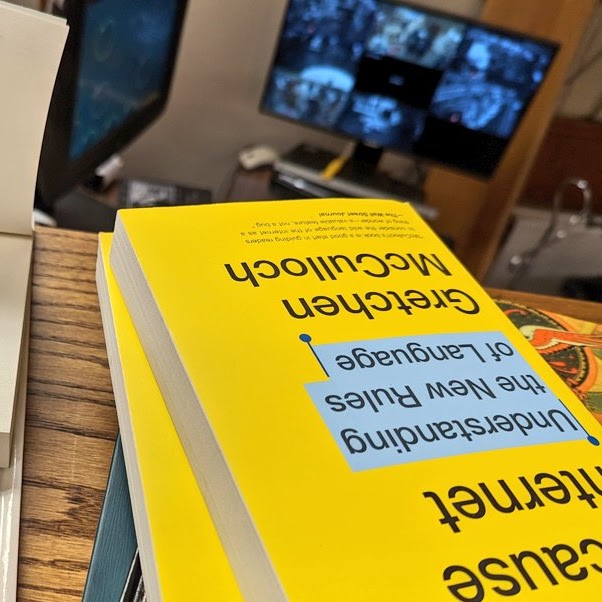
This month’s picture is Because Internet hanging out at the staff picks section with some book friends at my local independent bookstore, Argo Bookshop! Argo’s owners were linguists in a previous life and it’s well worth a visit if you’re in Montreal.
You must be logged in to post a comment.