
Back in 2017, when I was deep in the writing process for Because Internet, I was feeling stuck on the emoji chapter and Lauren Gawne, my cohost on the then-baby Lingthusiasm podcast (we were less than a year old!) offered to read the current draft. I’ll never forget her comment that led to me rewriting the whole chapter: “You realize this is all related to gesture, right?”
Immediately, I wanted to dive into the gesture literature, which hadn’t been a part of either of my linguistics degrees. I asked Lauren where I should start. Was there some sort of short book or long survey article that put the rest of the literature into context so I could figure out which papers I needed to read more deeply and how they fit into relationship with each other? Lauren was like, “Read these parts of McNeill 1992, and then McNeill 2005, and then these three chapters of Kendon 2004…” — which was when I realised maybe I was going to have to solve this problem for myself. She ended up sending me her classroom slides and answering my questions herself, which led to a much-revised chapter in Because Internet and an academic paper together on emoji as gesture.
Since then, we’ve done several Lingthusiasm episodes about various aspects of gesture, but that gap we noticed in 2017 has still been there: if someone wants a more in-depth entry point into the gesture literature, one that doesn’t assume they have any background in gesture specifically but does assume they want more details than we can fit into a podcast episode, where do they go? Especially since many people’s degrees, like mine, still don’t contain much about gesture, so a prof in linguistics, cognitive science, anthropology, and related fields might not know where to advise a student with a gesture-related project to start reading.
That’s why Lauren has written a book! It’s called Gesture: A Slim Guide and it’s available now from Oxford University Press. The Slim Guides are part of an Oxford series in the genre known as academic crossover books: they’re much less technical than a typical academic monograph, but more in-depth than a trade book from a commercial publisher like Penguin. Here are some ways you can learn more about it:
- Lauren’s post about it on her blog Superlinguo
- Lauren’s and my Lingthusiasm episode about it
- Lauren’s guest episodes on the podcasts Let’s Learn Everything, Because Language, Language on the Move, and Grammar Girl
Events and media
I also did other things this quarter than just take credit for Lauren’s hard work! Quite a few things, in fact: three conferences…
- The LingComm25 conference, where I presented a lightning talk on collaborations between academics and non-academics and learned that November 26th will be National Linguistics Day in the UK. Stay tuned for some National Linguistics Day celebration on the podcast!
- The Canadian Linguistic Association, where I learned about this “living dictionary” tool for documenting endangered languages and the Canadian Language Museum.
- Scintillation, a science fiction con, where I participated in panels on worldbuilding and stakes in fantasy.
…two guest appearances…
- I presented with Amal El-Mohtar — coauthor of This Is How You Lose the Time War, a book I greatly enjoyed — in a conversation about her new book, The River Has Roots at the Argo Bookshop in Montreal, a great place where I’ve done events before.
- I appeared on the podcast A Language I Love Is, talking about Montreal French and bilingualism in Canada.
…and a few anniversaries:
- I celebrated my 13th blogiversary! I started All Things Linguistic in the spring of 2012, and while it isn’t my most active lingcomm project at the moment, it’s still important to me as my very first public-facing one.
- It was the 10th anniversary of LingWiki, another lingcomm project which I started in 2015 and which many linguists have picked up since, where we host Wikipedia editathons to improve linguistics-related articles on Wikipedia. I didn’t feel like writing an anniversary post so Lauren did — and not just a quick celebration, but a whole informal history of LingWiki.
Lingthusiasm
We had a few special lingnouncements this quarter. (Is that a word? It is now.)
You can now gift a Lingthusiasm membership to someone else. Depending on the tier you buy, this could get them access to bonus episodes and our Discord server, or even a spot with their favorite IPA character on the Lingthusiasm Supporter Wall of Fame.
We also celebrated our 100th bonus episode on Patreon. In celebration, we went back into the vault and revisited our very first bonus episode — with updated sweary commentary on Important Swearing Developments that have happened since 2017. We’ve made this extra bonus bonus version available to all patrons, free and paid, so feel free to send it to your friends!
Plus, we had a full quarter of three regular and three bonus episodes:
- A hand-y guide to gesture
- Linguist Celebrities (bonus)
- Reading and language play in Sámi: Interview with Hanna-Máret Outakosk
- The linguistics of kissing 😘 (bonus)
- Linguistics of TikTok: Interview with Adam Aleksic aka EtymologyNerd
- Fun linguistic experiments, linguistic etiquette, and language learning scenarios (bonus)
Posts
- A while ago I asked, “does anyone on Linguist Twitter know of research on the intersection of signed languages and synesthesia?” Nobody knew then, but now we do: Elizabeth Droubi wrote an honors thesis at Gallaudet University about it.
- We had a great discussion thread on dreaming in a language you’re learning.
- “this is a version of monopoly where you’re trying to recreate proto-indo-european and I don’t know how to feel about it“
- Another great Bill Labov story that a lot of students need to hear
- The perennial problem of writers worrying about how kids talk: this time, brainrot!
- “How are we feeling about the consensus-seeking ‘we’? 🐦🐦“
- Sharps and flats as kiki and bouba
- Birdsong as kiki and bouba
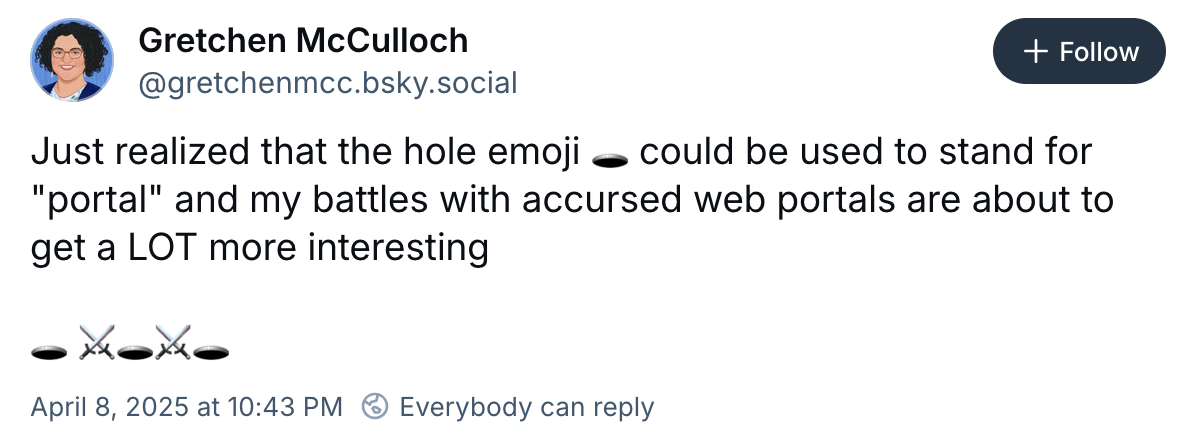
- ‘Just realized that the hole emoji 🕳️ could be used to stand for “portal”…’
New favorite linguistic data
- Fort-yearly (Analogical creation)
- Woodsqueer: one who squees in the woods (Word segmentation is hard)
- This article says younger Californians say pony differently than older ones. But what’s the pronunciation and how should we write it? POH-nee? pau-nee? poh-nay? per-nih? Sounds like we’re all looking for ways to convey GOAT fronting. (Writing about English vowels is hard too, but lexical sets make it easier…)
This quarter’s image is me, holding onto Lauren’s Gesture book with my own two hands (well, one hand had to hold the camera), since it exists in the real world! I hope it brings joy to students, researchers, and autodidacts!



 Gretchen McCulloch
You must be logged in to post a comment.